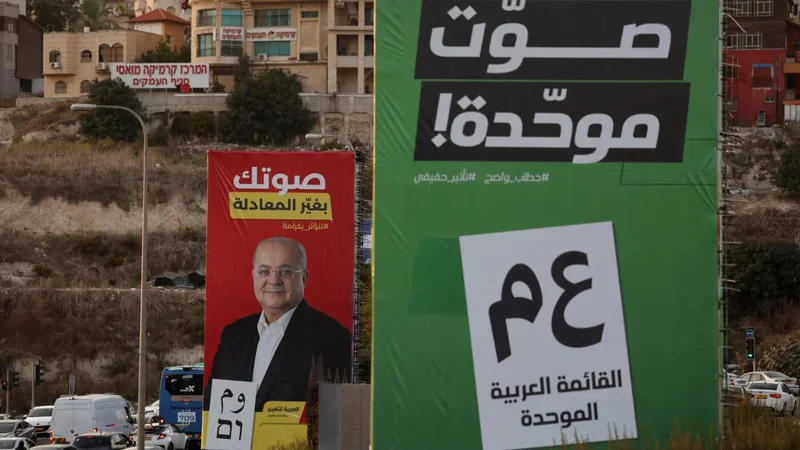
Three Palestinian parties in Israel form joint list ahead of elections
Three Palestinian-led parties in Israel announced on Wednesday that they will run on a joint slate in the upcoming parliamentary elections.
The three parties – the Democratic Front for Peace and Equality (Hadash), the National Democratic Assembly (Balad) and the Arab Movement for Renewal (Ta’al) – said the alliance was driven by the need to counter the “fascist and racist” threats facing Palestinian citizens of Israel.
“Our task is to harness our collective political weight and translate it into stronger representation in the Knesset,” the parties said in a joint statement.
Their aim, they added, was to “defend our dignity, place the interests of our people and our national principles at the centre, and turn the will of our constituencies into a political force capable of bringing down the fascist right-wing government”.
The revival of the Joint List, which has historically brought Palestinian parties together under one electoral umbrella, has been under discussion for months.
The Joint List was first formed in 2015 in response to a legislative change that raised the electoral threshold for entering the Knesset from 2 percent to 3.25 percent of the total vote cast nationwide.
The move was widely seen at the time as an attempt to exclude Palestinian parties.
The original list included Hadash, Balad, Ta’al and the United Arab List (Ra’am).
Internal disagreements led to the alliance fracturing in 2019 and again in 2022.
Since then, pressure has mounted on the parties to set aside their differences, particularly amid the genocide in Gaza and rising violent crime in Palestinian communities in Israel.
A major strike and mass protests against gun violence in the northern city of Sakhnin in January pushed leaders of the four parties to sign a pledge to revive the Joint List.
However, Ra’am leader Mansour Abbas said in June that his party would not join the alliance.
Instead, Ra’am will run independently and has held talks about including Yoav Segalovich, a Jewish former police commander, on its electoral list.
Potential kingmakers
Israel’s parliamentary elections are scheduled for 27 October. The Joint List won 15 of the Knesset’s 120 seats at its strongest showing in 2020, making it the third-largest political bloc in the parliament.
Latest polls suggest the three-party alliance could win eight seats, while Ra’am could secure a further six.
The role of Palestinian parties in the Knesset has gained significance in recent years as competing political blocs have struggled to secure a majority, putting Palestinian parties in a potential kingmaker position.
Recent polls suggest a bloc led by Prime Minister Benjamin Netanyahu and another led by opposition leader Gadi Eisenkot would both fall short of a majority without the support of Palestinian parties.
However, both camps have said they do not intend to partner with Palestinian parties after the elections.