China's LineShine is the world's fastest supercomputer – though having said that, it does depend on who exactly is counting. The machine, based in the National Supercomputing Center in Shenzhen, debuted at number one in the June 2026 TOP500 list published in mid-July because of its eye-popping results, with nearly 2.2 exaflops, or more than two quintillion floating-point calculations per second. The system also topped the competing HPCG ranking. But the picture was more mixed taken in the round: LineShine finished fourth on the mixed-precision HPL-MxP test and was well off the pace on the Green500 energy-efficiency table.
The gap for the supercomputer sits depending on who's ranking it, showing how what used to be a simple race for supremacy has actually become several overlapping competitions. It also highlights how "fastest" has different definitions depending on what is measured, how it is measured, and which operators publish their results.
We previously reported how LineShine uses 13.79 million cores built around China's domestic LingKun platform, 304-core LX2 processors, the proprietary LingQi interconnect, and Kylin operating system. It's also the first CPU-only machine on the TOP500 to sustain more than two exaflops, reaching around 80% of its theoretical peak while drawing 42.2 megawatts. That makes it impressive enough – but it’s also a big win on a geopolitical stage.
China rising
LineShine is the first Chinese system to lead the TOP500 since 2017, ending a period in which China stopped submitting its most advanced machines to the public ranking. Jack Dongarra, emeritus professor of computer science at the University of Tennessee and one of the TOP500's founders, has previously said that two unreported Chinese systems may already have been faster than the then-leading US machine, Frontier.
The TOP500 has used the High Performance Linpack benchmark, or HPL, since the ranking began in 1993. In the test, computers have to solve a dense web system of linear equations using double-precision arithmetic. Like many tests, the regularity of it can be heavily tuned, producing a clean output that invites long-run comparisons across architectures and decades.
It’s tempting to look at rankings like this as the be-all and end-all, but even TOP500 says its result doesn’t reflect a machine's overall performance, because no single number can. But HPL remains valuable because it tests whether millions of processor cores and the links between them can be corralled into one tightly coordinated calculation. "It shows you can go 400 kilometres per hour with your Porsche," said Julian Kunkel, professor of high-performance computing at the University of Göttingen and deputy head of high-performance computing at GWDG, in an interview with Tom’s Hardware Premium. "This is the maximum speed. TOP500 does not tell us anything other than we have an instrument that could go that far."
That speed matters because supercomputers are as much scientific instruments as anything else, used to simulate climate systems, aircraft engines, nuclear accidents and prospective fusion reactors. Scientists want answers relatively quickly. "Imagine I do the weather prediction for tomorrow, and you need 25 hours to calculate it," says Kunkel. By the time the answer arrives, so has tomorrow, rendering it useless.
A mixed picture
The HPCG test and its sparse calculations make less efficient use of processors while putting greater strain on memory bandwidth, latency, and communication between nodes – the sorts of things that scientific applications really need. LineShine's first-place score of 22 petaflops on this measure suggests that its memory and interconnect systems are as powerful as its CPUs. "Those results describe different capabilities, not a contradiction," said Dongarra, responding to Tom’s Hardware Premium’s questions by email.
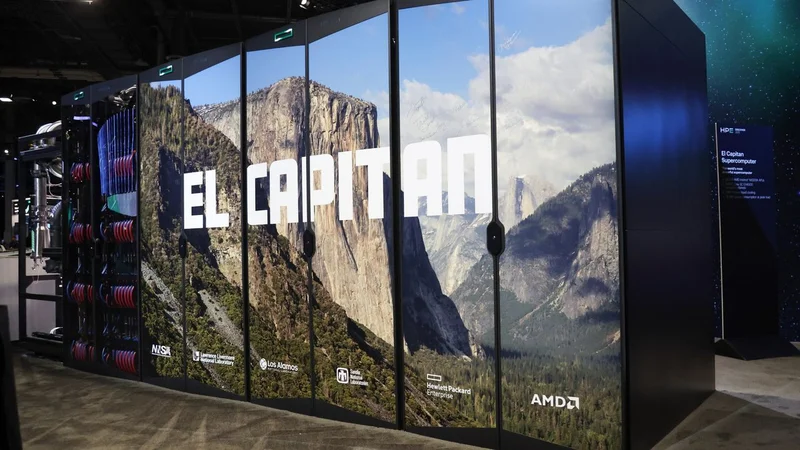
But another ranking looks at performance in a different way. The way HPL-MxP is designed favors GPUs and dedicated tensor or matrix engines. On this one, LineShine nabbed fourth place globally with 7.92 exaflops, a 3.6-fold increase over its HPL result. But the published HPL and HPL-MxP lists show the accelerator-heavy El Capitan achieved a 9.2-fold improvement, Aurora 11.5-fold and Frontier 8.4-fold.
Dongarra said the different results on different checks show a trade-off in specialization, rather than a universal weakness. LineShine's CPU-centered design has less dedicated low-precision throughput, so other machines do better on mixed-precision workloads – but he said it would be churlish to say LineShine is less capable overall. And the IO500 – which Kunkel co-founded — tests storage bandwidth and metadata performance, while Green500 divides HPL performance by power consumption.
The different metrics by which supercomputers can be measured mean that those procuring them often overlook the rankings in favor of things like time-to-solution and reliability or energy use.
What about AI?
The race for public supercomputing has been disrupted by the rise of private AI infrastructure. Although Microsoft's Eagle system appears at number seven in the latest TOP500, most frontier AI clusters publish only GPU counts, theoretical FP8 performance, or tokens-per-second claims – and some don’t really disclose much at all publicly, worried that their competitors might pick up on it.
There are some AI-based testing regimes out there, including MLPerf, which offers standardized AI training and inference tests, including new DeepSeek-V3 and GPT-OSS 20B workloads in its 2026 training suite. However, submissions to the scoring system remain voluntary, and AI labs might not want to submit them in case they score badly, torpedoing their public perception — meaning we know very little about some of the world's most consequential computing systems.
It’s also a distraction, said the experts. "There is no sense for any private AI system to run HPL," said Kunkel. Doing so would take thousands of expensive accelerators away from commercial work and require days of tuning a result their customers don’t use, and probably don’t care about.
Dongarra reckons LineShine probably isn’t best at everything, even though among those systems that are submitting public results, it showed the strongest measured double-precision and HPCG performance. That, he believes, makes it good enough to say this is a very good supercomputer. Any credible assessment, he said, "requires a portfolio of measurements" — covering time-to-solution, sustained performance under mixed workloads, reliability, ease of programming, cost and power alongside the headline benchmarks.
So while LineShine's HPL victory is significant and technically impressive, it also highlights how there is no longer one supercomputer race. Systems whose results are never disclosed may be faster for particular AI workloads, "but without comparable public evidence,” said Dongarra, “that remains a claim rather than a ranking".
Chris Stokel-Walker is a Tom's Hardware contributor who focuses on the tech sector and its impact on our daily lives— online and offline. He is the author of How AI Ate the World, published in 2024, as well as TikTok Boom, YouTubers, and The History of the Internet in Byte-Sized Chunks.