Why did Uganda unveil a statue of Netanyahu's brother at Entebbe?
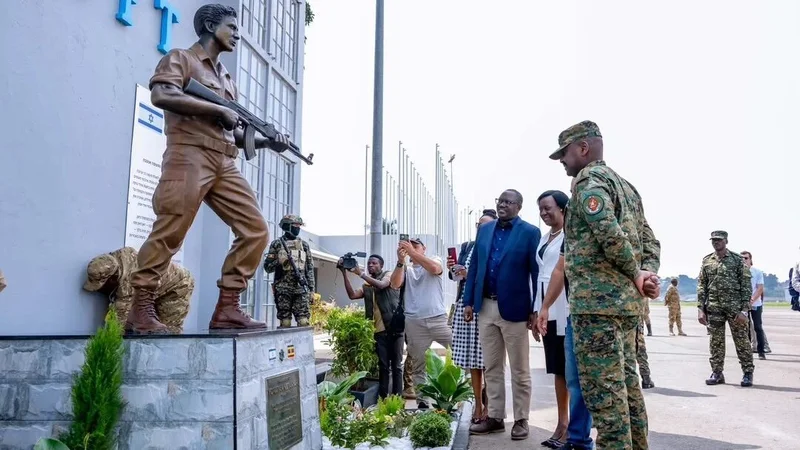
In early August, the Ugandan military unveiled a bronze statue of Yonatan Netanyahu, the brother of Israeli Prime Minister Benjamin Netanyahu, who was killed during a hostage rescue operation in the country in 1976.
The statue, commissioned by Ugandan army chief Muhoozi Kainerugaba to mark the 50th anniversary of the Entebbe raid, was unveiled at the Old Entebbe Terminal, about 40km from the capital, Kampala.
The unveiling came just days before Uganda's parliament approved the deployment of Ugandan troops to Gaza as part of the controversial International Stabilisation Force (ISF).
"Today, this memorial stands not only in remembrance of a distinguished soldier, but also as a tribute to the enduring values he embodied: courage in the face of danger, unwavering commitment to protecting innocent lives, and steadfast devotion to duty," General Kainerugaba said at the ceremony.
"Monuments are more than stone and bronze. They preserve memory, teach history, and inspire future generations. This monument, therefore, carries significance far beyond commemorating one brave individual," Kainerugaba, who is the eldest son of Ugandan President Yoweri Museveni, added.
The statue, which shows Yonathan standing tall with a machine gun in his arms, has raised eyebrows in Uganda and elsewhere on the continent, and comes as Israel continues to kill Palestinians in Gaza, despite the so-called ceasefire agreed last October.
What was the Entebbe raid?
On 27 June 1976, members of a branch of the Popular Front for the Liberation of Palestine (PFLP), together with members of the German-based Revolutionary Cells, hijacked an Air France plane from Tel Aviv to Paris, following a stopover in Athens.
The plane, carrying 248 passengers, including 105 Israelis, was redirected to Benghazi and then Entebbe in Uganda, where the hijackers were personally received by Ugandan ruler Idi Amin and received support from his government.
The PFLP hoped to use the Israeli hostages to negotiate the release of Palestinian political prisoners held by Israel.
On their arrival in Entebbe, most of the non-Israeli hostages were released and the Israeli government opened negotiations with the hijackers.
Simultaneously, it prepared a rescue effort that would bring its commandos into direct confrontation with Ugandan soldiers stationed at the airport.
On 3 July, Israeli special forces flew thousands of kilometres to Uganda and stormed the airport without the Ugandan government's consent, killing 45 Ugandan soldiers and all of the hijackers.
The Israelis rescued 102 hostages.
Yonatan Netanyahu, who commanded the Israeli assault force, was the only Israeli soldier to be killed during the operation.
In Israel, the raid, known as Operation Thunderbolt, entered Israeli folklore as one of its most daring operations.
Yonathan Netanyahu's death also became central to how the raid was remembered in Israel.
The raid also proved formative for Benjamin Netanyahu.
His brother's death propelled him into the public campaign against terrorism that would eventually launch his political career.
How did African leaders respond to the raid?
In the early 1960s, Israel identified Uganda as an important gateway to the continent.
"Israel prioritised relations with Uganda immediately after Uganda's independence, and Uganda reciprocated, Mahmood Mamdani writes in his book, Slow Poison: Idi Amin, Yoweri Museveni, and the Making of the Ugandan State.
Israel was present at independence day celebrations; it provided fellowships for Ugandan students, and it was among the first to open an embassy in Uganda.
Israeli companies built Uganda's airport and many of its roads, and the Israeli army and police trained their counterparts in Kampala.
When Idi Amin took control of Uganda in a coup in 1971, he did so with the support of the Israelis and the British. Amin's first trip as leader of Uganda was to Israel.
But by 1976, ties between Israel and Uganda had sharply deteriorated.
Idi Amin had severed diplomatic relations with Israel in 1972, expelled Israeli military advisers and ordered Israeli nationals to leave the country. He went on to cancel arms deals and all developments by Israeli construction companies and booted out the Israeli ambassador.
put them up in the Israeli ambassador's former home.
After the October 1973 War between Israel and the Arab world, another 25 African states would cut ties with Israel.
Both Uganda and the Organisation of African Unity (OAU) condemned the Israeli operation, placing it within the continent's wider struggle against colonialism.
The raid was seen as an assault on Ugandan sovereignty and territorial integrity.
How has Netanyahu's statue been received?
Though the unveiling of the statue has not received much international attention, it has raised eyebrows in Uganda and in other parts of the African continent.
The monument has also been seen as a symbol of the deepening security relationship between Uganda and Israel.
Among those who have raised concerns in Uganda is Asuman Kiyingi, a former minister of foreign affairs for regional affairs.
He described the symbolism as "troubling" and called for the monument to be removed.
"The state appears prepared to honour the commander of a foreign military force that entered Uganda without consent while offering no comparable national recognition to the Ugandan soldiers who lost their lives defending Entebbe Airport in the course of their military duties," Kiyingi wrote in The Observer.
"It reinforces a hierarchy in which foreign military power is glorified while African sovereignty is diminished," he added.
Middle East Eye reached out to the Ugandan armed forces for comment but did not receive a response by time of publication.
What does the monument mean for Uganda-Israel ties?
Museveni has had close ties with Israel for decades and first visited Israel in 1986 - the same year his rebel group toppled the government and won a five-year guerrilla war.
In 2003, Museveni returned to Israel for what was seen as an attempt to purchase weapons for his army.
"Three of the five days he will spend in the country will be devoted to tours of Israel's defense industries," Haaretz wrote of his visit in 2003.
Museveni travelled to Israel again in 2011.
As ties deepened, the Entebbe raid itself was gradually recast from a violation of Ugandan sovereignty into a symbol of the two countries' friendship.
'We also recognise today the Ugandan soldiers who fought valiantly that day in what they believed was a justified cause'
-
Ugandan army chief Muhoozi Kainerugaba
In 2016, Netanyahu travelled to Entebbe to mark 40 years since the operation.
"Idi Amin was wrong to keep the hostages and Israelis were right to use their capacity to rescue the hostages," Museveni said in a statement ahead of the visit. During his speech at Entebbe in 2016, Museveni referred to Israel as Palestine several times.
He described the Entebbe raid, as a bond linking "Palestine to Africa".
At the unveiling of the statue in early August, his son, General Kainerugaba, further reinforced Kampala's effort to distance contemporary Uganda from the actions of Amin's government in 1976.
"We also recognise today the Ugandan soldiers who fought valiantly that day in what they believed was a justified cause," he said.
"Of course, today we know that the government of Idi Amin, which they served, was a brutal dictatorship which did not represent the Ugandan people in any way," he added.
While countries such as South Africa, Namibia and Algeria have remained among the Palestinians' most vocal supporters, Uganda, alongside countries such as Kenya and Ghana, has been more receptive to Israel's efforts to deepen its diplomatic, economic and security ties across Africa.
That openness, however, has not translated into wholesale support for Israel's policies towards the Palestinians, with Kampala still backing Palestinian statehood.
It has also supported resolutions critical of Israel at the United Nations.
In September 2024, it voted for a UN General Assembly resolution demanding an end to Israel's unlawful presence in occupied Palestine within 12 months.
Uganda has not formally joined South Africa's International Court of Justice case, nor has it publicly called for a comprehensive arms embargo on Israel.
In 2020, Netanyahu also pressed Uganda to open an embassy in Jerusalem, but Kampala has yet to do so.
In the book Rising for Palestine: Africans in Solidarity for Decolonisation and Liberation, Suraya Dadoo writes that Uganda's born-again Christian movement has become a seminal force in shaping the country’s relationship with Israel.
This is reflected in the establishment of Ugandan chapters of Christian Zionist lobby groups such as Christians United for Israel.
Dadoo argues that "while Israel has made inroads with religious diplomacy, it has yet to secure a significant shift in Uganda’s official foreign policy".