Jacky Nichol had a job to do.
It was midmorning on August 23, 1944, and the 13-year-old was en route to the third classroom on his list. The headmaster of the teenager’s school in Freckleton, England, had tasked him with checking that the windows in each classroom’s coatroom were closed to prevent water from pouring in as a severe thunderstorm barreled through the village. Before Nichol could move on to the next room, however, a teacher came out of the one he’d just left. “Have you no manners, boy?” she asked. “Don’t you know to knock on doors before you enter rooms?”
Chastened, Nichol made sure to knock before walking into the infants’ wing, the section of the school that housed its youngest students, all between the ages of 4 and 6. Opening the door, he saw the children sitting at their desks as one of their teachers, Louisa Hulme, looked out the window. Suddenly, an explosion transformed the classroom into an inferno, raining down debris and enveloping the space in flames.
“My lungs were filled with choking, acrid smoke, and I struggled to breathe,” Nichol later told village librarian Joyce Turner, the author of a 2007 book on the tragedy. “I remember the searing heat and the terrible smell. Through the smoke, I saw Miss Hulme engulfed in flames—something I will never forget.”
An adult’s reprimand had inadvertently saved Nichol’s life, delaying his work but ensuring that he wasn’t in the infants’ wing coatroom at 10:47 a.m., when an American aircraft crashed in the vicinity of the Holy Trinity School. Known today as the Freckleton air disaster, the accident claimed the lives of 61 people, including 38 schoolchildren, 2 teachers, 18 civilians and service members at a nearby snack bar, and all 3 airmen on board the downed plane. Of the 41 young students in the infants’ wing at the time of the crash, only 3 survived.
One of the deadliest aviation accidents in the world up to that point, the crash was also “the single greatest civilian air disaster suffered by the Allies” during World War II, historian James R. Hedtke wrote in his 2014 book on the disaster. “In a fireball that lasted minutes, an English village lost an entire generation and was left with a legacy of loss that continues to the present day.”
The disaster inflicted a heavy toll on Freckleton’s roughly 1,000 residents, many of whom lost relatives, friends or acquaintances. It also loomed large in the memories of the thousands of American airmen stationed at Base Air Depot 2 (BAD2), in the neighboring village of Warton. The B-24 Liberator that struck the school had taken off from BAD2 on a routine test flight, only to crash less than 20 minutes later. The causes of the accident are unclear, though they were linked to the severe weather.
Yet the Freckleton air disaster is little remembered today in either the United Kingdom or the United States. It has been overshadowed by both the sheer scale of the devastation wrought by World War II and later tragedies that loom large in collective British memory, including the Aberfan disaster, a 1966 mining accident that killed 144 people in Wales, and the Pan Am bombing, which felled a plane transporting 259 passengers and crew over Lockerbie, Scotland, in 1988.
Ruby Currell, one of the three young children who survived the crash, has dedicated her life to memorializing her lost classmates, whose brief lives might otherwise be forgotten. “I just need the children to be remembered,” she told Bluffton Today in 2017. “This is my mission.”
The war comes to Freckleton
Freckleton is located in the ceremonial county of Lancashire, on England’s western coast, nearly 200 miles northwest of London. The rural village was believed to be a safe haven during the war, with approximately 14 children evacuated there from London and other British cities threatened by German bombs. (At least three of these evacuees were killed in the accident.)
But this illusion of security lasted only so long. As the Manchester Evening News reported in the aftermath of the crash, “Lancashire has for long escaped the sudden, agonizing tragedies of war, but one came upon us yesterday. … It was a grim reminder that so long as war lasts, no part of the country can be safe from the swift blaze of death.”
The greatest risk posed to Freckleton was the presence of BAD2, a depot used by the U.S.’s Eighth Air Force. Part of the U.S. Army Air Forces (USAAF), a precursor to the modern Air Force, the Eighth suffered more fatalities than the entire Marine Corps over the course of World War II. Daring aerial raids over Nazi-occupied Europe accounted for many of these casualties, but mishaps on the airmen’s home turf also contributed to the staggering numbers, with 15,000 men killed during training at airfields in the continental U.S. alone.
Did you know? “Masters of the Air” and the Bloody Hundredth
- The Eighth’s 100th Bombardment Group earned the nickname the “Bloody Hundredth” after sustaining devastating losses on a series of bombing raids.
- The 2024 mini-series “Masters of the Air,” a follow-up to “Band of Brothers” and “The Pacific,” dramatized the 100th’s exploits, with a focus on two best friends, Gale Cleven and John C. Egan.
BAD2 was a highly productive depot, repairing or overhauling 10,068 aircraft used in the European theater of war. In the months leading up to the accident, more than 10,400 American service members lived and worked at BAD2, with many forming close ties to the local community.
“Friendships were formed over pints in the local pubs, while the Americans’ generosity won over the affections of local children, who were the grateful recipients of chewing gum, chocolate and sweets,” Hattie Hearn, a curator at the American Air Museum in Britain, tells Smithsonian magazine.
USAAF and Royal Air Force (RAF) airmen alike frequented the Sad Sack Snack Bar, a Freckleton café operated by a local family. (The eatery’s name referenced Sad Sack, a comic strip character who served as a “lowly private, experiencing some of the absurdities and humiliations of military life,” author Elizabeth Ashworth writes in Lancashire: Who Lies Beneath?) The U.S. service members were such a prominent presence in the area that Freckleton soon earned the nickname “Little America.”
The Freckleton air disaster
The weather forecast for August 23, 1944, was relatively mild, calling for “some early sunshine and light clouds followed by rain showers later in the morning.” It was a Wednesday, the second day of the school year for Holy Trinity’s 176 students.
In the infants’ wing, Hulme greeted the last set of children she would ever teach, looking ahead to her planned retirement the following week. The classroom’s other teacher, Jennie Hall, was a Freckleton native in her early 20s marking her first week on the job.
Currell recalled waking up with a sense of foreboding, telling her father that she didn’t want to go to school that day. “I wasn’t ill,” she told a reporter in 2004. “I didn’t know what was wrong with me. But my dad was having none of it. He sat me on his bicycle crossbar and rode me to school.”
Shortly before the accident, a British sergeant had written a letter to his family while dining at the Sad Sack Snack Bar. “There is a very nice little café near here which sells lovely breakfasts,” Walter W. Cannell reported. “Bacon and real eggs, toast and marmalade. Very tasty! Very sweet!” On the morning of August 23, business was slower than usual because of the rain, but a small group of airmen had braved the weather.
Less than a mile away, 27-year-old First Lieutenant John Bloemendal was distracted by duties assigned to him as officer of the day, a rotating position shared by BAD2’s commissioned officers. He’d been slated to take a bomber nicknamed Classy Chassis II out on a test flight at 8:30 a.m. but was delayed by two hours. At 10:30, Bloemendal, co-pilot Jimmie Parr and flight engineer Gordon Kinney received clearance to take off. A second B-24 piloted by Peter Manassero departed right after, also on a test flight.
In the air, Manassero spotted a rapidly developing storm formation, which he later described as “a very impressive sight [that] looked like a thunderhead.” By 10:40, weather conditions had deteriorated so much that service members at BAD2 instructed the two pilots to return to base. The storm covered an area of at least 40 miles, bombarding Freckleton and Warton with torrential rain and winds up to 60 miles per hour.
As Classy Chassis II reversed course, it vanished from Manassero’s view, prompting him to radio Bloemendal with a warning: “We had better head north and get out of the storm.” Bloemendal agreed but lost control of the aircraft before he could follow through. One woman on the ground saw the plane flying so low that she felt certain it would crash; another eyewitness suggested that a bolt of lightning had struck the B-24, sending it into a deadly downward spiral.
The 25-ton plane careened toward the earth, losing its right wing tip after clipping a building. Its main wheel and tail turret struck the café, while its nose turret and engines barreled into the school. Nearly 2,800 gallons of fuel ignited at the crash site, turning the center of the village into an inferno.
“There was a great crack,” headmaster F.A. Billington told reporters later that day. “The windows came in, and children all over the school were knocked over. Flames spread rapidly everywhere.”
In the minutes before the accident, Hall and Hulme had abandoned all lesson plans, encouraging the youngsters to rest their heads on their desks and listen to a story as the storm raged. When the B-24 hit, Currell saw a classmate “falling from her desk as if in slow motion,” according to Turner’s book. The 5-year-old dove beneath her own desk, where she remained until rescuers found her a few minutes later. “Everything was falling around me, but I remember the screams, the darkness and the smoke,” Currell recalled. “The overpowering smell of fuel was everywhere, and I was surrounded by burning rubble.”
David Madden, one of the three survivors from the infants’ wing, said that his teachers had attempted to evacuate the classroom, only to find that the children who’d survived the initial impact were too scared to move. The young boy saw Hall faint, probably from smoke inhalation, and decided to make a break for it. He ran through a burning doorframe to escape outside, sustaining severe burns on his lower body in the process.
None of the students outside of the infants’ wing sustained serious injuries in the crash, but many suffered lifelong psychological trauma from the scene they’d witnessed that day. Harry Latham, who was 9 at the time of the accident, told Turner that he and a friend “grabbed each other and made for the door,” only to find it locked. “By now, children from the other classes were at the door desperately trying to escape,” he said. “They were treading on each other and screaming in terror.”
Locals and BAD2 personnel were the first to arrive on the scene, joined shortly after by firefighters, police and other rescuers. A pair of Americans in a Jeep offered blankets to two RAF airmen who’d survived the blaze at the Sad Sack Snack Bar. “As we looked at our hands, we saw the skin was peeling away,” Sergeant Ray Brooke recalled. “It was as if we had been wearing gloves.” He added, “Four of us went into the café that morning, but only two of us came out.”
Back at Holy Trinity, firefighters struggled to extinguish the flames. The plane’s wreckage was blocking the main water supply, so 50 men from BAD2 took it upon themselves to carry a bulky trailer pump down the road to an old mill as an alternative source. Rescuers used cranes and other heavy equipment to search for survivors. Nearby, Americans and locals alike dug through the debris with their bare hands, ignoring the searing pain. The Associated Press reported that one American soldier “hoisted an iron beam to his shoulder to free some trapped children,” only to lose his arm when the structure collapsed.
In total, 52 people died during the crash and its immediate aftermath. Among the dead were 34 children and all 3 airmen on board the Classy Chassis II, as well as the married couple who’d owned the Sad Sack café and their 15-year-old daughter. Of the 15 severely burned victims who were hospitalized for their injuries, only 5 survived: Currell, Madden, their classmate George Carey, Brooke and RAF Sergeant Bill Bone. Nine individuals died from their burns in the days following the accident. Shortly before her death on August 25, Hulme asked to be buried alongside her students—a request that was readily granted.
The aftermath of the Freckleton air disaster
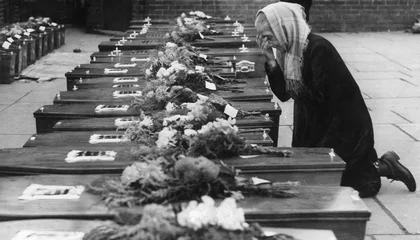
Freckleton laid the majority of its dead to rest on August 26, three days after the disaster. The U.S. military covered the costs of the mass burial, and service members from BAD2 dug the communal grave, in addition to acting as pallbearers for the children. Hall and her students were buried in the arms of the T-shaped grave, while Hulme and the other adult villagers were later interred in the vertical trunk of the “T.” The USAAF airmen killed in the crash were buried in Cambridge alongside other American service members; all but one were repatriated to their families in the U.S. after the war.
On September 1, the American entertainer Bing Crosby visited the four surviving children at the hospital. (Maureen Denise Clarke, the last casualty of the disaster, would die just three days later.) “He said he would sing for us, but when he came to me and saw how badly injured I was, he broke down and said he couldn’t sing in the same room as us,” Currell told the BBC in 2007. Instead, she recalled, Crosby performed “White Christmas” and “Don’t Fence Me In” from the hallway outside of the ward.
“My arms and legs were in splints,” Currell said in 2004. “I looked like a mummy. I was bandaged head-to-foot and had to sit with my arms out straight because of all the burns.” The survivors’ recovery was long and painful, with Currell, Madden and Carey all facing years of surgeries. Brooke had nearly 50 operations, while his friend Bone endured 18. The emotional trauma lingered even longer. Currell noted that she often saw the mothers of her deceased classmates staring at her, perhaps wondering what their own children might have looked like if they were still alive.
USAAF’s investigation into the accident placed the blame chiefly on Bloemendal, with a report suggesting that while the cause of the crash was unknown, it “resulted from pilot’s error in the judgment of the violence of the storm.” To prevent future tragedies, investigators advised headquarters to warn pilots of the dangers posed by British storms, whose severity was routinely dismissed by Americans accustomed to flying in the Southern U.S.
According to Hedtke’s book, the “simplest and most widely accepted theory” of the accident posits that Bloemendal, upon realizing that it was too dangerous to land, attempted to follow the other B-24 pilot as he flew north to safety. A downdraft caught the plane as it turned, sending it straight into the ground. Two eyewitness accounts supported this version of events, but another offered an alternative explanation, blaming a rogue lightning strike for interfering with the aircraft’s instruments and causing Bloemendal to lose control of his plane.
Ultimately, Hedtke wrote, “the dearth of eyewitnesses, the complete destruction of the aircraft and the succinctness of the accident report will always make the cause of the Freckleton air disaster speculative at best.” Still, the historian maintained that Flight Control Operations bore at least partial responsibility for the disaster, as only the service members back at base “possessed the updated weather forecasts, knew the ferocity and track of the storm, and could visibly see the impact of the weather conditions on the immediate vicinity.”
In the days after the crash, an American general sent a message to the crown’s representative in Lancashire, expressing “the deep regret of myself and the entire American Air Forces for the distressing accident.” In response, the official expressed his “deep appreciation,” promising to pass the general’s condolences on to the victims’ families. The exchange reflected the general sentiment among both the Americans and the British, neither of whom wanted the tragedy to negatively affect the relationship they’d built as wartime allies.
The first memorial to the victims was dedicated in August 1945, when American airmen gifted a playground to the village’s surviving children. Two years later, the local council erected a monument inscribed with the names of the dead beside the communal grave. But controversy dogged efforts to build a more permanent commemorative space, with locals divided over whether to construct a replacement school or a public memorial hall. Both projects eventually came to fruition, but it was only in 2007, after the BBC aired a short documentary on the accident, that a plaque was installed at the site of the crash. The rest of the world, meanwhile, has largely forgotten the tragedy that befell Freckleton 82 years ago.
“The disaster was not widely reported on, either in the U.K. or the U.S.,” says Hearn, the American Air Museum in Britain curator. “The story could have dealt a blow to Anglo-American relations at a time when the American presence in Britain was at its peak. Rather than reporting on the horror that had unfolded in Freckleton, the next day’s papers were filled with news of the Allies’ advance into Paris.” During the war, Hearn adds, “accidents were extremely common as pilots fought against changeable weather conditions, unforgiving terrain and crowded skies.”
Decades later, does Currell harbor any ill will toward Bloemendal? As she told Bluffton Today in 2017, the pilot and his crew lost their lives, too. “The storm brought him down, and unfortunately, we were in the line of fire. An accident: That’s all it was. A terrible, tragic accident.” She added, “You have to learn to live with it.”