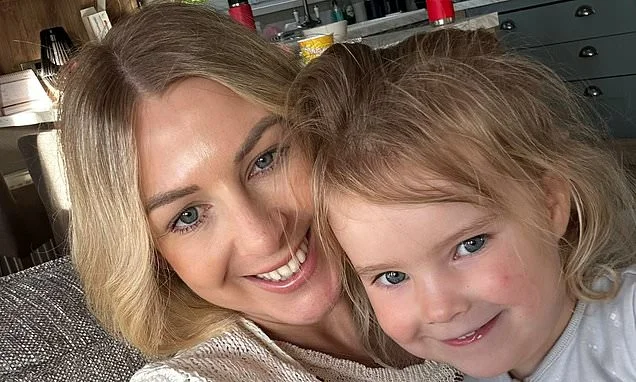
When I look at my younger daughter Bella, laughing as she chases her big sister Riley around our garden, my heart swells with a love so intense it almost hurts.
She is three now, a whirlwind of energy, giggles and pure joy. But tucked just beneath my happiness is a quiet, familiar weight that lives in the corners of my mind.
Because while I am a wife and a mother, at just 35 years old I am also living with incurable cancer.
I love both my daughters deeply and hate the thought of not watching them grow up, though our journeys to having them were very different.
Bella is adopted. She came into our lives as a tiny, vulnerable nine-week-old baby – at a point when doctors had already told me my secondary breast cancer was incurable.
I know this is a decision some will struggle to understand. Why would someone knowingly adopt a child when they are living with a terminal diagnosis? Was it fair? Was it selfish?
Those are questions my husband Jack and I asked ourselves over and over before we began the adoption process. We never made the decision lightly. By the time we started exploring adoption, my cancer had been stable for several years.
Jenna Haskins and her husband, Jack, have two daughters: Riley, nine, and Bella, three, who they adopted when she was just nine weeks old
Although I knew there was always a chance it would start to spread again and my condition would worsen, my oncologist believed I could have many good years ahead of me.
More than anything, we believed we had so much love to give a child who desperately needed a family.
We also knew that none of us can ever be certain how long we have.
Watching Bella growing up alongside Riley, who is nine, I have never regretted that decision for a second. But since my cancer started spreading again a year ago, I have also spent countless sleepless nights wondering whether I will have enough time to give her all the memories of having a mummy that she deserves.
That thought breaks my heart.
My journey to this point began in February 2019, when Riley was just 18 months old. I found a lump in my left breast but convinced myself it was nothing serious. I was 27 and healthy, with no family history of breast cancer.
Jack and I had been married for ten months, having met ten years earlier at a sixth form party. I was working as an occupational therapist, and Jack as a financial adviser.
While I went to my GP straight away, who gave me a referral, they assured me it was very unlikely to be cancer because of my young age. So the subsequent diagnosis of triple-positive breast cancer – where the cancer’s growth is fuelled by the hormones oestrogen and progesterone, and the HER2 protein – came as a complete shock.
Initially, doctors believed they had caught the disease early.
I underwent a mastectomy and tried to stay positive, reassuring both Jack and my family that everything would be fine.
Then everything changed.
Jenna, pictured after her mastectomy, was initially diagnosed with triple-positive breast cancer but was then told that the cancer had spread beyond her breast – and was incurable
After surgery, doctors discovered cancer in 23 of the 24 lymph nodes they had removed. A CT scan initially suggested it hadn’t spread, giving us enormous hope. My mum and I even celebrated with champagne after hearing the news.
Days later, however, another scan revealed a tiny lesion on my spine. It wasn’t early breast cancer after all. It was Stage 4 ‘secondary’ breast cancer, meaning it had spread beyond my breast – and was incurable.
I was told I had just three to five years to live. In an instant, my entire future disappeared.
My overwhelming fear wasn’t for myself, but for Riley. She was still a toddler. All I could think about was whether she would grow up without her mum. Thankfully, our story didn’t end there. Because of private health insurance, I was able to travel from our home in Bath to Madrid for specialist treatment.
Doctors there were able to treat the tumour in my spine aggressively with radiotherapy before putting me on continued doses of Herceptin, a drug used to treat breast cancer that targets the HER2 protein and stops the cancer cells from growing.
The treatment worked remarkably well. For two years my cancer remained stable. I attended hospital in Bath every three weeks for the intravenous Herceptin treatment, but otherwise I was healthy. I worked, travelled, enjoyed family life and, to most people, looked perfectly well.
That stability allowed us to start thinking about the future again.
Although pregnancy was no longer an option because my cancer is hormone-positive – which meant having all those pregnancy hormones flooding my body was too risky, plus my treatment had put me into early menopause – Jack and I desperately wanted Riley to have a sibling.
Adoption felt like the only path left open to us. But we were completely naive about how difficult that journey would be. The moment we disclosed my diagnosis upon starting the process in 2021, two agencies rejected us outright. Being told your illness makes you unsuitable to become a parent is incredibly painful.
After getting specialist treatment abroad, her cancer stabilised, allowing Jenna and Jack to think about their family's future again – including a sibling for Riley
We understood why agencies had concerns. Their responsibility is to protect vulnerable children. But it still felt devastating to have people immediately assume that my diagnosis defined everything I was capable of offering.
Eventually we found Adoption West, based in Gloucester. Instead of automatically dismissing us because of my medical history, they looked at us as individuals.
My oncologist wrote a detailed letter explaining that although my cancer was incurable, it had remained stable for years and there was no evidence suggesting that would suddenly change. He felt there was every reason to believe I could continue living a full life, though he was unable to put a time frame on this.
That letter proved crucial. But even then, there were no guarantees.
The assessment process lasted almost two years. We underwent extensive background checks, psychological assessments, training courses and endless conversations with social workers about every aspect of our lives.
Of course, my health formed a huge part of those discussions. We talked openly about my prognosis, our support network and what would happen if my health deteriorated.
Jack and I never shied away from those conversations because we believed any child placed with us deserved complete honesty once they were old enough to fully understand, or if I became visibly unwell. Were there risks associated with my health? Absolutely. But every family faces uncertainty.
Parents develop illnesses. They have accidents. Lives change unexpectedly. Nobody adopting, conceiving or giving birth can promise they will still be alive in ten or twenty years’ time.
The difference was that our uncertainty had a name: cancer.
I was 32 when we were finally approved in 2023. When we were given access to profiles of children waiting for families, it was overwhelming. Reading about so many children needing loving homes was heartbreaking.
Some adaptation agencies immediately rejected Jenna because of her illness, but eventually a a Gloucester-based firm led them to baby Bella. 'In an instant, my whole world had changed'
Then our social worker called about a nine-week-old baby girl. The moment I held Bella in my arms, she looked up at me and smiled. In an instant, it was like my whole world had changed. Within three days, Bella was placed with us. Overnight, our home was transformed by the smell of baby lotion, sleepless nights and tiny newborn cries.
Riley, who was six at the time, adored Bella from the very beginning. Watching her become a big sister confirmed what Jack and I had hoped for all along. Our family finally felt complete.
For nearly two years, life was wonderfully ordinary. I continued my treatment every three weeks, but cancer faded into the background. Bella took her first steps. Riley flourished at school.
We celebrated birthdays, family holidays and all the little moments that make up everyday life. Then, last year, everything changed again. I tripped over an open dishwasher door and broke my femur. Because of my cancer history, doctors carried out a full-body scan to make sure the bone hadn’t fractured because of the disease.
Before they even spoke, I think I already knew. The cancer in my spine had started growing again and had now spread to my bones.
This diagnosis hit me far harder than the first one. Back in 2019, my greatest fear had been leaving Riley without a mum.
Now I wasn’t only thinking about Riley. I looked at Bella and felt completely overwhelmed.
She had already experienced enormous upheaval before she came to us. The thought she could lose another mother was almost impossible to bear. For the first time since my original diagnosis, I wondered whether the people who had questioned our decision to adopt had been right all along.
Had we been selfish? Had we asked too much of this little girl? Those thoughts haunted me. My oncology team, however, remained optimistic.
Although the cancer had become active again, they believed it was treatable. I underwent another course of targeted radiotherapy.
Then came another devastating setback. The next scan showed that during a six-week break from treatment, the cancer had spread to seven of my vertebrae. They would need to try a different treatment, but there were no guarantees it would work.
It was one of the darkest periods of my life. Earlier this year, I started an aggressive new treatment regime of oral chemotherapy and faced the agonising wait for my next scan results.
Jenna, pictured at her final chemotherapy session, says she still lives scan to scan but is trying to maintain as much stability and normalcy as possible for her daughters
Finally, at the end of June, we received the news we had desperately hoped for.
While still incurable, the cancer is stable. Nothing new is growing, and several of the existing tumours are dying. I still live scan to scan. Every three months brings another anxious wait, and there are no guarantees about what the future holds. While I’ve outlived my initial three-to-five-year prognosis, I’ve deliberately not asked doctors how long I might still have. Maintaining stability, in every sense, is everything.
This summer we enjoyed a family holiday together to Portugal, and it felt like a celebration of something many people take for granted: simply being together.
People often tell me I don’t look like someone living with incurable cancer. They’re right. While the days I undergo my Herceptin treatment every three weeks leave me feeling tired and nauseous, most days, I don’t feel ill either.
Our daughters know that Mummy goes into hospital sometimes, but they don’t know why. Thankfully I still have the energy to play with them, though they know that I have a ‘bad back’, which hurts sometimes.
We have never used the word ‘cancer’ with them because, for now, we want their childhoods to be filled with as much joy and security as possible. We won’t tell them until they’re older, or until my situation visibly changes.
Whether that’s the right decision, I don’t know. Like every parenting choice we’ve made, we’re simply doing what feels best with the information we have.
The same is true of adoption.
I understand why some people think we shouldn’t have adopted Bella. If I’d been looking in from the outside, I might have had questions too.
But what those people don’t see is the life we’ve been able to give her over the last three years.
They don’t see Riley and Bella chasing each other around the garden until they’re breathless with laughter. They don’t see bedtime stories, family holidays, cuddles on the sofa, birthday parties.
If we had decided not to adopt because of fear then Bella might have missed out on a family who completely adore her.
Cancer has taken many things from me, but it has never taken away my ability to be a good mother. If anything, my diagnosis has made me appreciate motherhood more deeply than I ever thought possible. Every ordinary moment that makes up a childhood feels like a gift.
Would I make the same decision again knowing everything I know now? Without hesitation.
The fear about the future is real, and I won’t pretend otherwise.
I desperately hope I have many more years with my girls. I want to see Riley start secondary school. I want to watch Bella put on her first school uniform. I want to embarrass them as teenagers and watch them become women. Those are the milestones I cling to.
So far, Jack and I haven’t really talked through the reality of him raising the girls alone one day; we prefer to focus on the present and enjoy every moment as a family until a bad scan result forces us to have those conversations. But he’ll be an incredible dad to our daughters — he already is.
However much time I have, I know one thing with absolute certainty: adopting Bella wasn’t a reckless decision. It was one made with honesty, careful thought and love. And, as and when my time comes, that love will help see both Bella and Riley through.
Jenna is taking part in the My Life, My Way campaign founded by the charity Make 2nds Count, highlighting the ways people can live well with secondary (metastatic) breast cancer. For more information, visit make2ndscount.co.uk
As told to MATTHEW BARBOUR