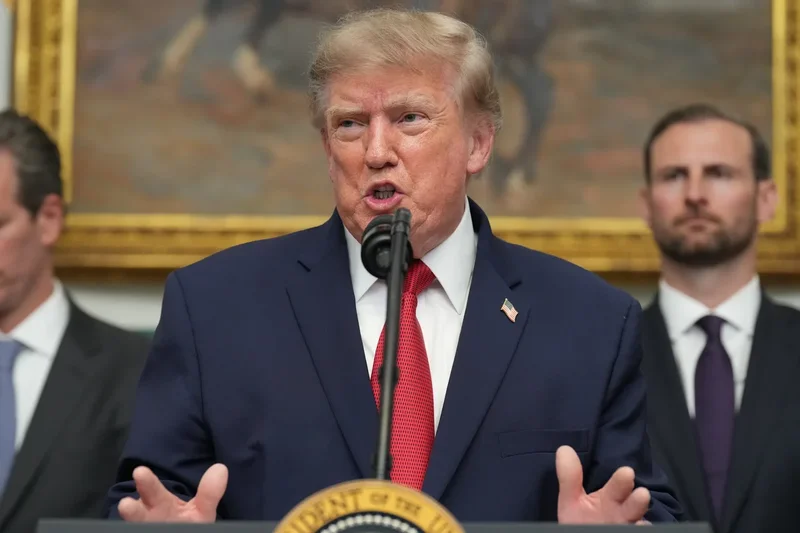
President Donald Trump has issued another economic threat against Iran, vowing “TREMENDOUS Economic Consequences” for any country that trades with Tehran.
In another rant on Truth Social on Wednesday, he wrote: “ANY country that allows its financial institutions, businesses, airports, or government entities to provide any type of lifeline to Iran will itself face TREMENDOUS Economic Consequences.
“This will be an ECONOMIC D-DAY, and we need all of our Allies to stand with the United States of America to isolate, and defeat, the Iran threat.”
Tehran’s foreign minister Abbas Araghchi said that the threats would only bring Trump “further defeat” as he struggles to find an exit strategy from an unpopular war.
“The so-called ‘Economic D-Day’ is a diversion from America's own crisis: unprecedented debt & surging interest costs,” he wrote in a post on X on Thursday, alongside screenshots of news headlines and graphs about America’s economic troubles.
“Doubling down on failed policies will only bring further defeat—and enmity of Iranians. US economic terrorism threatens global economy and sovereignty worldwide.”
What kind of sanctions could Trump impose?
The US had agreed to lift sanctions on sales of Iranian oil for the duration of a 60-day ceasefire that expired on Monday, but these were reimposed after the deal collapsed amid disagreement over the Strait of Hormuz last month.
For decades, it has imposed measures such as freezing assets, implementing trade embargoes and applying sanctions against Iran over issues such as its nuclear development and human rights violations.
Since the war, Washington has also imposed a naval blockade, restricting Iranian oil exports as well as levying additional maritime and energy sanctions since the war broke out.
Trump could escalate the situation by imposing secondary sanctions on third parties. However, he is limited in what he can enforce, say experts.
“The most likely step is tighter enforcement of secondary sanctions against companies, banks, insurers and shipping operators involved in Iranian oil exports,” says Dr Neil Quilliam, an energy policy, geopolitics and foreign affairs specialist, at Chatham House.
“The aim would be to make it more difficult and costly for third parties to do business with Iran, even if they are not based in the US.”
This is in line with what Trump has threatened, but Dr Quilliam says that even this could prove ineffective if the measures do not extend to China.
Could these sanctions have any impact on Iran’s economy?
Iran appears to have profited from the outbreak of conflict, with the country’s semi-official Fars news agency reporting that the country generated $7.5bn in oil revenues over the first four months of the year.
Citing the Iranian oil ministry, the agency said that this marked a revenue that is 1.5 times larger than the amount generated in the same period last year and is expected to cover the government’s foreign currency expenses for the rest of the year. These figures could not be independently verified.
Iran has developed ways to circumvent the worst impact of sanctions, including the use of shadow fleet tankers, floating storage and the use of alternative ports.
Dr Quilliam says that while further sanctions could increase pressure on Iran’s economy, alone they are unlikely to be decisive.
“Iran has spent years building networks to evade restrictions and has become adept at finding alternative routes to market,” he says.
“The greater challenge for Tehran would come if Washington succeeded in reducing demand for Iranian oil rather than simply targeting supply.”
Why China is so important
He says that the key issue here is China, which purchases 80 per cent of Iran’s oil.
“The US has repeatedly identified Chinese entities as facilitators of Iranian oil exports, but applying penalties on a large scale could have wider economic and diplomatic consequences.”
Iran has attempted to dodge the effects of this by offering discounts to Chinese companies.
“The credibility of Trump's threat will depend on whether he is prepared to target major buyers as well as Iran itself,” continues Dr Quilliam.
“The bigger question is whether Washington is willing to bear the economic and diplomatic costs of targeting major buyers, especially in China, as well as close allies, such as the UAE, which remains a key node in capital flows for Iran, though cut financial ties on Tuesday.
“That is where rhetoric meets reality. There are also so many areas where the oil and/or money is moved - Iraq, UAE, Malaysia, overground routes Pakistan, Türkiye, Central Asia - so there is a lot to capture.”
Should Trump’s threat be taken seriously?
Trump has developed a notorious reputation for issuing stern threats before later reneging on them - earning him the infamous ‘TACO’ nickname (Trump Always Chickens Out) on Wall Street.
But despite this, Dr Quilliam says that the repercussions of sanctions on Iran could still be dire.
“Trump's threat should be taken seriously, but its effectiveness depends on enforcement,” he says.
Secondary tariffs have been struck down by the Supreme Court on numerous occasions. Nevertheless, Trump could still sanction smaller “teapot” refineries in China that account for around 25 per cent of Chinese refinery capacity, sanction Chinese banks and impose a land blockade.
Last week, the Senate passed a Russia sanctions bill that included new Iran sanctions and could give Trump new tariff powers that he could potentially use against countries that aid Tehran’s commerce and weapons procurement.
But the legislation must still pass the U.S. House of Representatives, which could prove challenging given widespread concerns across both parties about the measures. Treasury secretary Scott Bessent said that the US would impose measures on Tehran that have "never been seen" before.
“The US can aim to tighten pressure on Iran's oil exports and the commercial networks that support them but the timelines for implementing complex sanctions like this are lengthy, and impact would be far from immediate.”