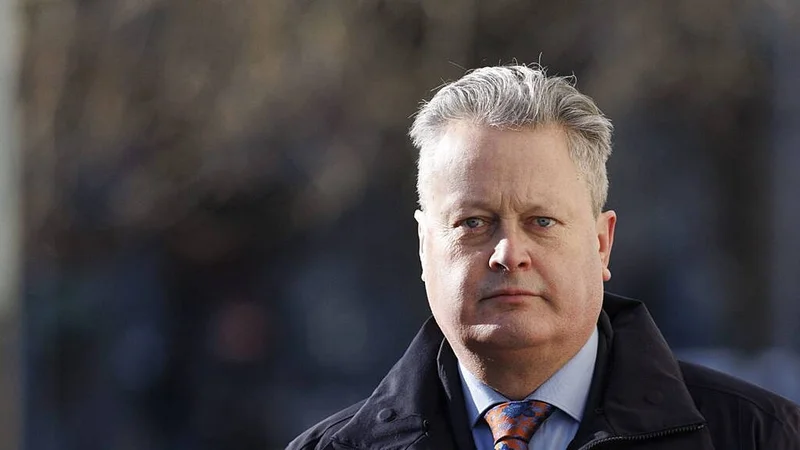
A former BBC journalist whose communications data was unlawfully obtained says he has “no doubt” other journalists in Northern Ireland have been “targeted in the same way”.
Vincent Kearney also said he has not been told if PSNI officers involved in the investigations into him – which included compiling information about his wife and children – are still working in the force.
On Thursday, three judges at the Investigatory Powers Tribunal (IPT) awarded Mr Kearney £10,000 in damages from the PSNI and the same award against MI5.
Mr Kearney, believed to be the first reporter to be awarded damages from MI5, said the outcome was a “good result for journalism”.
Speaking at the RTÉ offices in Belfast, he told the Press Association: “This reinforces the right of journalists to protect their information and to protect their sources.
“Because at the heart of the story was an illegal attempt by the police and by MI5 to try to identify sources who provided information to me for stories, sources who I promised to protect, and then, unknown to me, the PSNI and MI5 were using illegal means to undermine those promises that I had given people, to try to identify those sources, so I think this is very, very significant.”
He said the ruling was “setting a very clear signal” that “organisations that are supposed to uphold the law can’t be above the law”.
“Going forward I think that could be significant because it does send a strong message to the police and to other law enforcement agencies, and perhaps paves a way for other journalists to take similar action if they’ve been targeted in the same way because I’ve no doubt they have been,” he said.
“There’s no way that I was the only journalist in Northern Ireland that was being targeted in this fashion.”
He added: “They were looking at my data illegally over a period of many years, both the PSNI and the MI5, if they were looking at my data and trying to gain access to my sources and to identify them, then surely they were doing that to other journalists as well.
“Certainly, journalists who were involved in serious public interest journalism, trying to hold public bodies and police and others to account, I have no doubt that some of those other journalists may well have been targeted.”
PSNI Chief Constable Jon Boutcher publicly apologised to Mr Kearney after the ruling and said “significant changes to practice and policy have already been made”.
Mr Kearney said he had spoken to Mr Boutcher, and the police “have to take steps to make sure this doesn’t happen again”.
“A question I have and have had for some time is, the officers who were involved in this illegal activity, are they still working within the PSNI? Are they still working in positions where they could be monitoring communications of other individuals, including journalists?” he said.
“I still haven’t received the answer to that question.
“So an apology is one thing, and that’s very welcome, but I think the police have to set out very clear terms what kind of action it will take to ensure this can’t happen again.”
The IPT had heard Mr Kearney was potentially targeted “more than any other journalist in Northern Ireland”.
The veteran journalist said it was a “shock” to see the “extent of the efforts” the agencies went to in their investigation of him.
“They gathered information about thousands and thousands of my phone calls and texts, so that was really a very high level of intrusion over a long period of years as well,” he said.
“But not only that, they built up an intelligence profile on my family, including details of my wife, her mother who lived with us at the time, children who lived in the house, details of our cars that we were driving, the registrations of those cars, and that begs the question – why gather that information?
“You only gather that if you want to put someone under surveillance, and that certainly caused a degree of anxiety at home when members of the family were informed that they weren’t simply breaching my rights as a journalist, but that was a really serious intrusion of private life as well.”