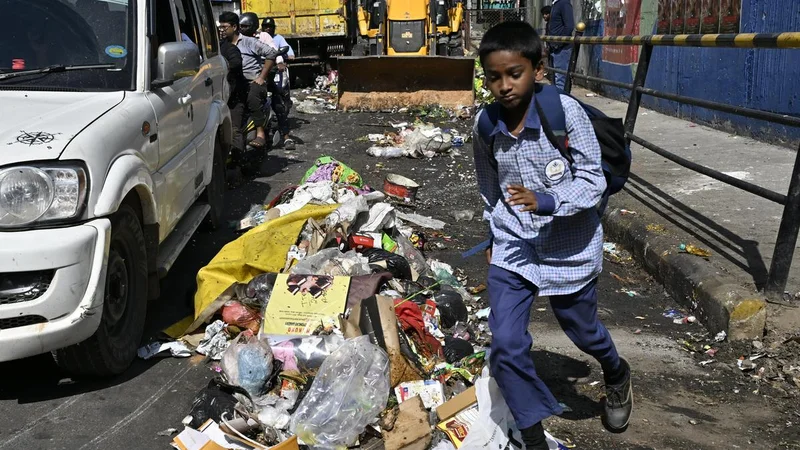
On 1 August, 2026, the Greater Bengaluru Authority (GBA) launched a month-long ‘Freedom from Waste’ campaign, marking the first city-wide cleanliness initiative since the Bruhat Bengaluru Mahanagara Palike (BBMP) transitioned to GBA.
Several agencies, including the city’s five corporations, Bengaluru Solid Waste Management Limited (BSWML), Rail Infrastructure Development Company (Karnataka) Limited, and Bengaluru Metro Rail Corporation Limited, are working in close collaboration to target 1,616 locations or blackspots holding approximately 22,732 tonnes of waste.
As part of this, authorities had directed property owners to clear waste from their vacant plots by 15 August, failing which civic agencies would undertake the cleaning and recover the cost through property tax. While clearing waste is an essential first step, it is important to understand why these blackspots emerge in the first place.
A symptom, not the cause
A holistic approach through a systems lens highlights that blackspots are not the cause of Bengaluru’s waste crisis but just a symptom of a fundamental problem. Each blackspot represents the larger interaction between collection efficiency, waste processing capacity, enforcement, and institutional coordination. Thus, clearing these blackspots may remove the symptom, only for it to reappear within a short time.
One of the key drivers of these blackspots is the inconsistent waste collection. On paper, Bengaluru has a city-wide door-to-door waste collection system; however, the auto-tipper model — the backbone of the daily collection system — is highly stressed.
According to the BSWML, one auto-tipper is expected to service around 750 households, making collection impractical and resulting in irregular waste collection. Although there have been past efforts to improve waste collection and the campaign also acknowledges this as one of the focus areas, the implementation roadmap for strengthening door-to-door collection models is not clearly outlined.
Further, a city that experiences intermittent waste collection with no bins around pushes the public to dump waste in open areas. Vacant plots and street corners are often perceived as convenient dumping locations, especially for wet waste, which is difficult to manage and store at homes, as it produces foul odours and attracts flies. As these waste piles grow, it encourages people to dump waste at the same location, increasing the burden for municipalities to clear the blackspot.
Shifting the burden of waste
Another systemic challenge is the tendency to shift the burden of waste, with collected waste often ending up in landfills located on the city’s outskirts. Under this campaign, GBA has identified 8 land parcels, covering nearly 57 acres on the outskirts, where the collected waste will be transported.
While sites such as Kannur and Chikkajala have existing construction and demolition (C&D) waste processing plants, there is limited public information on the processing facilities for the remaining sites, which account for nearly 75% of the identified land. Thus, transporting waste may provide an immediate solution for the blackspots, but it raises a broader systems question of whether these sites act as temporary aggregation points or merely shift the waste to the outskirts, which slowly become permanent waste relocation sites.
Further, Bengaluru has witnessed such cases in places such as Mavallipura and Mandur, where peripheral dumping evolved into long-term environmental and health challenges for people living in these locations.
Effective coordination
With the city continuously expanding, large-scale infrastructure projects such as metro construction generate a substantial amount of C&D waste. This C&D material forms the foundation of many blackspots in the city, over which municipal solid waste (MSW) accumulates, making them a permanent dumping spot. Also, C&D waste consists of high-value material that can be recovered and recycled, but when this gets mixed with MSW, it loses its economic value.
While the Environment (Construction and Demolition) Waste Management Rules, 2025, highlight the specific management needs and provisions for proper clearance, effective coordination between generators, transporters, collection agencies, and recyclers is crucial to avoid disrupting end-to-end operations.
To sum up, several reforms over the years have shaped the waste situation in Bengaluru. Each addressed a specific bottleneck and took action to curb it. Yet, there is a need to look beyond optimising individual components and understand the interdependencies within a system — those that weaken results and lead to recurring blackspots.
Viewed from a systems lens, the Freedom from Waste campaign offers an opportunity, as it brings together multiple civic agencies under a common objective. If coordinated efforts extend beyond clearing blackspots, it could address the drivers beneath illegal dumping. The success of this initiative could help build public trust and encourage greater citizen participation, turning a cleanliness initiative into a long-term shift towards cleaner Bengaluru.
Anushree Aggrawal and Pooja Verma work as analysts in the Sustainability group at the Center for Study of Science, Technology and Policy (CSTEP), a research-based think tank.
Published - August 20, 2026 07:09 pm IST