In this interview, industry expert Brian Matlock explains how UV-Vis and fluorescence measurements help assess nucleic acid and protein concentration. He also discusses the role of the NanoDrop in supporting faster nucleic acid and protein QC.
To get started, can you give us an overview of how the NanoDrop originated and what workflow limitations it was designed to overcome?
I’ve been working with NanoDrop products for close to 20 years now, and when I think back to graduate school and the early part of my career, we were quantifying DNA and RNA almost daily using cuvettes and traditional UV-Vis approaches.
That workflow had many pain points. You had to perform dilutions, clean quartz cuvettes between samples, and manually calculate concentrations. It was time-consuming, and there was also room for variability between users and measurements.
NanoDrop changed that by enabling microvolume measurements without dilution. It provided users with direct concentration readouts and used a variable path length, allowing it to handle a wide range of sample concentrations. So, it simplified what was already a very routine but critical step in molecular biology labs.
*Image Credit: Thermo Fisher Scientific - UV-Vis Spectroscopy *
What is UV-Vis measurement, and why has it remained such a core technique in life sciences labs?
At a basic level, UV-Vis measurement is about measuring how much light a sample absorbs at specific wavelengths. For molecules such as DNA, RNA, and proteins, that absorbance is directly related to concentration.
One of the most useful aspects, especially with NanoDrop, is that it enables the collection of full spectral data, not just getting a single concentration number. That means you can also get a sense of what else may be present in the sample, such as protein contamination, organic compounds, or other impurities that could affect downstream work.
UV-Vis is also a label-free technique, so you are not adding anything to the sample. It is very fast, and you can go from sample to answer in just a few seconds. This well-established technique remains widely used because it gives scientists both concentration data and a quick read on sample quality before moving into the next stage of their workflow.
Click here to watch Analyze That episode 11 - Beyond the Ratios: How NanoDrop™ Ultra Supports Biopharma Workflows
Why did NanoDrop become so widely adopted in molecular biology and biopharma workflows?
A big part of NanoDrop’s adoption lines up with the genomics boom in the early 2000s. As labs began generating more DNA and RNA samples, there was a real need for a fast, simple way to quantify them before moving into downstream applications.
NanoDrop made it easy to get accurate concentration data, required very little sample, and still provided full spectral information. In many cases, users only had a small volume of sample to work with, so being able to measure with just a microvolume was a major advantage.
NanoDrop helped users understand sample quality in addition to quantification. Working across DNA, RNA, and protein workflows, it became broadly applicable across many types of life sciences labs.
How has NanoDrop evolved beyond traditional purity ratios such as 260/280 and 260/230?
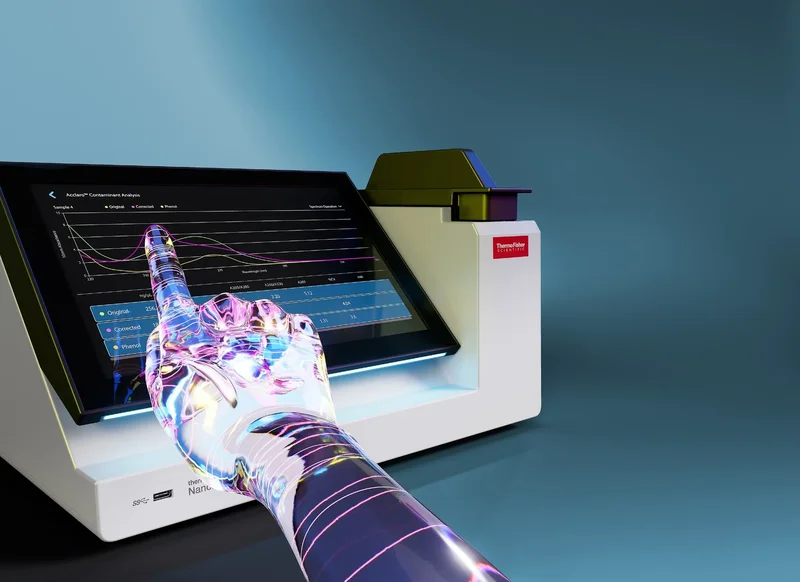
As the technology evolved, NanoDrop began to go beyond simply reporting classical purity ratios such as 260/280 and 260/230. With the NanoDrop One platform, we introduced the Acclaro suite, which included more advanced algorithms.
Those algorithms allowed us to use full spectral data more effectively. Instead of only giving users basic purity ratios, the software could help identify potential contaminants in the sample. That is important because contaminants can influence concentration measurements and affect downstream applications.
Today, NanoDrop acts as a central QC step upstream of many critical workflows, including qPCR, sequencing, cloning, and protein expression. It provides a quick checkpoint where scientists can confirm both concentration and quality before committing time, reagents, and resources to more complex downstream processes.
How is NanoDrop used in nucleic acid workflows?
A good place to start is with nucleic acid workflows, such as vector construction, plasmid prep, or oligonucleotide manufacturing for diagnostic kits. Once DNA or RNA has been prepared, scientists need a quick way to verify both concentration and quality before moving into steps such as ligation, PCR, and sequencing.
That is where NanoDrop fits in. With just one or two microliters of sample, users can obtain a concentration measurement along with full spectral data. That means they are confirming not only how much material they have but also whether contaminants are present that could interfere with downstream processes.
This is important because even small amounts of contamination can affect enzyme efficiency and lead to inconsistent results. In higher-throughput environments, such as oligonucleotide production, consistency becomes even more critical.
*Image Credit: Thermo Fisher Scientific - UV-Vis Spectroscopy *
What role does NanoDrop play in protein and antibody development workflows?
On the protein side, especially in antibody development and bioprocessing, NanoDrop plays a very similar role. It is used to quickly quantify protein concentration, typically using A280, during steps such as purification or before downstream assays.
Again, the goal is to obtain a fast, reliable measurement while also checking for anything that might interfere with the next steps. In protein workflows, sample quality and concentration are important because they can influence assay performance, purification decisions, and overall process consistency.
In more complex or highly concentrated samples, tools like Acclaro Pro can help improve accuracy and consistency. That becomes especially important when scaling a process or making batch-related decisions.
How does NanoDrop act as a QC checkpoint in biopharma and bioprocessing workflows?
Across both nucleic acid and protein workflows, NanoDrop acts as a quick QC checkpoint. It helps confirm that samples are ready before moving into more complex, expensive, or time-sensitive downstream processes.
In biopharma and bioprocessing workflows, that checkpoint is especially valuable because decisions are often being made across batches, production stages, or development workflows. If the concentration is inaccurate or if contaminants are present, that can create problems later in the process.
NanoDrop gives users a fast way to check concentration and sample quality using very small sample volumes. That helps reduce unnecessary delays and provides more confidence before moving into applications such as sequencing, PCR, protein expression, purification, or downstream assays.
Click here to watch Analyze That episode 11 - Beyond the Ratios: How NanoDrop™ Ultra Supports Biopharma Workflows
How does the NanoDrop Ultra build on the core UV capability?
The NanoDrop Ultra builds on the core UV capability by adding microvolume fluorescence, which brings an additional layer of sensitivity and specificity to the platform.
With absorbance, you get full spectral data and can use that information to identify what else may be present in the sample. However, absorbance can sometimes be misleading when contaminants affect the measured concentration. That is where fluorescence becomes very useful.
Fluorescence is a much more sensitive measurement than absorbance and is also highly specific. In fluorescence assays, a dye binds only to the molecule of interest, such as DNA, RNA, or protein. That gives users a more specific answer for concentration, especially when they need greater sensitivity or when the sample is more complex.
Why is it useful to combine absorbance and fluorescence measurements?
I like to encourage people to think about using absorbance and fluorescence together. Each measurement provides different information, and when used together, they give a fuller picture of what is in the sample.
Absorbance provides full spectral data, helping you understand the overall sample composition and identify potential contaminants. Fluorescence, on the other hand, gives you a more specific and sensitive concentration measurement because the assay targets the molecule of interest.
When working with complex samples, using both absorbance and fluorescence can help you better understand sample quality and how the sample is likely to perform in downstream steps. This is especially useful in biopharma and bioprocessing workflows, where sample complexity and accuracy can have a major impact.
What value does Acclaro Pro add for highly concentrated samples?
In bioprocessing and biopharma workflows, users are often working with highly concentrated samples. That is where the Acclaro Pro software becomes particularly valuable.
Acclaro Pro includes algorithms that allow the instrument to take accurate measurements, even on highly concentrated samples. Previously, users often had to rely on multiple dilutions or consumable-based approaches to measure these samples. Both approaches can introduce challenges: dilutions can introduce errors, and consumable-based methods can add cost.
With Acclaro Pro, users can take direct measurements without introducing dilution-related errors and without requiring consumables. It also makes it faster and easier to replicate measurements of high-concentration samples. Overall, NanoDrop Ultra helps extend the value of a microvolume approach into biopharma and bioprocessing QC workflows.
*Image Credit: Thermo Fisher Scientific - UV-Vis Spectroscopy *
Analyze That episode 11 - Beyond the Ratios: How NanoDrop™ Ultra Supports Biopharma Workflows
Beyond the Ratios: How NanoDrop™ Ultra Supports Biopharma Workflows
About Brian Matlock
Brian Matlock holds an MS in Microbiology and Molecular Genetics from the University of Illinois Urbana-Champaign and a BS in Biology from North Central College. He has worked at Thermo Scientific since 2008, and he is currently a Senior Application Scientist.
About Thermo Fisher Scientific - UV-Vis Spectroscopy
UV-Vis Spectrometers Overview
Scientists can count on our broad range of ultraviolet (UV) and visible (Vis) spectrophotometers to deliver reliable, accurate data. The Thermo Scientific SPECTRONIC 200, GENESYS, and Evolution product lines are designed to streamline measurements, providing consistent, high-quality results, time after time. Additionally, the innovative Thermo Scientific NanoDrop microvolume family of instruments has been helping scientists accelerate the pace of discovery for over 20 years. From classroom teaching–to routine measurements–to discovery of the next scientific breakthrough, our line of spectrophotometers is designed to fit into any modern laboratory.