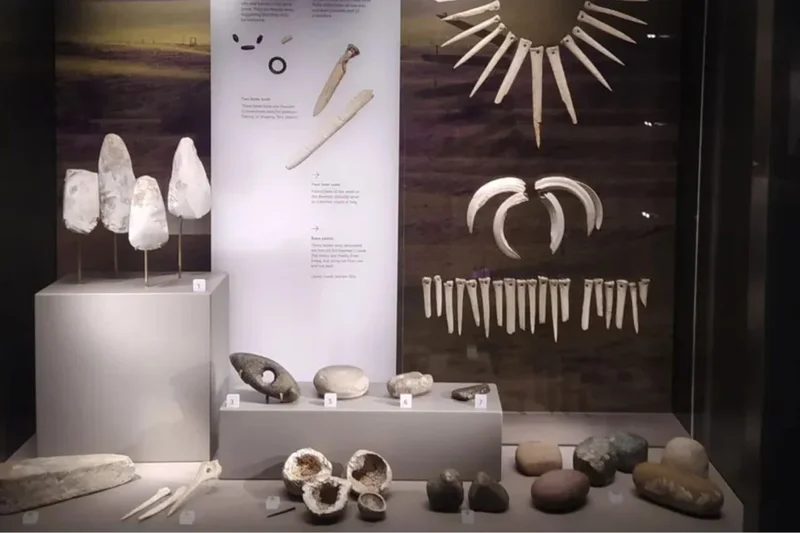
In 1803, British archaeologist William Cunnington dug up the remains of an individual buried with weapons, golden tools, and a decorative cloak in Upton Lovell, a village about 10 miles (16 kilometers) west of Stonehenge. From the generally stocky appearance of the bones, Cunnington concluded that the Upton Lovell Shaman must have been a âstoutâ man from the early Bronze Age. Well, who says women canât be stout?
That appears to have been the case for this individual, at least if Cunningtonâs initial assessment of the skeleton was correct. More than 200 years later, researchers revisited the skeleton with advanced DNA analysis techniques. They found XX sex chromosomesâtypical of genetically female peopleâin DNA extracted from the individualâs skull, teeth, and toe bone. The investigations also indicated that the woman was a metalworker from 4,000 years ago, probably had arthritis, and died around the age of 45.
The reevaluation of the Upton Lovell Shaman was announced in a statement from the Wiltshire Museum in the U.K., the current host of the skeleton. A detailed account of the scientific analysis is set to be officially published in a journal, the museum explained.
Actually, maybe not even a shaman
The announcement follows a 2022 study on the set of grave artifacts attributed to the Upton Lovell Shaman. The study reexamined the stone and copper-alloy goods, some of which had gold residues. The analysis led researchers to believe that some of these artifacts were, in fact, goldworking tools consistent with similar objects known to be from the Bronze Age.
That said, itâs still likely that the goldsmith lady was a special person in her community. In an interview with The Guardian, David Dawson, director of the Wiltshire Museum, said that metalworking was the âspace science of its day.â So the lavish decorations surrounding her body could be a reflection of her community’s respect, whose members perhaps âwanted her to take her tool kit into the afterlife,â he added.
Rewriting the story
The overturning of the assumption that the individual was male has had several implications. For one, it was the reason that female burials found nearby with grave goods were hypothesized to be the wives of âimportantâ men in society, Tom Booth, a researcher at the Francis Crick Institute in the U.K. who was involved in the scientific analysis, told CNN.
“It completely tears up previous assumptions,” Dawson said.
To be fair, Booth added that the metalworker woman was taller than average for the time. Assuming the DNA tests accurately guessed her age at death, she would have gone through menopause, after which female bones change to appear more like their male counterparts, he explained.
An evolving science
So, given the depth of knowledge and technical assets available to Cunnington, the older archaeologistsâ conclusions probably were what made more sense at the time. That said, those conclusions were why museum exhibits until now depicted her as a bearded spiritual leader, so maybe some new illustrations are warranted here. At the very least, Wiltshire Museum is already on this case. If you go to the exhibitâs landing page, youâll see they’ve really made a bolded, italicized effort to get their point across.
âSo often we have assigned the sex of an ancient skeleton partly on the basis of our own assumptions about sex and gender rolesâif it is buried with a sword, itâs male; with a necklace, itâs female,â Mary Beard, a classicist involved in curating the exhibition, told The Guardian. âAs with the Upton Lovell shaman, DNA analysis can help us correct those assumptions and think harder about the roles of men and women in the deep pastâand perhaps also about in our own world too.â