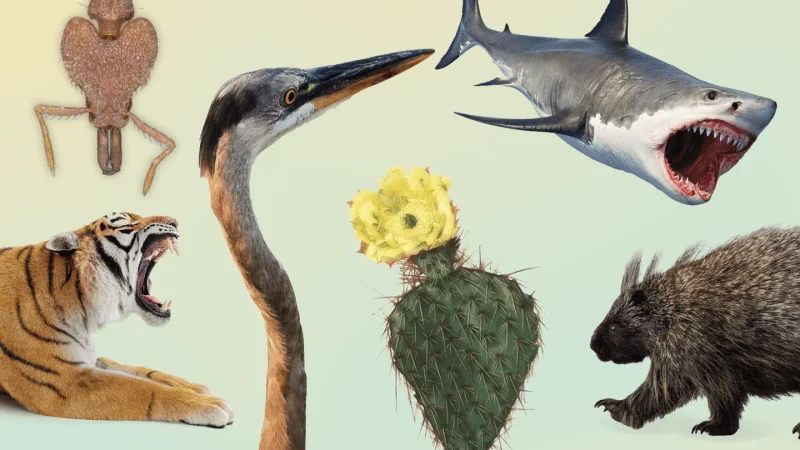
Spines, spikes, stingers, teeth, claws, beaks, fangs, tusks: Nature’s prickly bits come in a wide variety, but they all reflect the same trade-off.
These spiky sundries strike a balance between durability and puncturing prowess, researchers report in the July 8 Science Advances. But nature hasn’t settled on one winning shape.
The team measured the shape of 143 biological puncture tools, from formidable elephant tusks to tiny, shudder-inducing tools like the reproductive organs male bedbugs use to pierce females when mating. “You don’t need horror movies if you study puncture biology,” says evolutionary biomechanist Philip Anderson of the University of Illinois Urbana-Champaign.
Anderson and colleagues sampled a wide variety of spikes from the animal and plant kingdoms. The list includes lesser-known implements, such as the “love darts” that hermaphroditic snails lance their mates with and the needlelike ovipositors that parasitic wasps use to lay eggs inside other critters.
The researchers characterized each tool according to two properties: taper and roundness. Taper describes how elongated and slender a tool is. A cactus spine is highly tapered, a shark tooth less so. Roundness describes the shape of a tool’s cross section: If you slice through a cactus spine, you get a circle, whereas a shark tooth is flattened.
Using computer simulations, the team estimated the effectiveness of 25 idealized piercer shapes, calculating how much energy was needed for a hypothetical tool of that shape to create a puncture, as well as how easily the tool broke. Highly tapered and flatter tools can puncture more easily, but they also break more easily, the researchers found. Combining the two effects mapped out a high-performance region that stretched from low taper and roundness to high roundness and moderate taper.
When the researchers plotted their measurements of organisms’ piercing tools on this map, some fell on or close to the high-performance region while others were outliers. But that map assumed that puncture efficiency and durability were equally weighted. When the researchers changed how heavily the map weighted the two factors, the high-performance region shifted to encompass many of the previous outliers. That suggests that, depending on the demands on a tool, the relative importance of those factors could shift.
A panoply of piercers
Nature never settled on one ideal puncture tool — and this map of real fangs, spines, stingers and thorns shows how much their shapes vary. Slender, flatter tools pierce more easily but break more readily; stubbier, rounder ones hold up better but pierce poorly. (Four of the 143 tools the team measured are too stubby for the map and don’t appear.) Computer simulations point to a high-performance zone (blue-green) that balances the two. But real tools (each a dot, colored by its job) scatter well outside that zone. One reason: The zone isn’t fixed. Change how much the simulation weights piercing versus durability, and the zone would shift onto tools that look like outliers here.
For example, you might expect that replaceable tools, such as cactus spines, wouldn’t demand much durability. However, the replaceable tools didn’t seem to cluster in one part of the map. The study doesn’t pin down how or why those demands might vary.
The researchers also investigated whether the tools clustered based on their purpose. Piercing tools can work in various ways, including as a harpoon, a grasper or a defensive mechanism. But most of these tools didn’t cluster tightly according to their function. Whatever the task, a variety of shapes seemed to work. Love darts, for example, were all over the map, despite being used exclusively for jabbing snail flesh. There were some exceptions, however. Tools meant for injecting tended to be rounder, probably due to the need for a hollow interior.
So far, Anderson says, the analysis is “very exploratory.” Eventually, he hopes to use these techniques to understand what factors drove the evolution of the different tools.
The result suggests there’s probably not one “best” puncture tool out there, and no simple rule that explains all puncture tools, says materials scientist Haocheng Quan of Nanjing University in China, who was not involved with the work but studies puncture tools.
And other factors may be at play: The study didn’t consider differences in the materials that make up the implements, for example. Previous studies have found that elements such as zinc can help harden jaws and stingers. Also, the measurements didn’t quantify the detailed shape of the tool, particularly at its tip, which could affect the puncturing process. Still, Quan says, the simplifications are necessary to make comparisons between a broad variety of puncture tools.
The work needed to make those comparisons also has its hazards, Anderson says. He singles out cactus spines: “It’s hard to work with them and not accidentally stab yourself.”