Stars are a critical piece of the larger cosmos. They're engines of nucleosynthesis, forging the elementsâand the planetsâthat make life possible. Their feedback regulates physics on a galactic scale, they can serve as standard candles that let us measure the size of the Universe, and they're natural physics laboratories that we can never hope to replicate.
So it's no surprise that their originsâthe process of star formation itselfâis widely and deeply studied.
Star formation is shaped by gas flows in galaxies. Where gas congregates, stars can form; where it doesn't, they can't. Astronomers have some very clever ways to monitor these gas flows, building their understanding of star formation itself.
Research in The Astrophysical Journal Letters shows how gas flows into star formation hubs. It's titled "From Interfilamentary Gas to Filaments and Hubs: Gas Flows in the Monoceros R2 HubâFilament System," and the lead author is Jihye Hwang. Hwang is Assistant Professor at Kyushu University's Institute for Advanced Study.
The ESO's VISTA telescope captured this infrared image of the Monoceros R2 star forming region. It's about 2,700 light years away, and is mostly an illuminated cloud of molecular hydrogen, the star-forming gas. It's undergoing a wave of star formation, and astronomers have mapped how the gas moves around in filaments and interfilaments into star forming hubs. Image Credit: ESO/J. Emerson/VISTA. Acknowledgment: Cambridge Astronomical Survey Unit
"Hubâfilament systems (HFSs) are ubiquitous in star-forming regions and play an important role in the formation and evolution of high-mass stars and star clusters," the authors write. "In HFSs, filaments (Fs) are elongated structures with high aspect ratios, whereas hubs, located at the junctions of filaments, show larger column densities and low aspect ratios."
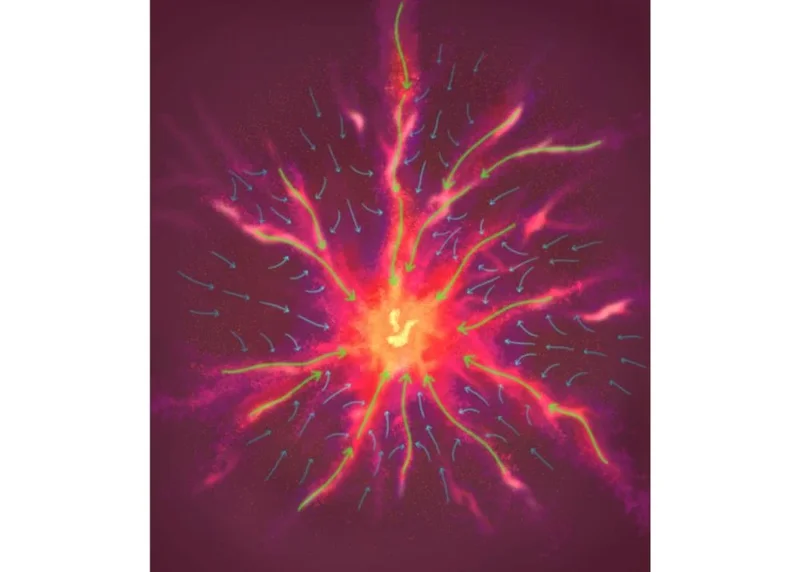
In stellar nurseries, star-forming gas flows along filaments into star formation hubs. Astronomers know that the filaments are made of dense gas and are responsible for delivering most of the gas to star-forming sites. But the regions in between the dense filaments also deliver gas, though it has a lower density in these regions. In this work, the researchers traced the movement of carbon monoxide with the Nobeyama 45 m radiotelescope to understand how gas flows in and around these filaments.
This figure from the research shows H2 column density (left) and dust temperature (right) in Monoceros R2 derived from Herschel data. The green box in the left panel indicates the observed region using the Nobeyama 45 m telescope. The white box in the left panel shows the same area shown in the image further along in this article. Black stars and cyan crosses in the left panel indicate the prestellar and protostellar cores. Image Credit: Hwang et al. 2026. ApJL.
"Although previous observational studies have demonstrated that the gas flowing along the filaments plays an important role in star formation in HFSs, it remains unclear whether the interfilament gas, which is less dense than the gas along the filaments, also flows toward the hub, and how the mass accretion rates along the filaments compare with those in interfilament regions," the researchers explain.
"Although the velocity structures along dense filaments have been studied, the gas kinematics in the low-density interfilament regions has not been investigated," they write.
The researchers measured two types of carbon monoxide in the Monoceros R2 HFS, 13CO (Carbon-13 monoxide) and C18O (Carbon monoxide with Oxygen-18). They're both rare isotopes, and 13CO traces low-density gas while C18O traces high-density gas. They found three dense filaments and three less dense interfilament regions, and measured the flow of gas toward the hub, and toward nearby filaments.
This figure from the study shows filaments (F) and interfilaments (IF) overlain on an H2 (molecular hydrogen, the main star-forming gas) column density map. "The filled contours indicate individual regions identified as C18O velocity-coherent structures tracing the Fs. The nonfilled contours correspond to the regions identified as 13CO velocity-coherent structures tracing the IFs," the authors write. A magenta star marks the location of IRS 1, an infrared source. The closest dotted white line marks the extent of the star forming hub, and the second dotted white line is the radial extent analyzed in this work. The green cross indicates a pre-stellar core. The three filaments and three interfilaments are also labelled. Image Credit: Hwang et al. 2026. ApJL.
The results show that gas flows along both the filaments and the inter-filaments (IF) toward the star formation hubs. The filament (F) gas flows faster than the interfilament (IF) gas. Some of the IF gas also flows into the filaments. "In addition, we find that at least 30% of the gas mass in the IFs may flow toward the Fs, replenishing the latter with new matter," the authors write.
âOur results indicate that understanding star formation requires accounting for the entire gas reservoir, not only that of the dense filaments,â Hwang explains. âFuture studies extending this analysis to additional hubâfilament systems and comparing the observations with numerical simulations will help determine how widespread these gas-flow patterns are.â
The study shows that both filaments and interfilaments in Monoceros R2 "shows dominant gas flows toward the hub", according to the authors, and that those flows play an important role in building up gas density in the hub, which drives star formation.
"We also detect significant mass flows across the IFs toward the dense Fs that could contribute to the growth of the dense Fs and the formation of cores within them," the authors conclude.