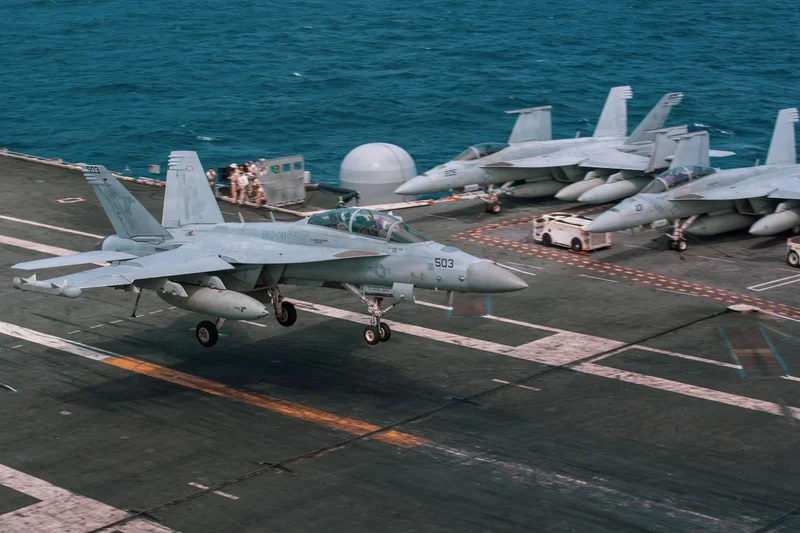
The United States Navy’s only forward-deployed nuclear-powered supercarrier reached a significant aviation milestone this month. After approximately 34 years of continuous service, USS George Washington (CVN-73) saw its 200,000th fixed-wing aircraft recovery while underway in the Indian Ocean on Tuesday, the U.S. Navy announced.
The warship, which is based in Yokosuka, Japan, the headquarters of the U.S. 7th Fleet, was dispatched last week to the Middle East to relieve the USS Abraham Lincoln (CVN-72).
CVN-73 is the flagship of the George Washington Carrier Strike Group, which also consists of Carrier Air Wing FIVE (CVW 5), the Ticonderoga-class guided-missile cruiser USS Robert Smalls (CG 62), and the Destroyer Squadron 15 (DESRON-15) Arleigh Burke-class guided-missile destroyer USS Shoup (DDG 86). Together, the flotilla forms the U.S. Navy’s largest and only forward-deployed carrier strike group.
Another Arleigh Burke-class destroyer assigned to the GWCSG, the USS Benfold (DDG-65), returned to Yokosuka earlier this month after suffering a power failure while operating in the South China Sea in July. It is unclear if the USS Benfold will rejoin the CSG in the Middle East.
The Recovery Mission
Fixed-wing aircraft recovery is a key mission of the U.S. Navy’s aircraft carriers, allowing the warships to function as mobile sea-based airbases for tactical power projection. It relies on special “arresting gear,” essentially a thick steel cross-deck wire stretched across the landing area, which catches an aircraft’s retractable tailhook in a high-precision maneuver known as a “trap.” It allows for rapid deceleration of the landing aircraft.
“For the George Washington, more than anything, it shows consistency over the last 34 years to be able to complete whatever mission the country calls upon it to do,” explained Lt. Steven Frazier, assigned to Strike Fighter Squadron 147, who made the 200,000th fixed-wing recovery in his Lockheed Martin F-35C Lightning II this week. “For me personally, it shows that if this aircraft carrier launches me off of the ship, I’ll be able to come back and land on it.”
According to the United States Navy, CVN-73 is capable of landing one aircraft on the deck per minute, and it typically conducts around 70 aircraft recoveries daily.
“I am immensely proud of every Sailor who has served aboard George Washington over the past 34 years,” said Captain Nicholas DeLeo, commander, USS George Washington. “The 200,000th trap belongs to the arresting gear teams, the yellow shirts, the maintainers, and every watch-stander who ensures this afloat airfield stays full mission-capable. Our ship continues to deliver combat power from the sea, and this milestone is proof that GW is ready for whatever the nation asks of us.”
As noted, the 200,000th recovery occurred as the warship is heading to the Middle East, a fact that serves as a reminder that the United States Navy’s nuclear-powered aircraft carriers can project power around the globe. During its nearly three and a half decades in service, the USS George Washington has recovered a range of fixed-wing aircraft, including the Grumman F-14 Tomcat, the McDonnell Douglas F/A-18C/D Hornet, the Boeing-made F/A-18E/F Super Hornet, the Boeing EA-18 Growler, the Grumman E-2 Hawkeye, and the F-35C Lightning II.
“Two hundred thousand traps is not just a number – it is a testament to the enduring strength of American naval aviation and the unmatching professionalism of the Sailors who make it possible,” said Rear Adm. Jeffrey L. Heames, commander, Carrier Strike Group 5 (CSG-5). “This milestone reminds the world that U.S. carriers remain ready to launch and recover aircraft anywhere, anytime, in defense of freedom and our allies.”
The Two Georges Are In The Arabian Sea
The USS George Washington entered the United States Central Command’s area of responsibility on Wednesday and is now operating in the Arabian Sea. The United States Navy hasn’t confirmed when CVN-72 will head home, but that could happen in the coming days. It will take around a month for the USS Abraham Lincoln and the rest of the CSG to reach the West Coast.
CVN-72 departed Naval Base San Diego, California, on November 21, 2025, and has been deployed for 273 days, spending 253 days without a port call, the current record for most days at sea since the early days of the COVID-19 pandemic, USNI News reported.
Even after the USS Abraham Lincoln departs the region, the U.S. Navy will maintain two carriers in the Middle East. The USS George H.W. Bush (CVN-77), the tenth and final Nimitz-class supercarrier, arrived in the Arabian Sea in April after departing from Naval Station Norfolk, Virginia, in late March.
Besides the Nimitz-class nuclear-powered carriers, the conventionally powered Wasp-class amphibious assault ship USS Boxer (LHD-4), along with the 11th Marine Expeditionary Unit, is also operating in the Middle East.