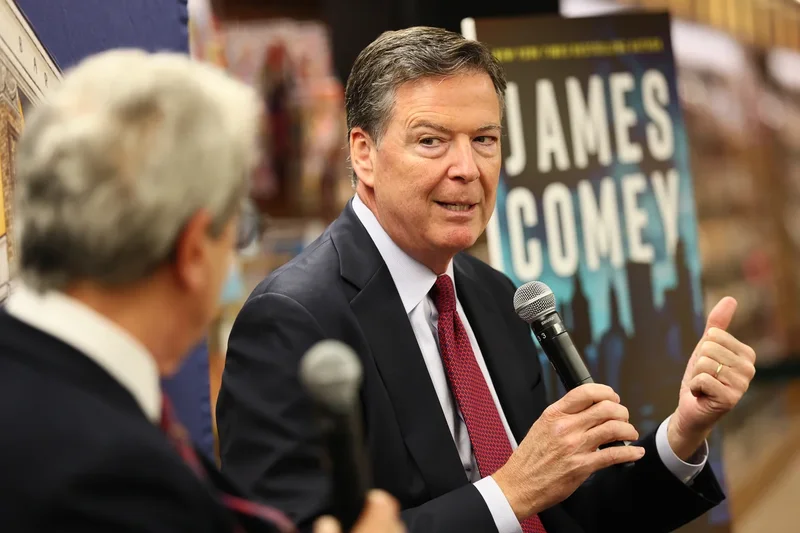
Prosecutors have cited former FBI Director James Comey’s own book to urge a federal judge not to dismiss criminal charges surrounding an “86 47” message they allege was used to threaten President Trump.
Comey, a longtime critic of the president, was fired by Trump during his first term. Comey was indicted April over a social media post showing seashells arranged into an “86 47” pattern.
“On May 15, 2025, a charismatic leader named James Comey, through the wonder of the internet, posted a coded message to his followers meaning “kill” or “get rid of” (a euphemism for “kill”) President Trump,” prosecutors claimed in a court filing earlier this week.
Comey, the court filing alleges, told the Secret Service that he had interpreted “86” to mean “ditch, dump or replace” and “47” to be a reference to the current president. Comey’s attorneys say he did not mean to threaten Trump, noting that the term “86” is used in restaurants by staff to indicate a menu item is no longer available. Trump is the 47th US president.
The new filing by prosecutors cites Comey’s novel, FDR Drive, noting that its antagonist is a popular far-right media personality who uses coded messages to his followers to kill an enemy.
An excerpt from the text, included in the filing, details one character explaining that: “It’s where a charismatic leader jacks people up but, through the wonder of the internet, avoids a direct connection to what comes next.”
“He knows an attack will follow his words, but he closes his eyes so he can say he wasn’t part of it,” the character adds.
Prosecutors say that the post was uploaded five days after FDR Drive was released.
Comey’s lawyers, in a filing in July, said that the phrase “86 47” is a “well-known political slogan that expresses opposition to the president.”
“No reasonable observer would understand the phrase ’86 47′ to connote violence at all,” a defense motion to dismiss said.
However, prosecutors allege that “86” has been used in news stories to describe killing. They also cite a “former mob boss” telling the FBI that “everybody knew” that “86” meant “kill.”
Comey has been indicted on two charges. The first being “knowingly and willfully making a threat to take the life of and to inflict bodily harm on the President of the United States.”
Comey has also been indicted for “knowingly and willfully transmitting in interstate commerce a threat to kill the President of the United States.” He denies all charges.
The July motion to dismiss from Comey’s defence team alleges that the indictment against the former FBI director “effectuates a yearslong campaign by the President to use the criminal process to punish Mr. Comey for his protected speech and because of the President’s deep-seated animosity.”
In their response on August 18, prosecutors said that Comey’s team have “not come close” to establishing “vindictive and selective prosecution.”
Comey’s connection with Trump dates back to before the now-president’s first term.
Comey, who had been appointed by former President Barack Obama, was fired by Trump, in part, over his handling of an investigation into former Secretary of State Hillary Clinton’s emails.
However, questions about the timing of the firing were quickly raised, given that Comey’s FBI was investigating possible collusion between Trump and Russian operatives.
Comey is one of several of Trump’s critics to become the targets of federal prosecution since the commander-in-chief returned to office, with both New York Attorney General Letitia James and Former National Security Advisor John Bolton being indicted on unrelated charges.
The case against James was dismissed late last year, as was an attempt to re-indict her.
Bolton, who was once a national security adviser to Trump, pleaded guilty to a single charge of willfully retaining national defense information.