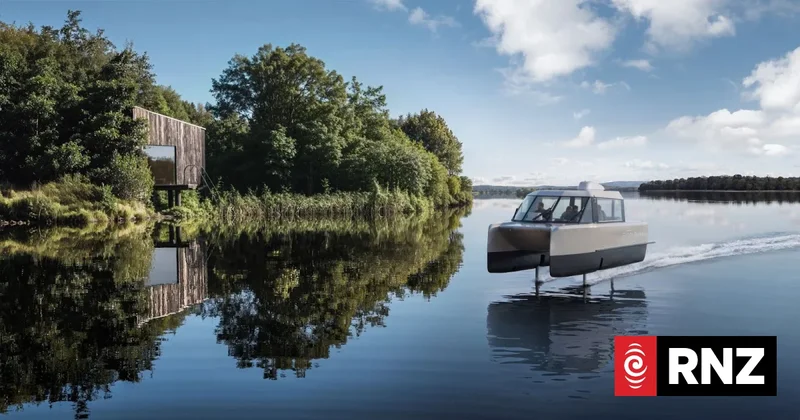
NZ marine tech company Vessev raises $32 million in funding for US expansion
A New Zealand marine tech company that makes electric hydrofoiling passenger boats has raised more than $30 million in investor funding and is expanding into the US.
Vessev co-founder and CEO Eric Laakmann said its first US customer, FlyTahoe in California, has purchased a number of boats that will be part of a zero-emission public transport service.
The VS-9 vessels can take 10 passengers and travel at 25 knots and up to 50 nautical miles with a light load.
They will be used in America's first electric hydrofoil "flying" ferry service across the lake, which aims to cut travel times, clear road traffic, and protect the lake's environment with zero-emission, wake-free transport.
Boats were "fundamentally inefficient" as they had to displace water in order to move and the hydrofoiling technology made marine vessels substantially more efficient, Laakmann said, which in turn enabled electrification.
"That's the big unlock here, you have more point-to-point transfers and you're not relying on larger vessels."
Vessev's electric hydrofoiling VS-9 vessels are also being trialled on Lake Whakatipu in Queenstown as a sustainable transport solution to ease highway congestion.
Laakmann said there were a lot of similarities between Lake Tahoe and Queenstown.
"Both are areas where a road system was developed around the lake, it's very difficult to expand it because of the way things have been built and those communities have been built up, built up, built up and now traffic and transportation has become a big headache for the folks that live and vacation there."
Vessev had raised $32.6m (US$19m) in Series A and follow-on financing. The investment round was led by Blackbird Ventures, with support from several other venture capital firms and existing investors.
Laakmann said the company had proven its product in order to secure more funding, which enabled further expansion and the development of bigger vessels.
Its first commercial vessel, a VS-9 went into service with Fullers in Auckland in 2025 and the company was building another vessel for Taupō Hydrofoil Tours, a venture that will run tourism services on the lake.
"We've put boats on the water, at this point they've been in commercial service, they've worked, they've been reliable and separately we've got a global pipeline filling up."
He said the benefit of smaller, hydrofoiling vessels, was that they could do more point-to-point transfers and were comfortable to travel on, regardless of size.
"When you look at this technology, you can use smaller, more agile vessels that are extremely efficient and extremely comfortable, just like a larger vessel might be."
The company now had 58 staff in Auckland and was ramping up production of the VS-9, with the aim of building a boat every five weeks by 2027.
"We have orders on four different continents. Most of our customers are fleet operators, so they want fleets of these vessels operating their local market to really augment existing transportation systems.
Laakmann said Australia was a particularly exciting market and the company had projects underway in Hobart, Perth and Sydney, with the vessels to be used as part of new transportation networks and the first boats due to be delivered into Australia next year.