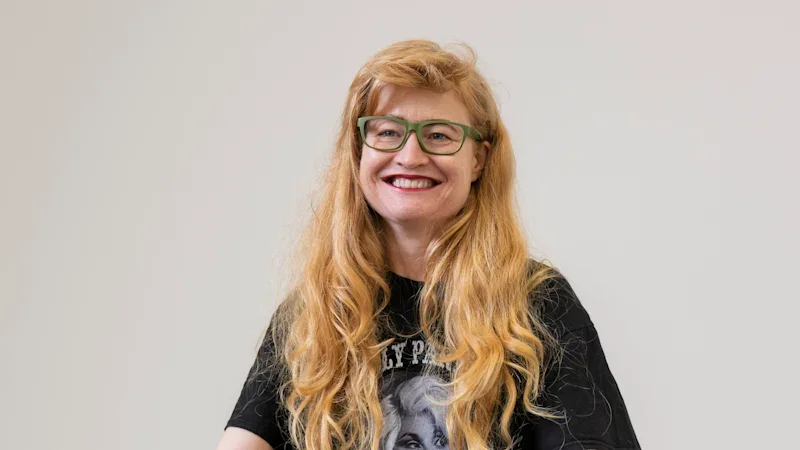
Each week, Benjamin Law asks public figures to discuss the subjects we’re told to keep private by getting them to roll a die. The numbers they land on are the topics they’re given. This week, he talks with Nell. The multi-award-winning artist, 51, works across painting, sculpture, video and performance, with permanent pieces at the National Gallery of Australia, National Portrait Gallery, MCA and MONA.
SEX
What was it like growing up queer in Maitland [in NSW’s Hunter Valley]? What characterised my sexuality in my youth in Maitland was repression. We only had two TV stations – the ABC and the local TV station – and there was no Triple J, no internet. So I started counting the days ’til I could leave Maitland and explore things, including my sexuality. Then I went to art school …
Always a hive of sexual degeneracy. Yeah! [Laughs] A place where you can be a wonderful weirdo. When I moved to Sydney in the early ’90s, I tried pretty hard to be straight, then tried pretty hard to be gay. But I just didn’t feel comfortable in either world. I remember going to Mardi Gras and – this is hard to say – hating the music, the drugs and the way people dressed. I thought, “Oh well, this mustn’t be for me.” Then I read that Quentin Crisp quote. Do you know it?
No, what is it? He says, “A lifetime of disco music is a high price to pay for one’s sexuality.” [
Laughs] That really hit because I was like: “I like ’50s rock ‘n’ roll and dresses.” It was confusing back then because it was very prescriptive: you were either gay or straight.
Very binary. Incredibly binary! So now, in my work, I’m always looking for a place where both things are true. I use the lightning bolt from AC/DC in my work [as] a personal symbol: it means in-between places, and bisexuality, in a way. It’s all there in my work.
Your partner is chef and cookbook author Kylie Kwong, whom you met at fellow artist Lindy Lee’s show in 2004. Did you find her sexy straight away? Yes. But I also had a boyfriend.
Scandalous! I did find her sexy straight away, but we didn’t get together for two years. Then, after living in Paris and Beijing, I emailed her when I got home: “I’ve broken up with my boyfriend; I’m totally around if you want to have dinner. And I think the universe wants us to be friends.”
POLITICS
Some people argue art exists to bring people together. Others argue its function is to provoke and engage in tough conversations. It’s both. It has to be.
Politics are about values. What values are you expressing in your work? So much of my work uses very familiar materials – clay or glass – and objects we encounter in our everyday life: windows or buckets, but with a smiley face carved in. Everyone knows what a smile is, or what a tear coming out of an eye means. You can’t unread that. It somehow cuts through politics, media, religion. I have made paintings with text from [her and Kwong’s late child] Lucky’s autopsy in it, with all these vessels, like little spirits. Many people reached out to say they felt the energy of a loved one or a deceased one, thanking me for putting these feelings out there. So it tends to be quite apolitical. It’s about human experience.
Can you be friends with people who do not share your politics? Absolutely.
**You were so quick with that reply! **
What do you mean? and high-net-worth individuals. All of them are really interesting and can hold very surprising values, despite coming from different classes. Democracy’s falling apart because it’s not black and white. So listen. There’s no two sides to anything.
MONEY
Let’s talk about how to make money as an artist. This reminds me: I made a watercolour painting when I was about 20 that said, “One Day I’ll Pay Tax Too.”
I love that that was your aspiration. Oh, I love paying tax! I know that’s bizarre, but I’ve earned the right to pay tax. And I’m grateful that I can now earn a living for myself and contribute.
How have you made your artistic career financially sustainable? I’m not going to lie; it wasn’t easy. I was really fortunate that when I was at art school, I worked for Lindy Lee as her studio assistant, and I got to see the full breadth of what an artist’s life was like: from making artworks to putting receipts in envelopes and helping her organise them. So I knew it was possible to be a professional artist; I had a really great example who wasn’t the cliché of the drunk artist. She was spiritually aware, super-fit – she gets up early, meditates, goes for a swim and spends all day in her studio – and really committed. And I was like, “I want to be that.”
What’s the poorest you’ve been? When I had my accountant ring my gallery and say, “What is Nell eating?” Because, basically, 95 per cent of my income, I’d spend on materials.
What were you eating? Porridge – sometimes for breakfast, lunch and dinner. Or I did the thing where you’d meet people for dinner and say, “Sorry, I’ve already eaten.” But I’m very grateful that I didn’t have that kind of immediate, runaway, financial success because it can really damage people. You become known for one thing, then everyone wants that thing. Whereas I’ve had more flexibility and freedom, and could be more clear about my motivations.
Which are? To understand myself and my place in the world. Not to just sell and have social cachet. I love selling my work – if you’re a singer, you want people to hear your song – and there were times I was desperate for it, but the original intention was to meet people and have broader experiences. And I’ve always been rich in my friendships.
Nell’s new work for Sydney’s Museum of Contemporary Art’s Loti Smorgon Sculpture Terrace opens August 26.
Read more from Good Weekend: