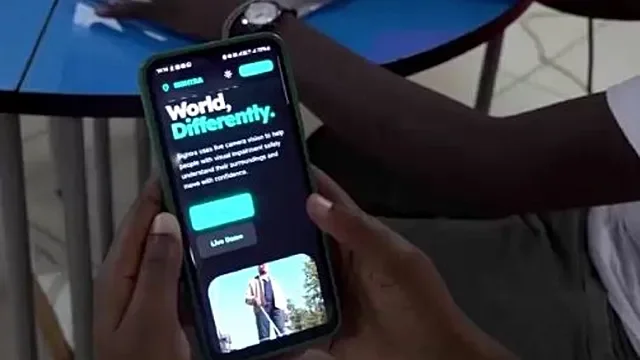
For lawyer Julius Mbura, getting from a car park into his Nairobi firm's office can mean working around parked cars, narrow gaps, trees, furniture and ground that changes underfoot.
Mbura is a lawyer with a visual impairment.
He uses a cane to read the space closest to him, while a phone tool gives him more information about what lies further ahead.
The app is called Sightra.
As Mbura walks, it gives audio descriptions in real time, adding spoken guidance to the physical feedback from his cane.
The tech doesn't replace the cane, but gives people with visual impairments another way to understand obstacles before they reach them.
Mbura says: "This app will be critical and very important for blind people. Like for me, I have used it to navigate to the office and the audio description in real time is helpful for me to know where the obstacles are and how to evade walking into cars, walking into trees and I feel like there is a lot of potential. In essence the Sightra web app becomes your guide for navigation aside from my mobility cane, this has come in handy. I feel like we need to refine more on the accuracy and description but overall this is a good start."
Mbura’s working day carries on inside the office, where daily movement involves judging furniture, desks, corridors and people using the same space.
Knowing what's nearby, what's directly ahead and how to move without relying only on memory or help from others can shape how independently someone gets around.
Sightra is being developed by Kenyan founders Ruth Nzuki and Brian Gillo as an assistive navigation system for people with visual impairments.
It runs as a web app, so users can access it through a phone rather than a separate specialist device.
The system uses AI powered object detection to identify obstacles in the user’s path and send that information as speech through an earpiece.
GPS helps guide users from a starting point to a destination.
Ruth Nzuki, co-founder of Sightra, says: "Sightra is a safe navigation solution for the visually impaired. It makes use of a web app that has AI powered real time obstacle awareness and object detection. So, as a user walks they are able to identify objects and obstacles along the way so the web app is able to do that and that information is relayed to them in real time through an earpiece. It also makes use of GPS for routing the users to guide them from the starting point to the end point."
A navigation tool in Nairobi has to deal with infrastructure that can be uneven, crowded and unpredictable.
Roads and walking routes can include open drains, missing kerbs, broken surfaces, informal crossings, parked vehicles and sudden obstacles.
That can be difficult enough for sighted pedestrians, and much harder for someone with vision loss.
The developers say local training matters because a model tested mainly on smoother roads or more predictable pavements might not understand the objects and layouts a user is likely to meet in Kenya.
Nzuki says: "What makes Sightra unique is that our AI models have been familiarised with the African infrastructure. So all the testing that we have done for our computer vision models are familiarised with Nairobi roads, Kenyan roads (and) infrastructure. So, the model is very much locally made so it is made for the African infrastructure. Secondly is the technology that we use. While other smart cane solutions or other solutions for the visually impaired make use of haptic feedback or vibrations or special awareness, what makes Sightra unique is that the user is able to know exactly what is ahead of them in their path, so the real time AI obstacle awareness is able to relay this information to the user in real time in a way that haptic feedback and vibrations will not be able to communicate that to the user."
Kenya’s 2022 Demographic and Health Survey reported that about 2% of people aged five and above had some difficulty seeing.
Assistive technology can help, but only if it’s reliable enough for daily movement and affordable enough for the people expected to use it.
Nzuki says: "Currently we have partnerships with visually impaired schools and also individual users who have tested and used Sightra. We have a subscription based model for the web app which is $100 (USD) for the year but for the first six months it is free to use."
The technology is being tested in an environment that still leaves many people with disabilities having to adapt to public spaces, rather than public spaces being designed around them.
Leonard Dawafula, chief disability services officer at Kenya’s National Council for Persons with Disabilities, says roads, buildings and other infrastructure remain difficult for people with disabilities.
Leonard Dawafula, chief disability services officer, National Council for Persons with Disabilities, says: "Our physical environment especially built environment the likes our roads, our infrastructure, our buildings are not accessible to persons living with disabilities. So with this kind of innovation, it enables persons with visual impairment to be able to understand the obstacles around the environment that we have. Our roads are not as good as the ones that they have in the developed world (meaning developed countries). So this technology is the way to go. However, just like any other innovation there is a lot that needs to be done to make it better such that persons with visual impairment are able to understand the environment around them. We need more work to be done to it; to fine tune it to be better."
It's hoped tech like this will give people like Mbura a new layer of information about the spaces around them, and more control over how they move.