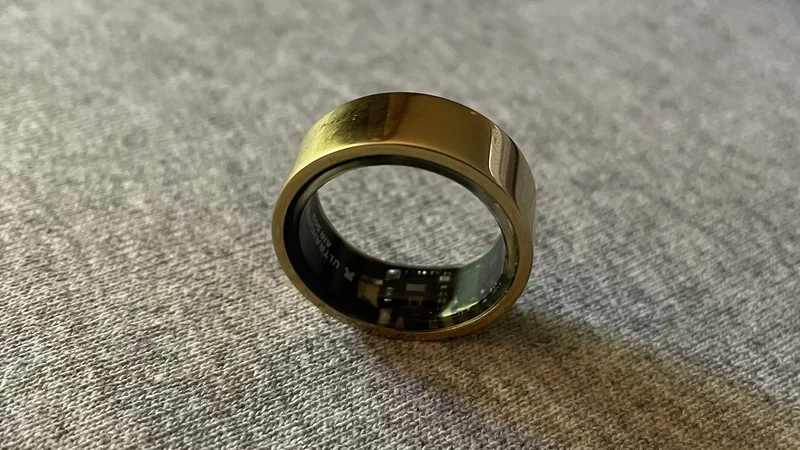
When I first reviewed an Ultrahuman ring (the Ring Air, last year), I wrote that my biggest complaint was that I found the app overbearing. To give an example of but one of the things that annoyed me about it, it scored me on a metric called “brain waste clearance,” as if that is something it could measure or that I could affect. But a new version of the app—Ultrahuman is calling it the Emerald Update—changes everything.
I’ve been using a beta version of this new app as I test the forthcoming Ring Pro, and so far, I'm impressed: It's now easier to navigate, and presents the data from my ring in a way that’s actually useful and easy to read.
Important information and actions are presented first
The first time I open the new Ultrahuman app each day, I see a screen that gives a small amount of information—just the important stuff—about how I slept and how my day is shaping up. For example, today it says my sleep is improving, my resting heart rate is normal, and my temperature is “borderline” (a little higher than usual). It tells me I only got six hours of sleep. That’s pretty much everything I want to know when I check the app early in the day.
On the home screen (what I see after I dismiss that initial greeting), the Ultrahuman app now distills its firehose of data into a few “next best actions.” The top one for me right now is to get up and move, since I’ve been pretty sedentary today. If I tap to see more, the next recommendation is to set an alarm to start my bedtime routine, since my bedtime has been inconsistent. These recommendations are actually pretty useful!
The app is easier to navigate
The old Ultrahuman app had tabs at the bottom of the screen, but most of them were useless unless you had purchased specific Ultrahuman products (blood testing, glucose monitors, or a home air quality monitor). Now, there are five tabs: the ring tab, with all my main data screens; “longevity,” which gives me an “ultra age” showing how fast I am supposedly aging according to my habits; Jade, which I’ll say more about in a minute; PowerPlugs, where you can choose add-ons that give you extra features (some free, some subscription-based); and “zones,” a social feature (a zone is apparently something like a group or club).
I find the longevity tab useful for longer-term metrics. I don’t put much stock in its exact longevity number (what does it mean to be two years older than I am?), but this tab also shows my estimated VO2max, along with a note explaining a recent algorithm update. As I scroll down, I can see some recommendations for “slow[ing] my aging,” which amount to advice for long-term health—mine is that I need to tackle my sleep debt (I also have low “blood flow smoothness,” apparently). The app’s mystifying ways haven’t disappeared entirely; they’re just a little further from the surface.
“Jade” houses an AI chatbot that I honestly try to interact with as little as possible. The card telling me about my blood flow smoothness suggested that I ask Jade what this means and how to improve it. I tapped the button to do so, and Jade told me it doesn’t know what blood flow smoothness is. This part seems to need some more work.
Circadian windows are easier to read
In the old version of the app, I was constantly being told when and when not to consume caffeine. This is still a big part of the app, though you can disable it by uninstalling the free caffeine PowerPlug that is on by default. Now, however, the app shows me my “active windows” at any given time. Right now, it's the afternoon, and the app tells me it’s fine to have caffeine, that sunlight and exercise won’t affect my sleep timing, and that it’s OK to look at screens. Later this evening, the caffeine window will close, and later, my screen time window will close.
The app doesn’t do a great job of explaining these windows, however. What exactly will happen when “phase delay window” starts? But I do like that there’s now a view that shows all three timelines in parallel, labeled with different times. That’s not to say I trust the underlying decisions any more—I’m still definitely going to stop having caffeine well before 6 p.m., but I also know the evidence doesn’t actually support skipping my morning coffee.
What this update means for those wearing Ultrahuman ring
Overall, I’ve found the experience of using the ring a lot more pleasant alongside the new app redesign. Ultrahuman says that data processing now happens on-device, so you don’t need an internet connection to get your metrics and recommendations. I’m still working my way through the app’s features as I test the Ring Pro, but I’m looking forward to the improved heart rate accuracy and the ability to use data from Garmin and other devices for workouts. There’s even a feature to “train your ring” by using it alongside another device. Sometimes, change is good.