Your support helps us to tell the story
From reproductive rights to climate change to Big Tech, The Independent is on the ground when the story is developing. Whether it's investigating the financials of Elon Musk's pro-Trump PAC or producing our latest documentary, 'The A Word', which shines a light on the American women fighting for reproductive rights, we know how important it is to parse out the facts from the messaging.
At such a critical moment in US history, we need reporters on the ground. Your donation allows us to keep sending journalists to speak to both sides of the story.
The Independent is trusted by Americans across the entire political spectrum. And unlike many other quality news outlets, we choose not to lock Americans out of our reporting and analysis with paywalls. We believe quality journalism should be available to everyone, paid for by those who can afford it.
Your support makes all the difference.
Read more
An Australian woman has given birth to identical quadruplet girls after a pregnancy doctors described as incredibly rare.
Jenitar Sau Na’amoana, who is 34 years old and already had four children, delivered the babies last week at Royal Brisbane and Women’s Hospital in Queensland state.
“We are very excited to be able to care for this amazing little family, a big family now,” Dr. Alexa Bendall, a maternal fetal medicine specialist who cared for Na’amoana, said in an interview released by the hospital.
The babies were conceived naturally and came from one fertilized egg that split into four, “which was incredible," Bendall said.
“We think the figures are probably around 1 in 15 million for a case like this to be spontaneously conceived,” she said. “We don’t think it’s ever happened in Australia.”
Overall, experts say, the chance of conceiving quadruplets naturally is only 1 in 700,000; most are conceived with the assistance of medical technology.
Hospital officials said Na’amoana and her husband, Jortham, hadn’t planned to have more children and were quite surprised when she became pregnant with the quadruplets.
Na’amoana faced a high risk of complications, especially given the fetuses shared one placenta. In general, being pregnant with any multiple fetuses puts a mom at increased risk for problems such as preterm birth, miscarriage and birth defects, according to Johns Hopkins Medicine.
Na’amoana was monitored by a large medical team at the hospital since 10 weeks gestation and was admitted as an inpatient at 25 weeks so she could be monitored, hospital officials said. She delivered the babies by cesarean section on July 14.
“The fact that we’ve got four beautiful, healthy babies born at 28 weeks and four days is incredible,” Bendall said. "Mum did lose a little bit of blood but not an excessive amount for having quads, and she’s doing well.”
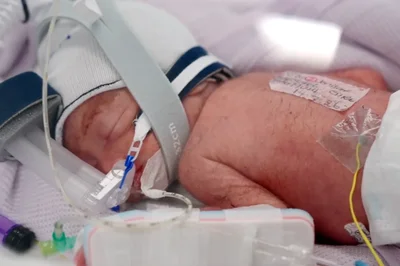
The babies are doing well in the neonatal intensive care unit. Their names are Emily, Harriet, Catherine and Alexa, in honor of Bendall. The doctor called the name a “beautiful tribute,” and said she feels privileged to have helped bring these children into the world.
“From an academic perspective, it’s really interesting,” she said. “But also from a human perspective, to be able to be part of the family’s journey and come out with four beautiful babies and a healthy mum is very precious.”
___
The Associated Press Health and Science Department receives support from the Howard Hughes Medical Institute’s Department of Science Education and the Robert Wood Johnson Foundation. The AP is solely responsible for all content.