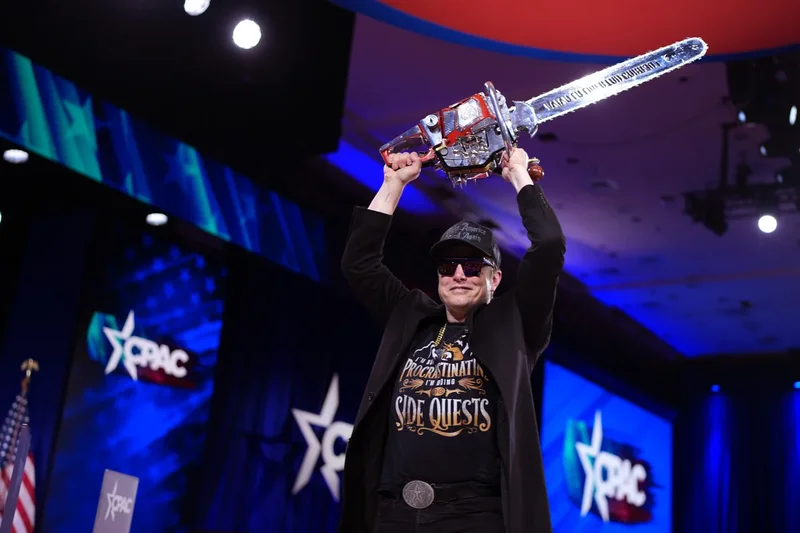
Elon Musk admits he “got carried away” working inside Donald Trump’s administration as the unelected director of the so-called Department of Government Efficiency, where he implemented mass firings and radically cut federal spending.
“I think I got a little too involved in politics. I got carried away, frankly,” he told The Economist in a wide-ranging interview published Thursday, but offered few specifics on what he regretted.
But the world’s wealthiest man — who pumped millions of dollars into Trump’s campaign before he was deputized to oversee the president’s brutal cost-cutting operation — defended the work of DOGE and his dismantling of the nation’s global aid agency that he once promised to put through a “wood chipper.”
“We need to sort of take a close look at spending and make sure that money is being spent in sensible ways and that it is not wasted or spent on fraudulent activities. And I got a lot of flack for this, obviously,” he said.
Musk smiled as he repeatedly claimed “zero” people died as a result of DOGE cuts to the U.S. Agency for International Development. Public health researchers have determined that potentially hundreds of thousands of people, mostly children, have died from infectious diseases and malnutrition that could have been prevented by treatments and vaccines previously supported by USAID funding.
A recent analysis published in The Lancet estimated that USAID assistance saved 92 million lives over two decades.
Musk called USAID “a political organization” and “the biggest funder of regime change.”
“How many NGOs are there that could step in?” he told The Economist. “These claims are false. They’re nonsense, absolute nonsense.”
The decades-old USAID supported life-saving projects abroad as part of its expansive mandate, from combatting HIV/AIDS and containing Ebola outbreaks to staffing field hospitals in war-torn regions. Musk previously called the agency a “criminal organization” and a “radical-left political psy op.”
“When funding is stopped for a fraudulent organization, or for something, do you think they’re going to say, ‘please keep funding the fraud,’ or do you think they’re going to come up with a sad story that sounds sympathetic in order to get the funding restored? Obviously it will be the latter, and that’s exactly what they did,” he told The Economist. “But zero died because of DOGE.”
He suggested that other groups including the Gates Foundation and MacKenzie Scott’s Yield Giving are “equally responsible” for the consequences of USAID cuts because they also did not step in to fill funding gaps.
DOGE shut down July 4 after a chaotic 18-month run and an avalanche of lawsuits that accused the agency of politically motivated and unconstitutional abuse.g
Trump established the agency by executive order on his first day in office. Through the U.S. DOGE Service — which Trump repurposed from the government’s in-house tech team U.S. Government Service — Musk intended to find “waste, fraud and abuse” in the federal government.
In the months that followed, more than 272,000 federal employees were forced out, including nearly 140,000 workers who agreed to leave the government through a deferred resignation program.
DOGE staffers also cut millions of dollars in grants and funding for health research, arts and other projects — largely based on their uninformed judgments about their scope and whether they are considered “DEI” — while hollowing out the Social Security Administration and other essential services.
Still, Musk appears unlikely to relinquish his role as a political lightning rod, coming to the defense of Europe’s far-right and amplifying political views that The Economist labels “plainly bigoted.”
Elsewhere in the interview, he described European far-right factions as misunderstood “normal people” who want safe cities, secure borders and sensible spending, according to The Economist. Asked whether he is anti-Muslim, he said, “I’m against rape and murder.”
“I’m against the imposition of rules and laws that are contrary to what we’ve come to accept in the West,” he said. “It’s a crying shame that traditional media, like you, don’t recognize this.”