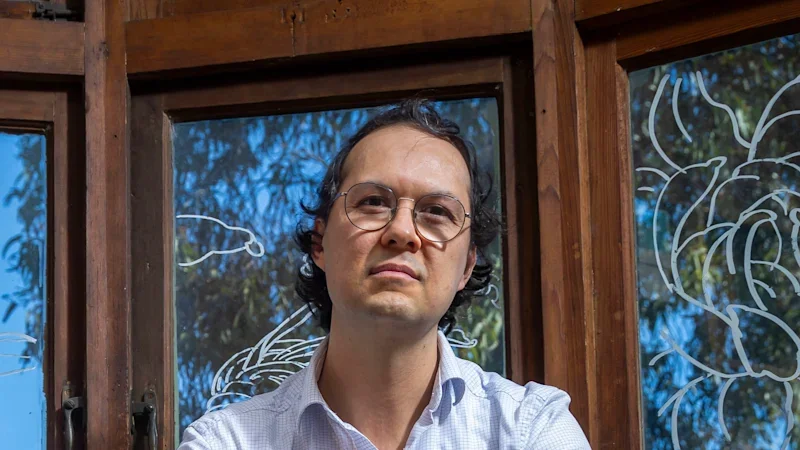
Long before Zeno Sworder’s Once I Was a Giant was named Australia’s picture book of the year, it faced its toughest judging panel.
Sworder, who works on his intricate children’s books at night after his family has gone to bed, showed a rough version to his daughters when they were about six and 11. Their reaction convinced the Melbourne-based author and illustrator to continue with his tale of a tree whose wood is turned into a pencil and then tells the story of its life.
“I think it moved them. That gave me the personal connection to it, and so a year and a half of actually making the book properly was just about doing something that would live up to what they saw in their imagination that had its impact on them,” Sworder said.
“To have the passion, the drive, to give up all of those nighttimes. It has to be something that I feel really strongly about and if I know it’s something they will enjoy and something they will potentially be able to share with their children, then that just gives me the motivation to power through a whole book.”
On Friday, Once I Was a Giant was named picture book of the year at the Children’s Book Council of Australia’s (CBCA) 80th annual awards, one of six major prizes announced at the State Library of NSW.
The award continues an extraordinary year for Sworder’s third picture book – recommended for readers seven years and older – which has already won the Australian Book Industry Awards’ overall book of the year and children’s picture book of the year, as well as the Victorian Premier’s Literary Award for children’s literature.
Growing up in Bendigo, Sworder spent much of his time outdoors, climbing a tree that he talked to and believed could listen to him. Years later, as protests over native forest logging unfolded and scientific discoveries revealed more about the ways trees interact through their root systems, he began thinking about telling a story from a tree’s perspective. The resulting book became an emotional project for Sworder, who said he sometimes found himself crying while drawing.
“Once you’re actually drawing a forest and you’re inhabiting that space, you don’t really want to leave,” he said. “This book in particular was really joyful to draw because there was this sense that I was stepping away from the studio or stepping away from this world and spending time somewhere else.”
Other winners included former teacher Barry Jonsberg, who took the older readers prize for his novel exploring masculinity, Darkest Night, Brightest Star, while Karen Wasson and illustrator Jake A. Minton claimed the younger readers category for Inked, the bestselling graphic novel about a talking octopus. Rae Tan’s The Emperor’s Egg, based on an ancient Chinese folktale about honesty, won the early childhood prize; Stephanie Owen Reeder and Ingrid Bartkowiak’s Peculiar Parents, about family diversity in the animal world, took the Eve Pownall Award for factual works. Eisner Award-winning cartoonist and journalist Eleri Harris was named new illustrator of the year for her debut children’s book, A Loo of One’s Own.
Children and young adults were also given the chance to “shadow judge” the shortlisted books. Their winners included Margot McGovern’s feminist horror novel This Stays Between Us, Jo Dabrowski and Cate James’ picture book Dear Broccoli, Renee Treml’s non-fiction graphic novel The Thylacine and the Time Machine, Sarah Armstrong’s middle-grade novel Run and Anne Donaldson and Matt Shanks’ picture book Derek.
CBCA board chair Jo Panckridge said identity and belonging, First Nations voices and environmental themes were key features of this year’s entries, reflecting how much Australian children’s literature had changed since the awards started in 1946.
“Today’s books reflect a much broader Australia. Readers encounter stories from a wide range of cultural backgrounds, family structures and lived experiences, alongside stronger representation of First Nations perspectives and contemporary social issues,” she said.
“The forms of storytelling have expanded too, from traditional novels and books with realistic or gently stylised illustrations to dynamically designed picture books, graphic novels, verse novels and richly illustrated non-fiction.”
Sworder has not yet returned to the tree that helped inspire his book. While making Once I Was a Giant, he tracked it down on Google Maps, only to discover the tree he remembered as enormous was a “miserable, shrivelled little thing” he had initially passed straight over. He hopes one day to return and see it in person, to tell it all about how the boy who once climbed its branches grew up to write an award-winning book about the secret life of a tree.
What else is happening in the book world?
- This is the email many authors dream of getting – but beware, it could be a trap
- Artist Tom Carment reflects on five decades of friendship with the late Robert Gray
- Novelist Richard Flanagan opens up about his early-onset dementia misdiagnosis
- A 3000-year-old poem is suddenly back on the bestseller list. Here’s why