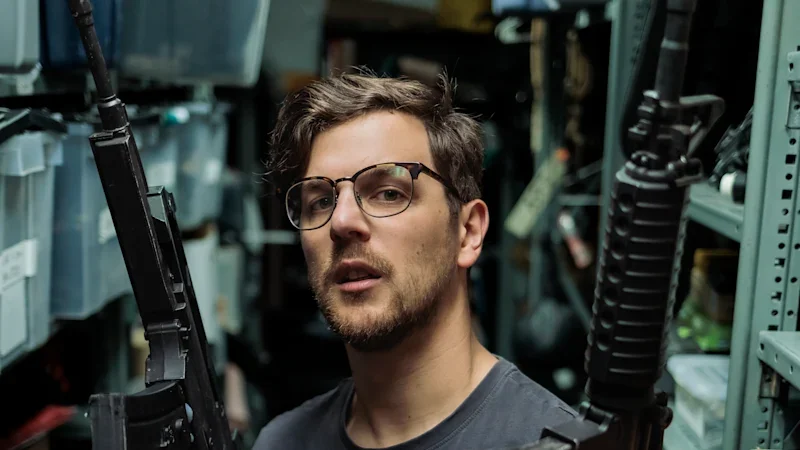
If Anthony Frith had realised just how easy it was to break into the movie business, he might have started sooner.
He’d been aware of The Asylum, the LA-based churn factory best known for Sharknado, since picking up a three-pack of DVDs from The Reject Shop in Adelaide and bingeing the cheap blockbuster knockoffs with a bunch of mates in a single sitting.
“I was like, ‘holy crap, this is amazing’,” he says of the triple bill — Triassic World, 30,000 Leagues Under the Sea and I Am Omega. “I just fell in love.”
Flash forward a decade to 2023, and Frith decided to take a punt and email David Latt, one of the founders of The Asylum. Ostensibly, saying he had an idea he wanted to discuss; in truth, he wanted to ask if he could direct one of these cheap-and-nasty knockoffs himself.
As it happens, such chutzpah was exactly what The Asylum trades on. “It took about three minutes on a Zoom for me to land my deal with them,” says Frith, laughing at the memory.
The tyro Australian director wasn’t an obvious choice to helm a feature film, no matter how shameless a rip-off it was. Sure, he had a couple of filmmaking courses under his belt, but other than some mucking-about-with-mates efforts, his screen credits extended to a bunch of corporate promos (including one for his parents’ industrial cleaning business). If he was the next Martin Scorsese, there was little evidence to show it.
Frith, who is now 36, didn’t come to the table entirely empty-handed, though. He was proposing to make a documentary about the making of an Asylum movie too.
“It was part of the same conversation, but they weren’t linked,” Frith explains. “I asked for the film first, and they were going to let me do it regardless, and then the documentary came. As far as I know, I’m the first person to get a deal just by asking for it.”
Given The Asylum has turned out something like 350 movies, it’s a little surprising no one had pitched a making-of project before. So, how did Latt respond to the idea?
“He thought it was hilarious. He’s like, ‘yeah, sure; we’re going to make the film anyway, so you might as well have your documentary’.”
Frith was a quietly spoken fellow, with a wife and a one-year-old at home in a brick-veneer house in Adelaide, when he embarked on the madcap adventure that has given him not one but two directing credits, the feature film The Land That Time Forgot (based on the 1918 novel by Tarzan author Edgar Rice Burroughs, which is in the public domain and royalty-free, and hence exactly the sort of material The Asylum laps up) and Mockbuster, his documentary about the making of that film.
But there’s obviously a tenacious streak beneath the mild-mannered facade; to actually make the doc he pitched in that two-for-the-price-of-one Zoom would take another couple of years, as he went through the far more traditional process (in this country) of applying for and securing the finance (Screen Australia was the principal investor) that would enable him to develop and shoot it.
Without the doc to complicate matters, he says, his Hollywood paymasters “would have sent the script, and I would have been on my way immediately. But they held fire for the sake of the doco.”
Actually, paymasters is a pretty loose term in the circumstances. As we see in Mockbuster (henceforth the documentary), the total budget for The Land That Time Forgot (which we will rather generously call “the movie”) was about $US73,000 (around $130,000). His fee? About the price of a return airfare to LA.
In the documentary, which cost about 10 times as much to make as the movie, Frith flies to Los Angeles twice, first to meet the Asylum team (the meeting in which he pitched his documentary idea was recreated for the camera because, Frith confesses, he forgot to record it, “which was so stupid of me in retrospect”) and then to oversee some additional scenes for the movie.
Both times he paid his own way (well, to be more precise, the travel costs for him and his small crew came from the documentary’s budget).
The bulk of both productions were shot in and around Adelaide. Not that you’d necessarily know that from the finished movie. As The Land That Time Forgot opens, the camera is flying high above a mountainous and lush tropical island (at a guess, it’s Hawaii) rather than the flat coastal landscape of the South Australian capital. It’s amazing what you can do with a stock footage library.
When Frith had his ducks in a row for the documentary, The Asylum told him what he’d be shooting. Production would start in three weeks. He’d get the script in two. No cast or crew or locations were in place, but he should start planning on the basis of the one-page outline with which he flew home from LA. Your time starts … now!
“It’s wild, it’s crazy,” he says of the timeline. “This wasn’t an instance of them letting things slide, that’s just what they do, it’s how they function as a company.”
He needed an experienced local producer on board to make it happen, but it was impossible to convince anyone that the gig was real, or doable – especially once they saw the budget.
“A lot of people thought the film was a prank, no one really wanted to commit, there were concerns about what it would do for people’s companies and reputations,” he says. “The Asylum was kind of an unknown quantity to a lot of people, so there was a lot of fear around it, and fear of it being this Candid Camera sort of joke.”
Making one movie this way would be stressful enough. But Frith was making two at the same time. He tried his best to keep them discrete, but it was a challenge. “I was mic’d up and the documentary crew had in-ear monitors, so I could talk to them but they couldn’t talk to me. I just had to whisper into the wind and hope they heard me.”
The film crew knew the doco was being shot, of course. “But I didn’t want people to be like characters or playing it up. I wanted it to feel observational, I wanted to capture that part of it quite realistically.”
In truth, though his influences include the mockumentary films of Christopher Guest, there was little need for Frith to contrive anything for the sake of a laugh. Making a move for The Asylum is inherently an exercise in insanity. From the day he got that one-pager to the first time he saw the finished movie on a big screen was, he says, about six weeks. The six-day shoot was intense but, he says, “I’m glad because any more and my brain would have melted into mush”.
Having been through it once, would he check himself into The Asylum again?
He ponders the question. “I had full-on anxiety attacks the whole production. I had ulcers from the stress, and during pre-production there was a moment where we thought it was dead,” he says. “But maybe I’ll get the itch and beg for another job.
“I would probably do a shark film if they offered me one,” he adds. “It feels right to do a shark film in Australia. We’ll see what happens.”
Mockbuster is in cinemas from August 27.