Editor's note:Wang Jin is the director of the Center for Strategic Studies at Northwest University, a special researcher for Beijing Club for International Dialogue and an expert on the Middle East. The article reflects the author's opinions and not necessarily the views of CGTN.
Tensions between the United States and Iran have remained high in recent months. The United States has not only continued to exert significant pressure on Iran and sought to maintain a prolonged state of military confrontation with Tehran, but has also gradually intensified economic sanctions and pressure in an effort to compel Iran to make concessions.
Recent statements by the Trump administration indicate that the strategic confrontation between the United States and Iran is becoming increasingly protracted. This ongoing rivalry is also likely to contribute to profound changes in the geopolitical landscape of the Middle East.
**Military means alone not enough to compel Iran **
Although the US has maintained a relatively low-profile posture towards Iran, the methods through which it exerts pressure on Tehran are quietly changing. After nearly half a year of intense conflict and confrontation, the United States has gradually recognized that military means alone are insufficient to force the Iranian government to change course or compel Iran to make major concessions on key issues such as the nuclear issue and the Strait of Hormuz. It is increasingly difficult for Washington to achieve its strategic objectives solely through military means.
At the same time, the US is unlikely to sustain indefinitely the high costs associated with maintaining military operations around Iran. The US carrier strike groups deployed in the vicinity of Iran have already experienced extended operational deployments, while US inventories of air-defense missiles have been significantly depleted, potentially limiting Washington's ability to sustain a high-intensity war over an extended period.
Meanwhile, Iranian attacks on US military bases in the Middle East, together with Iran's blockade of the Strait of Hormuz, have caused the regional conflict to expand and escalate rapidly.
Vessels are seen in the Strait of Hormuz, off the port city of Bandar Abbas in southern Iran, August 10, 2026. /VCG
These developments have not only caused further disruption to the global economy but have also affected the US economy itself. Against this backdrop, the US and its Middle Eastern allies can no longer rely solely on military means to achieve their strategic objectives. They therefore need to seek new approaches and instruments to maintain and increase pressure on Iran.
**Economic pressure **
The United States' economic pressure on Iran is being implemented primarily in two ways.
First, Washington is expected to maintain its maritime blockade and continue deploying carrier strike groups and naval forces around Iran, sustaining pressure on Iranian ports and maritime transportation while strengthening efforts to intercept vessels traveling to or associated with Iran. The objective is to weaken Iran's overseas trade networks as much as possible.
Second, the US is gradually advancing a new round of sanctions against Iran, expanding the scope of sanctions targeting Iranian individuals and institutions while further strengthening oversight of Iran's foreign trade and energy transactions. These measures are intended to constrain Iran's external economic activities as much as possible and maintain sustained economic pressure on Tehran.
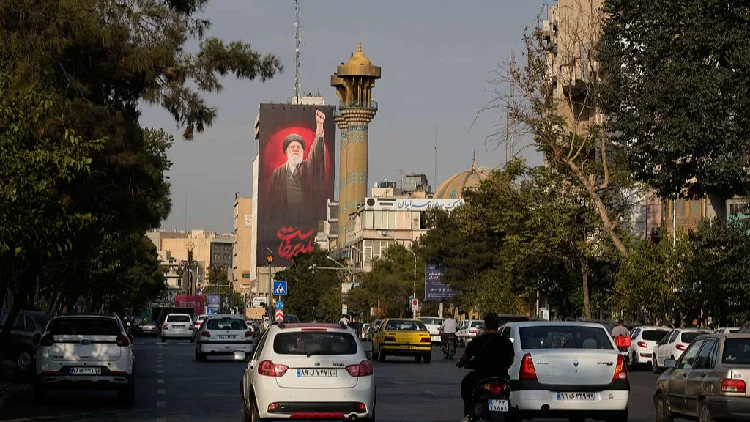
A billboard bearing a message in Farsi that reads "We must rise up" and an image of late Iranian Supreme Leader Ayatollah Ali Khamenei towers over downtown traffic in Tehran, Iran, August 15, 2026. /VCG
Will the US achieve its intended objectives?
However, considerable uncertainty remains over whether US economic pressure on Iran will fully achieve its intended objectives.
On the one hand, US sanctions and economic restrictions against Iran have continued for decades. In particular, following the unilateral US withdrawal from the Iran nuclear agreement in 2018, American economic sanctions caused significant economic and social difficulties in Iran and contributed on several occasions to heightened domestic political and social tensions.
Nevertheless, against the backdrop of continued US military strikes against Iran, domestic support for the Iranian government has increased to some extent. Moreover, the economic difficulties caused by long-term sanctions have not completely destroyed Iran's economic foundations or disrupted the basic functioning of Iranian society. Therefore, even if the United States further intensifies economic pressure, it may still be difficult to compel Iran to make major concessions in the short term. Iran retains a certain capacity to withstand and respond to external economic sanctions.
On the other hand, Iran is actively developing alternative trade routes. In particular, following the outbreak of the conflict at the end of February this year, Iran has made greater use of overland transportation networks through Iraq, Pakistan, Central Asian countries and Russia, seeking to establish more diversified channels for external trade. These trade networks have, to some extent, helped maintain Iran's economic links with the outside world while making it more difficult for the US to completely sever Iran's external trade and economic activities. Against this backdrop, Washington's attempt to completely cut Iran off from international trade through sanctions and economic restrictions is unlikely to be fully successful.
The United States' economic pressure on Iran reflects its growing recognition that military means alone are unlikely to achieve its strategic objectives. Washington is therefore relying more heavily on economic instruments in an effort to reduce the likelihood of future direct military confrontation while maintaining comprehensive pressure on Iran and preserving the domestic political standing of the US government.
Nevertheless, neither military pressure nor economic pressure is likely to force Iran to make major concessions in the short term. Continued US pressure on Iran is unlikely to fundamentally resolve the region's security problems and may instead leave the United States locked in a prolonged confrontation with Iran, increasing the strategic and economic costs of its Middle East policy.