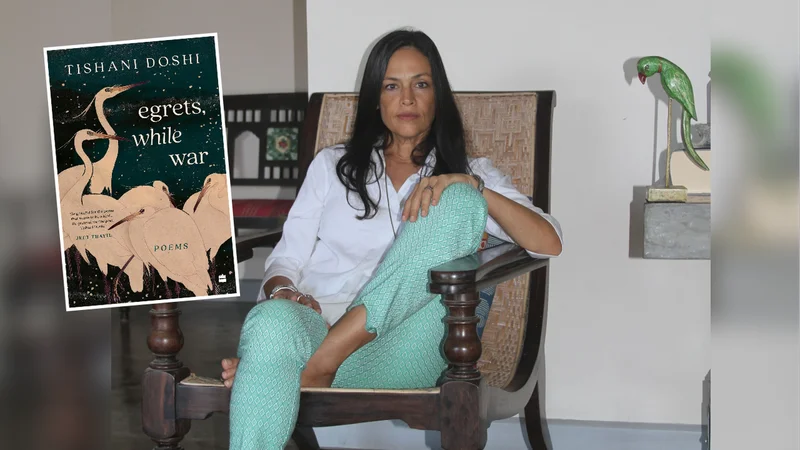
Birds flit in and out of Tishani Doshi’s fifth poetry collection, Egrets, While War: “emerald-bodied” parakeets; “soft and earthbound” dodos; “limitless feathery blue” peacocks; Martha, the very last passenger pigeon in the world who died in 1914 at the Cincinnati Zoo, aged 29; egrets, those “feathered dinosaurs”, even an archaeopteryx, believed to be a transitional species between reptiles and birds, fossilised in a shallow lagoon.
While these winged creatures have been in her poems for a long time, in this collection (published by HarperCollins), they are present in a different way, says the award-winning poet, writer and dancer over a Zoom call from Paramankeni, the coastal village near Chennai where she lives. “It’s not just that birds happen to fly into the poem, but they’re actually quite active in the making of the poem.” And, as anybody who reads about birds will know, there are millions of things that are just amazing about them, believes Doshi. “Just seeing its flash of colour is a joyous thing, and when you are faced with images of such horror, having this image of lightness or colour, even if for a brief moment, is uplifting.” Edited extracts from the conversation:
Grief, in its different forms, whether solastalgia, Weltschmerz or anticipatory loss, lies at the core of this anthology, which draws deeply from what is happening in the world right now. Could you tell us more?
The last three years have been one thing after the other. You would imagine that after a pandemic, there might be this move towards renewal of things, like wonder, awe and what it means to be alive, because we were so close to annihilation. But we’ve gone in the other direction, and I feel, like many people, a sense of helplessness, anger and confusion about how we got here.
It feels hyperbolic to talk in this way, but we have been witnessing remarkably exaggerated things — conflicts, genocide, climate change, politics of real horror. So, I think the poems come simply from a sort of disbelief that, of all the directions we could have taken, this is where we are.
Essentially, that is the feeling of it… very much a sense of how to hold this enormous grief and threat of endtimes, while also picking through the ordinary day, the human present.
Something that really struck me was how time works in this anthology: the prehistoric past intertwined with the present, the cyclicity of death and destruction, the body being an archive of lived experiences as well as ancestry…
It has to do with being at a particular stage in my own life, this feeling of having arrived at a kind of mid-path where you are neither young nor old, but looking, with your face, to both directions. The past is childhood and ancestry and the beginnings of where you came from, and the future is unknowable, but you are trying to move towards it with a particular intention.
I found that in these poems, I have a real longing to know about people who preceded me in my family: the people I’ve come from. There is also the planet’s time, the big, universe time that makes human life completely inconsequential. We are so small, but nevertheless, within that large planetary time, thinking about one’s own ancestry and how one might find place in it, or this question of belonging, is something that I have addressed in all my writing, whether it be poetry or fiction.
But yes, in this book, there is a lot of turning back, saying that while I might be moving into this next stage of life, I want to bring that childhood and those ancestors with me. I don’t want to leave that behind because I need them to travel with me and take this journey, a strange dependence, which I don’t think has been there in my previous work.
The ageing body, in fact, is a recurrent theme in this anthology, which I found especially interesting, given how central the physical body has been to both your writing and performance.
While the tech bros are trying to live forever, we know from all the myths the hubris of this kind of quest for immortality. So, it is both wanting to embrace ageing, but also acknowledging that it is difficult to see the ageing body, whether it is the things happening to your own body or in the bodies of the people you love. It is a question of trying to think about where we can source strength, power and joy in the body; desire is very grounded there.
And then there are the bodies that I’ve seen on my screen, mutilated bodies, bodies of children and the horrors enacted on those bodies, so it is very dissonant. We are living through a time when there is not even a possibility to go through full mourning because the horrors are ongoing and there’s no sense of them ever being over. In a way, the poems are just really trying to navigate, without being able to answer or give any clear answers, what it means to be alive now.
There is a film featuring three masked women, created as a companion piece to the book. What prompted you to make it?
I’ve done short video poems in the past, but this was something different. I was really interested in building an alternative world of images to go alongside the images in the poems. Not in a narrative way, but just trying to create resonances. I’ve been interested in the idea of the mask for a long time, and after COVID-19, when we were all masking up, this feels to be the age of unmasking. So, it was really an exploration of the themes of the collection through image, interchangeability, transformation, play.
I’ve created some choreographic work as solo pieces, but this was the first time I got to work with other bodies. Three is such a magical number in many ways: the trinity of gods in many religions, the past, present and future. Also, I am the middle of three children. It was really an experiment to combine poetry, movement, film, and how the image works between these three mediums so differently. Poetry has this elasticity across forms, which interests me more and more.
preeti.zachariah@thehindu.co.in
Published - August 21, 2026 06:20 am IST