In the space of six months, it has been some turnaround. The first time Max Verstappen drove the much-maligned, energy-dependent breed of 2026 Formula 1 car at February testing in Bahrain, his response was apoplectic. “Anti-racing” and “like Formula E on steroids” were two such protestations. Six weeks on, after round three at one of Formula 1’s staple high-speed circuits, Suzuka in Japan, the Dutchman’s disgruntlement had reached boiling point. Quitting the sport seemed a real eventuality.
“It’s really anti-driving,” Verstappen told BBC Radio 5 Live. “Then at one point, yeah, it's just not what I want to do. And of course you can look at it and make a lot of money. Great. But at the end of the day it's not about money any more because this has always been my passion."
Yet behind the scenes, conversations and proposals moved quickly. Highly-respected F1 chief executive Stefano Domenicali held cordial talks with Verstappen while the Dutchman’s long-term manager, Raymond Vermeulen, spoke to McLaren boss Zak Brown. Verstappen’s outspoken father and former driver, Jos, was also seen in conversation with Mercedes team principal Toto Wolff in Canada. Team Verstappen were plotting their next move.
Yet all the while, the biggest turning point came in May, when F1 announced changes to the sport’s controversial engine regulations, with traditional energy power increased and the energy recovery system decreased for 2027. Further afield, there is a genuine push from FIA president Mohammed Ben Sulayem for a return to the ear-splitting V8 engines (last seen in 2008 to 2013) for the next regulations cycle in 2030.
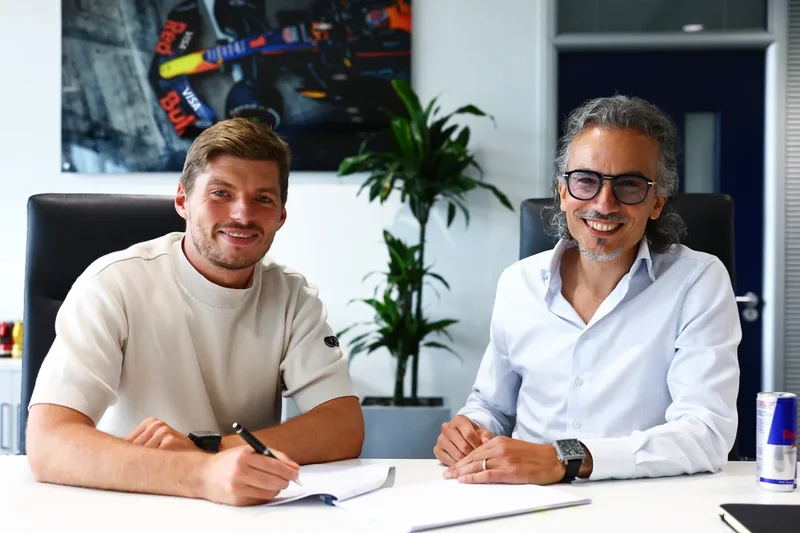
No wonder, then, that Verstappen’s fresh Red Bull extension – with improved terms beyond his previous £60m-a-year deal – is until that very year.
“From my side, I adapted and accepted the situation that we’re all in,” Verstappen said on Thursday, at a packed media conference in Red Bull’s “Energy Station” motorhome at his home circuit in Zandvoort, hosting Formula 1 for the last time this weekend.
“I’m just trying to make the best of that. With the year that I signed to [2030], it again opens up the door, maybe, when potentially the V8s come in, to look at that again as well.”
Verstappen’s new contract, kept impressively under wraps at the team’s Milton Keynes HQ over the last 48 hours, is more a show of faith in Formula 1 than it is in Red Bull. It is a team he has represented for 11 consecutive seasons now – the 28-year-old is now set to break the F1 record for a driver-team partnership, currently held by Lewis Hamilton and Mercedes’ dozen years together – and now looks set to see out his career with.
Despite his trusted race engineer Gianpiero Lambiase joining McLaren as Head of Racing, either next year or in 2028, and summer encounters in Sardinia with Wolff and his family, an under-emphasised characteristic of Verstappen’s irrepressible on-track hunger is his loyalty: to his people, to his team and to the brand. For team principal Laurent Mekies – a year on from taking over as Christian Horner’s replacement – it is the biggest of boosts heading into the second half of the season.
“I was closer to retiring than changing teams,” Verstappen said. “I like it here. I think it would be a great story if that were possible, being picked up by Red Bull and finishing your career with one team.
“I don't feel the need to change just to change… after the first few races [this season], I said to Laurent, 'Don't come to me with any kind of questions about the future because I didn't even know if I want to stay’.
“But honestly, we always kept it very open. I love racing, and I had a lot of very good discussions with F1, but also with the FIA. We are slowly working towards something that becomes better and better.”
There is also an underlying sense at Red Bull that, despite high-profile technical exits in recent years (as well as Horner, design genius Adrian Newey, pit-stop guru Jonathan Wheatley and strategy chief Will Courtenay have all departed), the team have plenty of unfulfilled potential in this current regulation cycle.
Building their own engine for the first time this season, in partnership with Ford, Red Bull were statistically named the strongest power unit in the spring, in spite of Mercedes’ supposed dominance. That represents plenty of room for development in a chassis which both Verstappen and teammate Isack Hadjar have struggled to contend with in the opening 11 rounds.
Regardless, it is a suspicious time for Verstappen to commit, ahead of 12 races in 16 weeks to conclude the current campaign. Despite four very respectable podiums, Verstappen is currently on course for his first winless season since his rookie campaign with sister team Toro Rosso in 2015. Yet here he is, a four-time world champion, who could probably land any seat on the grid if he opted to forcefully abandon ship, committing for the foreseeable future with the only team he’s ever known.
In similar circumstances two years ago, Hamilton opted for a final swansong move to the prancing horse of Ferrari. Verstappen, however, has stayed put, perhaps in the knowledge that great times are ahead for Red Bull once more. Yet there will be performance clauses; there will be exit stipulations. The penning of fresh papers silences the noise for now. But only Red Bull’s on-track performance will quieten the doubters in the long run.