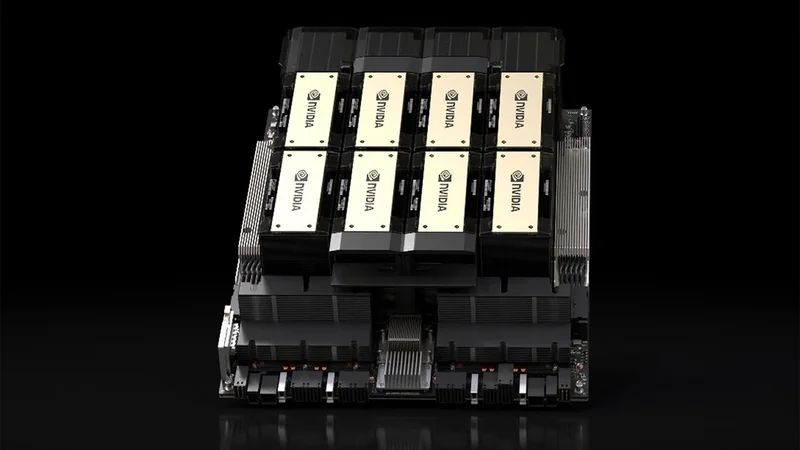
ByteDance and Tencent each took delivery of roughly 10,000 Nvidia H200 accelerators in recent weeks, and a handful of other Chinese tech groups may soon receive approvals of similar size. The deliveries are the first meaningful movement of the chips into mainland China since President Trump cleared their export in December, but they arrive under strict oversight from China’s National Development and Reform Commission, which approves each purchase individually.
Most of each company's U.S.-licensed allowance, understood to be up to 100,000 units apiece, must stay outside the mainland, largely in Hong Kong. Measured against the 400,000-plus units that ByteDance, Alibaba, and Tencent were collectively approved to buy in January, the chips now on the mainland amount to roughly 2.5% of the order book.
Two licensing regimes
Trump approved H200 exports in December last year, in exchange for a 25% cut of every sale to the U.S. Treasury, and terms formalized in January require each chip to pass through US territory for third-party inspection before re-export. The Commerce Department moved license applications to case-by-case review on January 16 and had cleared roughly 10 firms by mid-May, including Alibaba, ByteDance, Tencent, and JD.com, with Lenovo and Foxconn approved as distributors.
In response, China built the NDRC’s per-purchase approval process from scratch to mirror the Commerce Department’s case-by-case license review. The 10,000-unit mainland allocations function as quantity caps, the very instrument that U.S. export rules have used since the first Hopper restrictions in 2022. The requirement to route imports via Hong Kong operates as an end-location condition, identical to Washington's demand that every chip transit U.S. soil for inspection.
The Cyberspace Administration of China summoned Nvidia last July over alleged backdoors in the H20. State media outlets subsequently ran a campaign calling the chip unsafe and outdated, and state-funded data centers were barred from foreign accelerators. Eight months of NDRC silence on H200 orders left Jensen Huang telling investors Nvidia's China market share had gone from 95% to zero.
DeepSeek’s training bottleneck
A transcript of DeepSeek founder Liang Wenfeng's May 20 closed-door investor meeting, leaked online in July, arguably explains why Beijing is letting any Nvidia silicon in at all. According to the document, whose authenticity DeepSeek hasn't confirmed, Liang told investors he wanted 200,000 Huawei accelerators to train a frontier model and received an allocation of 16,000, against total Huawei capacity of roughly 750,000 chips this year split across every Chinese AI company, a constraint he reportedly expected to persist for around three years. The remarks circulated widely enough that DeepSeek paused a fundraising round targeting a roughly $71 billion valuation days after they appeared.
If we look at DeepSeek’s production history, it appears to match the numbers Liang cited during the meeting. lab's attempts to train its R2 model on Huawei Ascend hardware failed repeatedly, and training moved back to Nvidia chips while Ascend accelerators handle inference. Per the Financial Times’ unnamed source, which broke the story of resuming H200 imports, domestic silicon increasingly serves inference, while Nvidia hardware still carries training.
The H200 obviously fills that gap nicely, with each unit carrying 141GB of HBM3e at 4.8 TB/s, delivering roughly six times the performance of the H20, and approaching the banned H100. A 10,000-GPU cluster is genuine frontier-training capacity, comparable to the builds behind the GPT-4 generation, though it represents a fraction of the 100,000-GPU-plus systems U.S. labs now run. That ratio seems to have been precisely calibrated by Beijing officials, large enough to keep flagship labs training their models, but small enough that inference stays a captive market for domestic chipmakers.
Domestic supply gaps
TrendForce's August 10 supply chain survey projects that domestic chips will take nearly 90% of China's high-end AI chip market this year, with domestic high-end shipments growing 83% year over year, a projection that TrendForce itself revised up from roughly 50% in its December outlook. Bernstein has recorded the same displacement from the other direction, with Nvidia's China share falling from 66% in 2024 to 40% in 2025 and a projected 8% this year.
Huawei planned to roughly double output of its 910C Ascend chip to about 600,000 units in 2026, against a total Chinese accelerator market that ran to roughly 4 million units in 2025, 2.36 million of them supplied by Nvidia and AMD. So, while domestic chips can cover the volume, they can't yet cover frontier training, making the 90% projection and H200 easing two halves of the same policy.
Washington's case for export controls rests on exactly the dependence these deliveries demonstrate: Four years into the restrictions, China's leading labs still can't train frontier models without American silicon, and Beijing has now conceded as much through its licensing decision.
The leaked transcript has Liang arguing that open access to Nvidia would make domestic substitution a much harder commercial proposition, meaning the controls themselves built the market Huawei and Cambricon now hold, and TrendForce's numbers show that market approaching 90% share three years after the first Hopper bans. This month's deliveries disprove neither side's theory, but Nvidia does bear the cost of both, with 500,000 chips reportedly in inventory, a 25% fee on anything that sells, and a Chinese market rationed to 10,000 units per buyer — admittedly, that’s better than zero.
Luke James is a freelance writer and journalist. Although his background is in legal, he has a personal interest in all things tech, especially hardware and microelectronics, and anything regulatory.