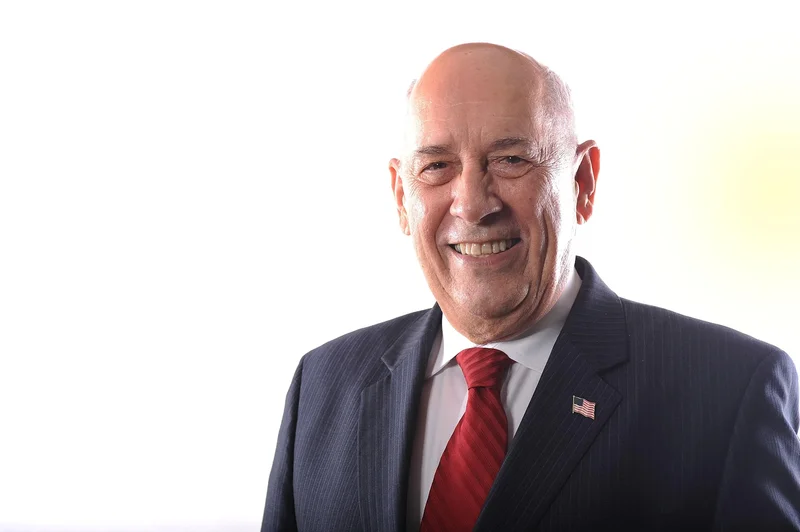
In August 1978, Bill Rasmussen was stuck in traffic on Interstate 84 with his son, Scott, trying to solve a problem: They had plans for a sports cable network and enough satellite capacity to cover 8,760 hours a year. What could possibly fill all that time?
Scott offered an answer that sounded almost absurd: play sports all day.
From that traffic jam emerged the blueprint for what became the Entertainment and Sports Programming Network, soon known by its initialism, ESPN.
That brainstorm established Rasmussen, who died Aug. 18 at 93 from the effects of Parkinson’s disease, as a founding father of around-the-clock sports television and helped change how generations of fans consumed sports.
“He had an idea, and he had a dream,” Bob Rauscher, who launched NFL GameDay in 1985, said. "And he made it happen."
From Traffic Jam To ESPN
Rasmussen’s broadcasting career began in western Massachusetts in the 1960s, before he became communications director for the New England Whalers of the World Hockey Association. After being fired alongside the entire Whalers front office in 1978, Rasmussen began exploring the possibility of creating a cable sports operation of his own.
His original concept was a local Connecticut cable channel that could carry University of Connecticut basketball games, following the model of MSG in New York and WGN in Chicago, according to Vince Doria, ESPN’s now-retired vice president for news.
Rasmussen was reminded that once the signal was sent to the satellite, it could be received well beyond Connecticut. That realization expanded the possibilities dramatically, Doria said, even though not everyone saw the idea’s merit.
“Everybody thought it was a nuts idea at the time,” Doria said
“Play Football All Day”
Rasmussen had already incorporated E.S.P. Network when the idea crystallized during that August 1978 road trip, he recalled in a 2012 Forbes interview.
“Scott finally said something like, ‘Play football all day, for all I care,’ and suddenly, the ideas started coming fast and furious during that car ride,” Rasmussen recalled in that interview. “We came up with the idea for ‘Sports Center,’ we had designed the entire building we would be in, we had decided what types of sports we should go after.
“That car ride was where we hung the heavy steel work for the network.”
The Entertainment and Sports Programming Network set up shop on land Rasmussen bought in Bristol, Connecticut, and launched with its opening show, SportsCenter, at 7 p.m. on Sept. 7, 1979, available in about 1.4 million cable households.
Rauscher said the concept of a channel devoted to sports highlights and coverage far beyond the three-minute local news segment was unprecedented, making it a “sports fan’s dream.”
"I think [Rasmussen] understood that there was this appetite there,” Rauscher, who came to ESPN in August 1980, said. “There would be this allegiance and loyalty to want to consume that much material.”
It also came with challenges. Few people had cable when the network launched and many that did were confused by the network’s name, Doria said. Securing enough programming was another challenge, forcing ESPN to fill portions of its schedule with Australian rules football and even circus events.
24-Hour Sports Coverage
Rasmussen also had to persuade a trio of constituencies that didn't yet know they needed round-the-clock sports on television: investors to finance it, sports organizations to provide games and advertisers to believe somebody would watch.
Rasmussen parlayed his own $9,000 credit-card advance and $75,000 in financing arranged through K.S. Sweet into the fledgling venture. Stuart Evey, who oversaw who oversaw Getty Oil’s investments outside its core oil business, persuaded the company's board to invest $10 million for an 85% stake. Anheuser-Busch signed on as an advertiser with what was then the largest single advertising buy in cable history.
“Bill was the one that sought the financing,” Doria said. “He was the one that chased the NCAA. He got the property in Bristol. He made the deal with RCA.
“This was all him.”
Taking Getty's money, however, also meant surrendering control.
As ESPN prepared to launch, Evey decided to bring on more experienced television management in the form of Chet Simmons, president of NBC Sports. Simmons became ESPN president in July 1979. Rasmussen was moved to chairman, effectively stripping him of day-to-day authority.
Rasmussen left his active role at ESPN in 1980 and remained largely disconnected from the company until then-president George Bodenheimer welcomed him back for ESPN's 20th anniversary in 1999.
“He was gone so quickly,” Doria said. “He wasn't there for the heyday of when it really became successful and a household name.
“But without his initiative, perseverance and determination, it doesn't happen. ”
A Culture Built To Survive
Steve Anderson was trying to follow his Pulitzer Prize-winning father, Dave Anderson, into the sports media game when he read about a little cable company in Connecticut that was “hiring anybody.”
“I never thought this thing was going to make it,” Anderson said. “I was only hoping that it was going to last long enough so I could get some experience and go back to New York, and get a real job at a real network.”
ESPN instead became Anderson's professional home for more than three decades, and he credits Rasmussen with helping establish the family culture that defined its early years.
“Many of us who were there back in the ’80s and ’90s, we talk about the bond that we all had, the camaraderie we all have just being a part of that team,” he said, “because we weren't sure ESPN was going to make it.”
Life Beyond ESPN
Rasmussen remained an entrepreneur after leaving ESPN, and advised the Big Ten on television strategy and pursuing several early internet sports ventures. He also spent decades telling the story of ESPN's unlikely creation through speeches and books, culminating in the 2026 documentary and book Sports Heaven: The Birth of ESPN.
He learned he had Parkinson’s disease in 2014 and publicly revealed the diagnosis in 2019. He later became an ambassador for the Michael J. Fox Foundation for Parkinson’s Research and joined its Patient Council.
Even as his health declined and he used a wheelchair, Rasmussen continued gathering in Florida with retired ESPN veterans.
“He always made you feel like he knew you and appreciated what you did for ESPN and everything else,” said Anderson. “He was remarkable in that way.”
Recognition, At Last
There was, however, a bittersweet element to Rasmussen’s relationship with the company he created. He was pushed aside so early that he missed being part of ESPN’s emergence as a sports-media powerhouse, Anderson said.
“He never even experienced the early successes of ESPN,” he said. “As I got to know him a little bit and got to see him and listen to him talk, I always felt sad for him that he never really experienced the real success of ESPN firsthand.”
Yet Anderson said Rasmussen eventually received the respect such an accomplishment deserved. When he attended ESPN alumni gatherings later in life, he was routinely approached by people seeking to express their gratitude.
“Everybody who had been there at ESPN was going up to him thanking him,” Anderson said. “Because he was such a humble man and such a nice man, it was easy for everybody to do.”