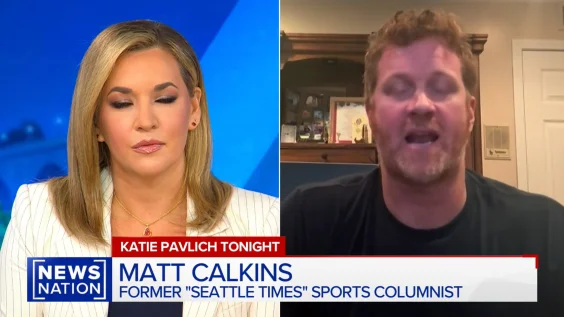
People sometimes wonder what editors do. It's a fair question to ask, given how difficult it is to read a column or blog post and be able to discern exactly how much influence an editor did or did not have over the final product. It's easy to assume that editors don't do much at all, actually, and just skim a hardworking writer's drafts before publication. Thankfully, there are guys like now former Seattle Times columnist Matt Calkins out there to remind us of how much value editors can provide to their publications.
Calkins spent 11 years covering sports for the Seattle Times, and announced his resignation from the paper yesterday on Substack. His stated reason for resigning is that his editors refused to publish a column he wrote about anti-trans protestors who gathered outside the arena before a recent Seattle Storm game. After interviewing one of the protestors, he was inspired to write:
One of them was 16-year-old Ahnaleigh Wilson, who’d lost to a biological male in a track and field race in eighth grade and was holding a sign reading “Thank You Sophie for Speaking up for Girls!”
I didn’t know if I was going to write something at that point, but after she allegedly got cussed out by a Storm co-owner during the game, I felt like I had to weigh in.
One thing Wilson emphasized to me at the rally was that she wasn’t anti-trans. Another student-athlete named Frances Staudt — who said she’s endured daily verbal abuse after refusing to play against a biological boy in a basketball game — echoed Wilson’s sentiment.
So that was the thesis of my column (which you can read here) — that supporting the separation of biological females and males doesn’t automatically make you transphobic, so let’s stop throwing those labels around.
Calkins claims that his editors held onto the column for almost a week before informing him that the paper wouldn't be running it, at which point he resigned.
If Calkins's editors deserve any criticism, it is only for how long it took them to communicate their decision. A column with a thesis as obviously wrong as the one Calkins produced should be spiked without too much consideration. If a writer brings an editor a poorly written or poorly argued column that the editor never asked for, it is the editor's duty to put it into the trash can as quickly as possible, so that the writer can find a better idea on which to spend their time.
So Calkins's editors did him a service by spiking his column rather than trying to make it fit for publication. If they had gone through the trouble, he may have ended up having to answer some difficult questions. Did he fact-check any of Wilson and Staudt's claims? What race did Wilson lose, and to whom? When did it happen? Did he reach out to anyone else at Staudt's school who could confirm her story about quitting the basketball team and subsequently being harassed? Did he ask Staudt to explain why being in a locker room with a trans athlete "made her feel uncomfortable"? What evidence is there to support Staudt and Wilson's claim that "this whole thing isn’t about hate”? How is participating in an astroturfed campaign coordinated by people and organizations who explicitly want to use trans participation in sports as a way to energize a broader movement against trans rights not an inherently transphobic act? What about Staudt and Wilson's insistence, which Calkins himself adopts, on only referring to trans women as "biological men"? An editor who actually wanted to fuck up Calkins's week could have done a lot more than just mercy kill this column.
Calkins also wants people to know that he's not being unreasonable and quitting his job over one spiked column. He claims in his Substack post that this is part of a pattern dating back years:
That may come off as an emotional decision, but it was exactly what I was prepared to do. This, after all, was one of several columns of mine that had been spiked at the Seattle Times.
One was a piece questioning whether players for the U.S. Women’s Soccer Team were really the victims of discrimination in their equal-pay lawsuit. Another was a more general column on cancel culture in sports. The last, written shortly after George Floyd’s death, implored people to listen to state-champion basketball coach Mike Bethea — a black man urging the public not to stereotype cops. The common theme? All of these challenged prevailing newsroom narratives and likely would have triggered the outrage mob.
I am seeing now that there's a reason Calkins has spent the last 11 years quietly enjoying a cushy columnist gig without becoming widely known as one of the dumber writers working in the English language, and that reason is that his editors were really looking out for him. Quitting in a huff over these columns being spiked? Brother, you should have been bringing your editors muffins every day for how well they were covering for you.
An editor's first obligation is to protect writers from themselves—good writers and bad writers alike. Good writers understand and accept this, because it works to their benefit. Bad writers? Calkins claims he's going to publish on Substack now, seemingly without an editor. I bet his stuff is about to get really good now.