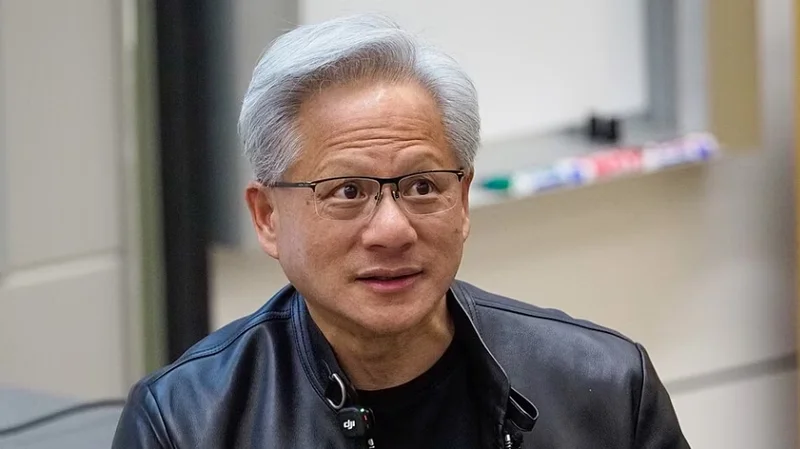
Nvidia is in early talks with the Korean AI chip designer Rebellions about a technical partnership, an investment or possibly an acquisition, Bloomberg reported on Friday.
Jensen Huang met Rebellions co-founder and chief executive Sunghyun Park at Nvidia’s Santa Clara headquarters this week, people familiar with the matter told the news agency. They asked not to be identified because the information is not public.
The talks are preliminary and may not produce a deal. Nvidia did not respond to Bloomberg’s questions. A representative for Rebellions declined to comment.
It would be the fourth arrangement of this shape in under a year. Nvidia has spent that year buying access to rival chip and model designs rather than buying the companies outright.
What Rebellions makes
The company is based in Bundang, south of Seoul, and was founded in 2020. It designs neural processing units for data centres, tuned for AI inference rather than training.
Inference is the work of running an AI service once the model exists. It needs less compute per query than training does, and vastly more of it in total.
Rebellions has raised roughly $850mn from SK Hynix, Samsung Ventures and Arm. It also holds a direct investment from the Korean government. Its most recent valuation was around $2.3bn.
Silicon Republic puts Nvidia’s own investment portfolio above $63bn, most of it in Intel and SpaceX. Nvidia is worth about $5.2trn.
It has been shipping for three years. Its Atom and Atom Max NPUs entered mass production in 2023, and DataCenterDynamics reported that customers in Japan, Saudi Arabia and the United States have deployed them. The company merged with Sapeon Korea in 2024, a chip business SK Telecom had spun out in 2016, and partnered with Marvell last year on hardware for sovereign AI projects.
Nvidia has a template for this
The structure Bloomberg describes is one Nvidia has used repeatedly. Buy a licence, hire the engineers, take a stake, and leave the company standing.
Nvidia paid Groq $20bn for a nonexclusive licence and absorbed most of its engineering talent. Nvidia said it was not an acquisition, because Groq continues to operate separately and runs its cloud business independently.
It repeated the shape this week. Nvidia agreed to pay Poolside $6bn for its model factory and hire 109 of its staff.
Rivals are moving the same way. AMD bought Taalas, a startup that etches models into silicon, in August.
What happened to the first one
Groq is the case with a full arc, and it is not flattering.
Nvidia valued the licence at $20bn. Groq then raised $650mn for what remained. This month it closed $350mn at a $3.5bn valuation, with Nvidia joining the round.
Silicon Republic noted that the valuation fell by nearly half at that round.
A company Nvidia paid $20bn to license is now worth $3.5bn as a going concern.
Nvidia already sells the product
This is the part that makes the Rebellions talks legible.
Nvidia turned the Groq licence into its own inference chip. It unveiled the Nvidia Groq 3 language processing unit at GTC in March, and said it would add a new LPU architecture every year alongside its annual GPU cadence.
The chip ships in the second half of this year in liquid-cooled racks holding 256 LPUs, with 128GB of on-chip memory and 640 terabytes per second of scale-up bandwidth.
Rebellions designs the same class of part. Nvidia would be licensing a second inference architecture after productising the first.
Nvidia’s own executive on the economics
Ian Buck, who runs Nvidia’s data centre business, described the trade-off at GTC.
“The LPU is optimized strictly for that extreme low-latency token generation, offering token rates in the thousands of tokens per second,” he said. “The trade-off, of course, is that you need many chips in order to get that kind of performance. And the economics, or the tokens per second per chip, is actually quite low.”
That is Nvidia’s data centre head saying the per-chip economics of the category are poor. He was describing Nvidia’s own chip.
Why a deal would be difficult
Two regulators would take an interest.
Nvidia’s share of the chips used to train frontier models is large enough that it has to watch for antitrust scrutiny, Bloomberg noted, and sizeable technology acquisitions usually need clearance from the US Department of Justice. The licence-and-hire structure sidesteps the review a purchase would trigger.
Korea is the second problem. Seoul treats advanced semiconductors as strategic national assets, and Samsung and SK Hynix work closely with the government on investment projects. SK Hynix is a Rebellions shareholder. It also backs Etched, whose valuation doubled to $10.3bn in seven months.
Rebellions said it wanted to go public
The company has been pointing at an IPO rather than an exit.
Chief financial officer Sungkyue Shin said a year ago that going public was the “master plan”. In March the company raised more than $400mn in a round it described as pre-IPO, and used the moment to launch two rack-scale platforms called RebelRack and RebelPod.
No listing date has been disclosed. An Nvidia licence would give the company cash without a listing, which is the trade Groq and Poolside both took.
What is not established
No deal exists. Bloomberg’s sources described the discussions as preliminary and said they may not lead to a transaction.
No structure, price or stake has been reported. Whether this would be a licence, a minority investment or a purchase is exactly the question the sources did not answer.
Neither company has commented on the record. Nor has either said what a partnership would cover if it stopped short of an investment.
Separately, Nvidia spent this week denying a different chip report. Asked about a claim that it had built a China-specific LPU, a spokesperson said the reporting “is incorrect”, adding: “We have no LPU sales in the China market today, and no China-specific LPU product in our roadmap.”
Get the TNW newsletter
Get the most important tech news in your inbox each week.