Unique summer retreat in Gyeonggi Province opens new sections for 1st time since 1912 mine development
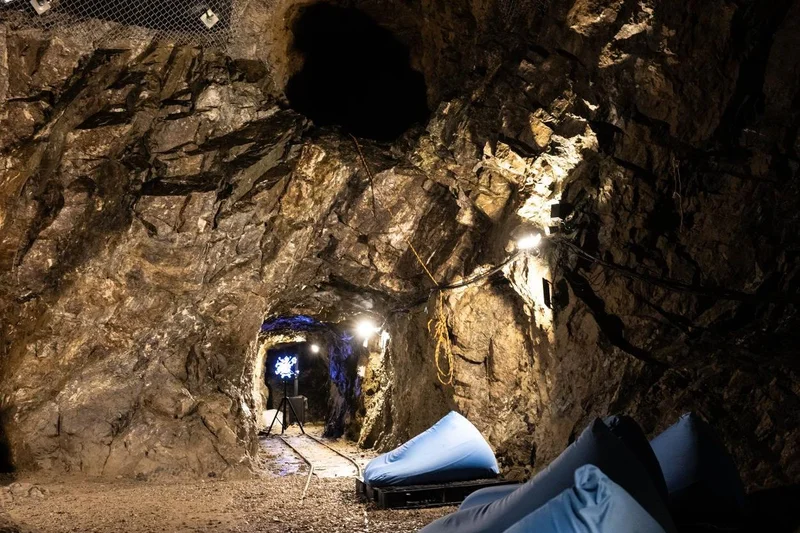
Ten beanbag chairs, each large enough for one person to lie down, fill the dark cavern. A single shaft of light filters through an opening on one side, but it is nowhere near enough to illuminate the deep darkness. Even taking a single step requires carefully following the guide's cellphone flashlight.
It is hard to believe that this is part of a tourist attraction visited by around 1 million people a year. Yet this is one of the previously inaccessible sections of Gwangmyeong Cave in Gwangmyeong, Gyeonggi Province.
Gwangmyeong Cave stretches a total of 7.8 kilometers, but only about 2 kilometers are routinely open to visitors. The remaining sections have been closed because they require maintenance, have been flooded or are too narrow for public access.
Efforts to make use of the restricted areas began in July 2020, when three previously inaccessible sections were opened. This year, two additional sections — one above ground and one underground — are being opened temporarily.
The above-ground section is hosting the Dark Immersive Meditation program throughout August, while the underground section will host the Dark Music Stage for six days later this month. Organizers say this is the first time these areas have been opened to the public since the mine was developed in 1912.
Abandoned mine section within popular tourist spot
Gwangmyeong Cave is unlike most tourist caves. It is perhaps best described as a "cave theme park."
That is because it is not a natural cave. The site was once a mine where gold, silver, zinc and copper were extracted. It was closed in 1972 after being flooded by heavy rains and was redeveloped as a tourist attraction in 2011.
This explains why the cave contains a dense array of photo spots, lighting installations and sculptures. Unlike natural caves, there was less need to limit development for the sake of preserving natural formations.
The cave is a popular summer getaway from Seoul, and the cool air is immediately noticeable at the entrance. When this reporter visited, daytime temperatures were approaching 40 degrees Celsius, yet the heat seemed to vanish upon entering.
The above-ground restricted section used for meditation is not far from the entrance. It takes about five minutes on foot to reach the entrance to the area after entering the cave.
Before going in, participants receive a brief orientation. "You can sleep, or you don't have to do anything at all," the guide explains. "Spend the time however you like."
It is an unusual message for a carefully designed program. One might expect the organizers to be disappointed if participants spent the session sleeping, but the opposite is true. They say that falling asleep in the isolated space is actually evidence that participants have become sufficiently relaxed to enjoy the program.
And it is easy to understand why.
The old mine tunnel leading to the restricted area branches off like a side passage just before the expansive section where a media facade performance takes place. At the entrance, a swirling "gateway" appears to lead into another world. Images are projected onto vapor, creating a mysterious visual effect.
Beyond the gateway, visitors are completely cut off from the bustling outside world. The sense of isolation is heightened by the fact that the program is limited to just 10 participants per session because of the nature and size of the space.
The main area of the restricted section is a small chamber furnished with 10 beanbag chairs. An old rail track for mine carts runs along one side, while another tunnel of similar size lies above it. In one corner, discarded pieces of wood raise questions about what they were once used for. Near the entrance, close to the gateway, a seemingly bottomless pit is enclosed by a metal fence. The cave walls are markedly different from the smooth, flowing surfaces found in natural caves. Their rough texture makes it clear that this is an artificial space carved out of solid rock.
Once everyone settles into a comfortable position in the beanbags, even the few remaining lights are switched off.
In the pitch darkness, a strange-looking character appears and again encourages participants to meditate as they are — whether they are bored or sleepy.
As the program begins, irregular patterns of light appear in the darkness, creating a dreamlike sensation. The colors and shapes vary, but because the surrounding space is so dark, even the dim light appears vivid. At the same time, its low intensity is far removed from anything jarring or stimulating.
The guide and the character's advice soon had the intended effect, bringing on a light sleep.
The meditation program runs five times a day, six days a week, with Mondays off, through Aug. 30. The underground restricted section also hosts Dark Music Stage, a music-listening program where participants listen to playlists selected by hosts including veteran music critic Lim Jin-mo and discuss the music together.
The event is designed to take advantage of the mine's darkness and natural acoustics, allowing participants to focus entirely on the music. The space is larger than the meditation chamber and can accommodate up to 50 people.
Underground aquarium fed by rock water
After leaving the meditation area, visitors return to the lively main section of the cave that is open year-round.
Beyond the Cave Arts Theater, where a media facade performance is staged, is the Cave Aqua World. The aquarium is filled with first-grade bedrock water that naturally rises from beneath the mine. It is modest in size compared with large commercial aquariums, but its setting in the dark cave suits it well.
Borneo plecos from Southeast Asia crawl slowly along the bottom of the tanks, while vivid red blood parrot cichlids swim in groups. A golden Asian arowana, once prized as an ornamental fish by China's emperors, is another resident attraction. Its golden scales reflect the aquarium lights, resembling the gold ore that miners might once have extracted from the site.
Beyond the aquarium are the Wall of Wishes, Wish Supernova and Wish Golden Tree, a series of popular attractions where visitors can write their wishes on golden plaques and hang them up.
A long staircase then leads deeper underground, toward the three previously inaccessible sections opened six years ago.
The sections consist of Miners' Way, Underground Lake and Horseshoe Way. Miners' Way is currently closed to visitors.
Sculptures created by Weta Workshop, the renowned New Zealand special effects and design company, are installed throughout the area. They include Gollum and Gandalf's staff from "The Lord of the Rings," as well as a giant dragon — figures seemingly selected for their associations with underground worlds and caves depicted in films.
The underground area feels much more like an abandoned mine than the upper levels, with blasting holes in the rock walls visible in numerous places.
Several rest areas are available, allowing visitors to take a break after descending the steep stairways while enjoying the underground scenery.
At the end of the route is the Wine Cave.
Because the underground tunnels maintain a year-round temperature of 12 to 13 degrees Celsius, the area was once used to store salted shrimp before Gwangmyeong Cave was redeveloped as a tourist destination.
After the site reopened, wine — which also requires stable temperatures — replaced the salted shrimp.
The cave once operated a restaurant, cafe and tasting area, but currently only wine sales are available.
This article from the Hankook Ilbo, the sister publication of The Korea Times, is translated by a generative AI system and edited by The Korea Times.
Explore More
- Q.
- Q.
- Q.