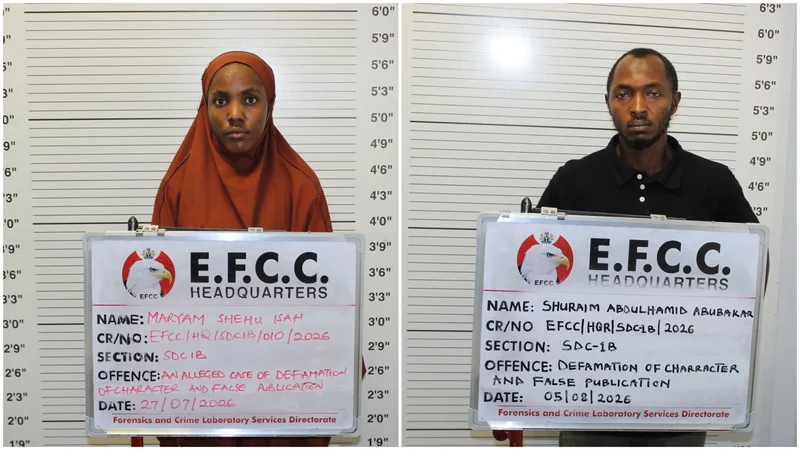
The Chairman of the Economic and Financial Crimes Commission (EFCC), Ola Olukoyede, has ordered the withdrawal of the charge instituted against a final-year student of Bayero University Kano (BUK), Maryam Shehu, a day after she was arraigned before the Federal High Court in Abuja for allegedly peddling malicious information against the commission on social media.
Mr Olukoyede also ordered the withdrawal of a separate but similar charge against Abubakar Abdulhamid.
The prosecution has drawn criticism from lawyers and many Nigerians alleging legal breaches in EFCC’s handling of the cases.
A statement from the EFCC said Mr Olukoyede’s decision followed appeals for leniency from Nigerians and apology from Ms Shehu’s father Nigerians.
| | |
|---|
“To this end, he has directed that charges filed against the two young Nigerians be dropped and warned that the EFCC would no longer tolerate any wilful attack on its image in any form, medium or platform,” the statement signed by EFCC spokesperson Dele Oyewale said.
“The EFCC’s boss assured Nigerians that the Commission would continue to function in line with its assigned mandate and in the best interests of the nation.”
Release delayed
But in a post on Facebook on Friday, the publisher of Sahara Reporters and activist Omoyele Sowore, who has been part of the campaign for release Ms Shehu’s release, noted that despite the withdrawal of the charges, their release was still being delayed because Mrs Abdulmalik had not sat in court.
“Unfortunately, the Federal High Court judge who sat yesterday and remanded them in Kuje and Suleja prisons respectively has not sat all day today, so their release is still being delayed.
“We are glad that wisdom finally prevailed at the Economic and Financial Crimes Commission,” he stated.
Mr Sowore thanked other lawyers who came in solidarity to speak and work to secure their freedom.
“I was also informed that the leadership of the National Association of Nigerian Students was at the Federal High Court today to lend its support and help secure Maryam’s freedom. Their solidarity is greatly appreciated.
“We sincerely hope that Justice Joyce Abdulmalik will still show up and sit, even briefly, today so that Maryam can regain her freedom and commence her final examinations tomorrow.
“If that does not happen in time, we urge the authorities of Bayero University Kano to take special notice of the extraordinary circumstances surrounding her detention and ensure that she is given the opportunity to rewrite any examinations she misses as a direct consequence of her detention,” he added.
Lawyers question EFCC’s action
The prosecution attracted criticism from lawyers who questioned whether the EFCC has the statutory authority to prosecute allegations arising from defamation and social media publications.
Abuja-based lawyer and activist Hamza Dantani, in a statement shared with PREMIUM TIMES on Thursday, urged the commission to operate within the limits of its enabling law.
Mr Dantani stated that defamation did not ordinarily become an economic or financial crime simply because it was committed through social media.
“The EFCC cannot assume jurisdiction over every allegation simply because the matter is controversial, politically sensitive or attracts public attention,” he said.
He also criticised the publication of suspects’ photographs before conviction, arguing that it could undermine their constitutional rights to dignity, privacy and the presumption of innocence.
Mr Dantani cited Sections 34(1), 36(5) and 37 of the 1999 Constitution, as amended, as well as Sections 8 and 15 of the Administration of Criminal Justice Act, 2015.
He noted that taking a photograph of an arrested person for investigative purposes was different from publicly publishing the person’s image in a manner that could amount to reputational punishment.
“The EFCC must remain an EFCC, not a general-purpose police force, not a civil-defamation tribunal and certainly not a court of law,” he said.
He called on the Attorney-General of the Federation and Minister of Justice, Lateef Fagbemi, to review the matter and ensure that the EFCC operates within its statutory mandate.
Another lawyer, Abba Hikima, also urged Mr Fagbemi, who is a Senior Advocate of Nigeria (SAN) to intervene.
In a Facebook post on Thursday, Mr Hikima said Ms Shehu had spent 35 days in EFCC custody before the commission filed the charge against her.
He questioned why it took the commission that long to file a charge arising from a social media publication.
Mr Hikima also stated that Ms Shehu had raised an allegation of corruption involving an EFCC zonal director and questioned whether the allegation had been independently investigated.
He urged the authorities to investigate the allegation against the EFCC official and called for Ms Shehu’s release on bail.
Background
PREMIUM TIMES earlier reported that the two defendants appeared before Justice Abdulmalik to answer to one count each.
They both pleaded not guilty when their charges were read to them.
EFCC had stated that Ms Shehu was arraigned on one count of publication on her Instagram account, @maryamshehu.
The commission alleged that on 21 June, she published a message claiming that EFCC officials assaulted Ahmed Uthman on the instruction of a zonal director who allegedly collected N20 million from one Usman Abbas.
The EFCC said the publication was intended to tarnish its reputation and violated Section 24(2)(c) of the Cybercrimes (Prohibition, Prevention, Etc.) Act, 2015, as amended in 2024.
Mr Abdulhamid was also charged under the same provision.
The EFCC alleged that in May, he used his X account, @shuraimi, to publish an image designed to resemble an official EFCC arrest placard.
The image allegedly portrayed one Sadeeq Kabeer as an EFCC suspect, with the inscription: “His only crime was selling laptops at an affordable price to students.”
The commission stated that the publication was intended to tarnish its reputation.
After the defendants entered their pleas, prosecution lawyer Elizabeth Alabi asked the court to fix a date for trial.
She sought an order remanding Ms Shehu in the Suleja Correctional Centre, Niger State.
But her lawyer, C.O. Amalaha, told the court that a bail application had been filed. She urged the judge to grant Ms Shehu bail on liberal terms.
Also, lawyer to Mr Abdulhamid, Adamu Adamu, also informed the court of his client’s bail application. He asked that his client be kept in EFCC custody.
Court order
Mrs Abdulmalik ordered Ms Shehu to be remanded in Suleja Correctional Centre and Mr Abdulhamid in Kuje Correctional Centre.
The judge adjourned the case until 31 August for hearing of the bail applications and commencement of trial.
The EFCC noted that the prosecution was part of efforts to bring alleged blackmailers, fabricators and people who deliberately tarnish the commission’s image to justice.