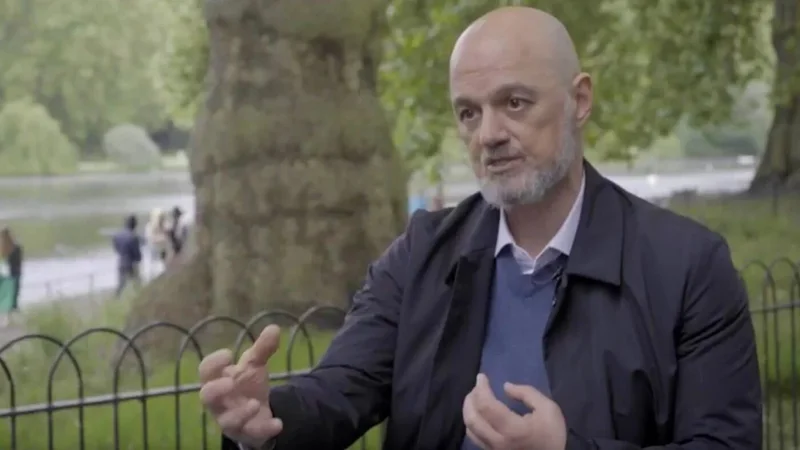
Anas Altikriti case raises crucial questions about Britain's alliance with the UAE
In the long-lost days when I was chief political commentator for the Daily Telegraph, I used to engage with Anas Altikriti, chief executive of the Cordoba Foundation, on Muslim issues.
Cordoba disputes the proposition, much favoured by other American and British think tanks, of an inevitable clash of civilisations between Islam and the West.
Altikriti himself came into the spotlight after revealing that he had suddenly - and without warning - been stripped of his bank account by HSBC in 2014. He told me: “Having a bank account in the modern world is like having electricity or running water. You can’t live life without one.”
Altikriti had banked with HSBC for around 30 years. HSBC simply told him that his bank account fell “outside our risk appetite”. Under British law, they had no obligation to say more.
HSBC had also written to his wife, Malath Shakir, and two sons (aged 16 and 12), cancelling their accounts.
I investigated and soon discovered that other politically active Muslim and Islamic institutions, including the Finsbury Park Mosque in north London, had suffered the same fate.
When I wrote about this for the Daily Telegraph, they would not publish my story. (When far-right politician Nigel Farage was later stripped of his bank account with NatWest in similar circumstances, the Telegraph turned the outrage into a front-page story for days on end.)
So instead I teamed up with Anna Meisel, a brilliant BBC journalist, to discover the truth. At first we ran up against a wall of silence, as HSBC refused to discuss the bank account closures.
Then we learned about World-Check, a confidential database used by the world’s biggest banks and owned by the financial information giant Thomson Reuters.
Terrorism designation
In the post-9/11 world, banks are required to know their customers, and they can be held responsible if their clients are involved in financing terrorism or money laundering. To avoid this, banks rely heavily on databases such as World-Check.
Journalists cannot access the database, but a client with strong reservations about the software allowed us in, and we saw the word “terrorism” printed in dark red, directly above the name of Altikriti’s Cordoba Foundation. World-Check sourced the “terrorism” claim to the United Arab Emirates, which had proscribed the group.
One of the smaller Gulf states, the UAE has itself been at the centre of money-laundering allegations. It has also been criticised for human rights abuses, including torture.
When Altikriti asked for more details about who was behind the threat and whether he should relocate, police refused to answer
Abu Dhabi habitually brands political opponents, such as Altikriti’s Cordoba Foundation, as terrorists. More recently, the UAE has been accused of sponsoring the genocidal Rapid Support Forces militia, which has slaughtered tens of thousands of innocent Sudanese people.
This week, we learned that the terrorism designation was not the only way the UAE targeted Altikriti. An investigation by ITV News revealed that the UAE also hired a mercenary to carry out a covert surveillance operation against him in Britain.
This is chilling. Altikriti is a British citizen. It goes without saying that any Briton who gets involved in terrorism should be arrested, and if necessary charged, by UK authorities.
But there is no evidence at all against Altikriti, beyond the fact that he was a political opponent of the UAE and had been a strong supporter of the Arab Spring.
By the same token, UK authorities should protect British citizens who are targeted by foreign countries. And this ITV investigation raises burning questions, which the British government needs to answer.
Opportunity to start fresh
On Thursday, Altikriti told Middle East Eye’s Areeb Ullah that 10 years ago, police visited his house to serve him an Osman notice - only given to individuals if police have reason to believe they are in imminent danger.
But when Altikriti asked for more details about who was behind the threat and whether he should relocate, police refused to answer.
Altikriti told MEE that he had never been charged with a crime or questioned by authorities, and has spent his life abiding by British law. Yet faced with evidence that his life was threatened by a foreign power, Altikriti was offered no protection.
In response to these revelations, Andreas Krieg, a London-based academic and expert on the UAE, posted on X (formerly Twitter): “Our adversaries Russia and China at least keep transnational repression to their own nationals. Abu Dhabi expands transnational repression to foreign nationals and critics overseas.”
He further noted: “As an academic who has been subjected to Emirati sponsored harassment in the UK for years, surveillance, letters from their embassies and their lawyers, it makes me think about my own and my family’s safety.”
Krieg added that “this rogue state behaviour” should disqualify the UAE “as a reliable partner for the UK”. Yet the British government regards the UAE as one of its closest allies - and it is easy to see why.
The country is Britain’s largest trading partner in the Middle East, and a massive investor in Britain, most famously through the Manchester City football club.
In response to allegations of complicity in an ongoing genocide in Sudan, British ministers did not just refuse to condemn the UAE’s involvement in the conflict; they couldn’t even bring themselves to name the Emirates in that context.
This is morally damnable. Andy Burnham, as the nation’s new prime minister, has an opportunity to start afresh. It is past time for Britain to ask whether the UAE is the kind of ally it wants.
The views expressed in this article belong to the author and do not necessarily reflect the editorial policy of Middle East Eye.