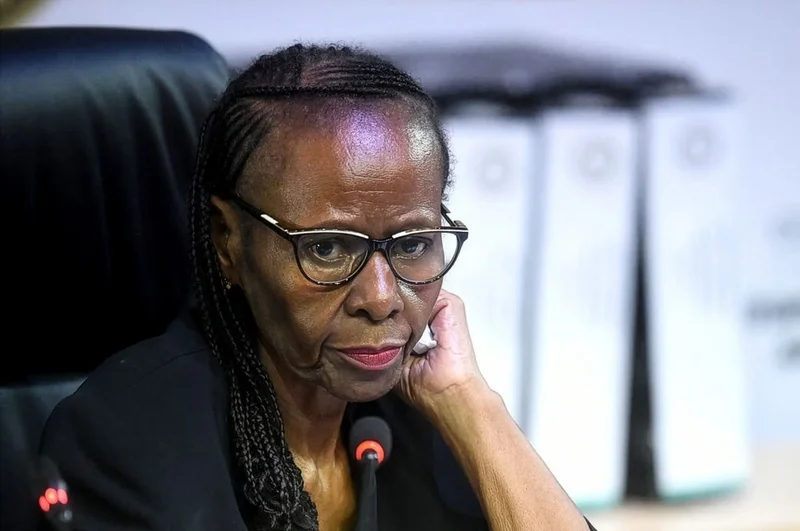
Two former senior executives of the National Prosecuting Authority (NPA) and an equal number of former Ministers of Justice and Constitutional Development appeared before the Truth and Reconciliation Commission (TRC) Cases Inquiry which is sitting at Newtown, Johannesburg.
They were interrogated on their roles in relation to the reluctance of prosecuting the TRC cases.
The Khampepe Commission's main purpose is to establish reasons why the TRC cases which were referred to the South African Police Service (SAPS) for investigations and NPA for prosecutions never made it to court.
The Commission is chaired by former Deputy Chief Justice Sisi Khampepe, alongside retired Northern Cape High Court Judge President Justice Frans Diale Kgomo and Advocate Andrea Gabriel, SC.
On Monday, the former head of the defunct-Scorpions, Geophrey Ledwaba, returned to the hot seat to answer for his role between 2003 to 2005 when he was heading the investigative unit.
Ledwaba defended the Scorpions refusal to provide investigators for the TRC cases because he believed that the Directorate of Special Operations (DSO) did not have legal authority to deal with TRC cases.
Earlier in April 2025 when he appeared before the Khampepe Commission, Ledwaba vehemently denied claims that he halted the Scorpions' investigations into TRC cases in 2003.
"All the TRC cases were initially with the SAPS and Director of Public Prosecutions (DPPs) after the TRC. Bulelani Ngcuka decided to bring those cases into his office and developed the Special National Projects Unit (SNPU) after the TRC hearings.
"It started operating in his office. Ngcuka with his management decided around mid-2002 or early 2003 to dump this unit into the DSO," charged Ledwaba.
Ngcuka served as the National Director of Public Prosecutions (NDPP) from 1998 to 2004. The TRC, chaired by the late Archbishop Desmond Tutu, held its public hearings between 1996 and 1998. Although the hearings ended in 1998, the commission officially concluded its work in 2000 after finalising its investigations and the amnesty process.
Former Minister of Justice and Constitutional Development, Penuell Maduna, who served from 1999 to 2004, maintained on Tuesday that his powers were limited to his political responsibilities.
"The Constitution deliberately does not say that the Minister is part of deciding whether to prosecute or not.
"It rests solely in the hands of the National Director of Public Prosecutions (NDPP). My work would be to answer questions in Parliament," said Maduna.
The 73 year-old Maduna was appointed as the minister between 1999 and 2004.
He emphasised that he could not cross the line between his political responsibilities and the administration of the department, describing it as "a no-go area for any minister".
He highlighted the glaring tensions between the then National Police Commissioner, Jackie Selebi and Ngcuka, echoing what Ledwaba had said on Monday. He acknowledged that attempts to mend their relationship had failed.
He lamented the government's absence of a policy or stance on the TRC matter, "There was never a cabinet position about that (TRC cases)," he said.
Yesterday, another former Justice Minister, Mohamed Enver Surty, echoed Maduna's sentiments that it would have been inappropriate and illegal to interfere with the work of the NPA. "I did not have powers to direct prosecutions. It solely rests with the NPA which has functional, institutional and legal authority. It is not in my nature to interfere with prosecutorial processes," he said.
Surty served a brief stint as minister from September 2008 to May 2009.