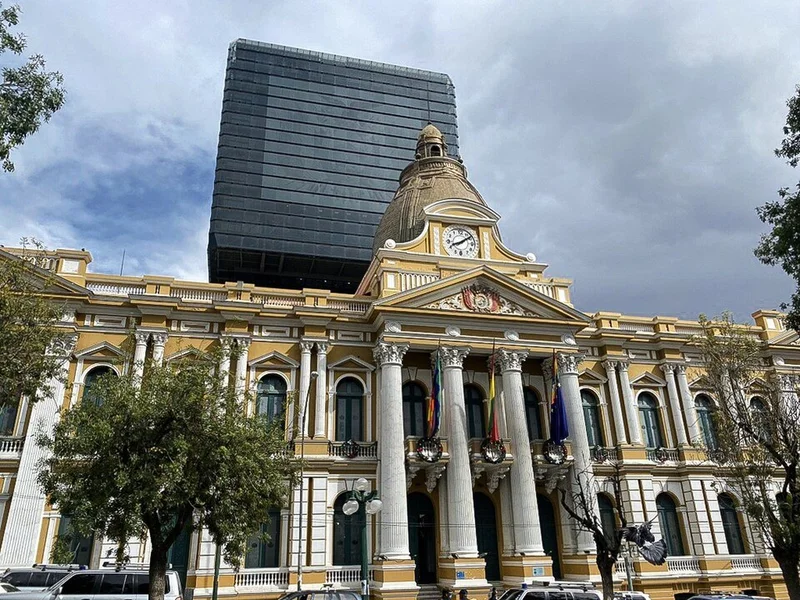
Bolivia’s Congress Says It Removed the Economy Minister. The Government Says the Vote Does Not Count
Bolivia · POLITICS
A censure that should have ended a ministry in twenty-four hours has instead produced an argument about arithmetic — and it is going to the Constitutional Court.
The Bolivia economy minister censured by Congress on Tuesday still has the job four days later. That is not an oversight. The government’s position is that the vote never met the constitutional threshold, and what began as a political defeat for President Rodrigo Paz has turned into a dispute about how you count two-thirds of a legislature.
What the Bolivia economy minister vote actually was
On 18 August the Plurinational Legislative Assembly censured José Gabriel Espinoza: 91 in favour, 34 against, 4 abstentions. There were 129 legislators present. The Assembly has 166 seats.
Those three numbers are the whole argument. Article 158.I.18 of the constitution provides for censure by two-thirds of the Assembly’s members, and says a censure shall imply dismissal. Law 1350 of 2020 puts a clock on it: once the censure is formally known, the president has 24 hours to remove the minister.
Ninety-one is comfortably two-thirds of the 129 who turned up. It is not two-thirds of 166, which would be 111. The Assembly read the requirement as two-thirds of those voting. The government reads it as two-thirds of the membership, and on that reading the censure is void.
So the deadline came and went. The presidential spokesman said Espinoza remained in full exercise of his functions, and the government called the resolution unconstitutional. Espinoza has said he will take the question to the Plurinational Constitutional Court.
Why the government is fighting rather than conceding
It would be easy to read this as a president protecting a colleague. The stakes are more concrete than that.
Law 1350 does not just require dismissal. Article 4 bars a censured minister from holding any ministry, or the leadership of any public institution or state enterprise, for three years. Conceding the censure does not cost Paz a minister for now; it costs him that person for the rest of his term.
There is also a precedent that cuts against the Assembly, and it is the strongest card the government holds. Bolivian presidents have dismissed censured ministers and then reinstated them — both Luis Arce and Jeanine Áñez did it. A mechanism that has been worked around before is not the automatic guillotine the Assembly is describing.
Which is why the Constitutional Court matters more than the vote. Until it rules, Bolivia has a censured economy minister running economic policy, and neither branch has an incentive to blink.
The censure was about an empty chair
The substance is worth separating from the procedure, because they are not the same thing.
Espinoza was not censured for his handling of the economy. He was censured for not showing up. Summoned to an interpellation carrying 29 questions, he cited official travel to Santa Cruz and to Brazil. The Assembly rejected that excuse by 81 votes to 43, and then censured him.
The questions he did not answer were substantial: monetary policy, macroeconomic planning, the general state budget, operations in sovereign bonds, matters concerning the central bank and Banco Unión, fuel supply, and unanswered requests for information.
One item on that list had been signed the day before. Supreme Decree 5676, promulgated on 17 August, sets the diesel price for large consumers at Bs 18 a litre — about US$1.58 — while transport operators and private motorists continue to pay Bs 9.80, roughly US$0.86. That is a partial withdrawal of the fuel subsidy for industrial buyers, announced one day before the minister responsible declined to appear before Congress.
The economy underneath the argument
The central bank’s latest inflation and monetary policy report projects the economy will contract 3.6% in 2026. The first half is already in: output fell 3.34%. Bolivia grew 0.73% in 2024 and shrank 1.58% in 2025, so this is a second consecutive year of contraction and a much deeper one — on track to be the worst since the pandemic.
Inflation is the one number moving the right way. The bank projects 9.22% for 2026, down from 20.4% at the end of 2025. That is real disinflation. It is also cold comfort when it arrives alongside a shrinking economy, and the same report projects the number of Bolivians in poverty rising to about 5.7 million from 5.4 million.
Then there are the reserves, and the composition matters more than the total. Bolivia held US$3,617.3 million at June 2026 — up from US$1,976 million at the end of 2024, which sounds like recovery until you look inside. Only US$666.1 million of it is foreign currency. US$2,882.9 million is gold, and the June fall came from a drop in the gold price rather than from spending.
An economy that imports its diesel and defends a managed exchange rate with US$666 million of actual currency has very little room. That is the backdrop to the fuel decree, and to the questions the Assembly wanted answered.
Why this matters if you are exposed to Bolivia
If you trade with or invest in Bolivia, the practical question is authority. An economy minister whose removal has been voted by Congress and refused by the president is not in a strong position to commit to anything, and counterparties should assume decisions will wait for the Constitutional Court.
If you follow the region, note what is being tested. This is not a fight about economic policy; it is a fight about whether a legislature can enforce its own censure. However the court rules, it will set the price of ministerial accountability in Bolivia for the rest of this term.
And if you are watching the numbers rather than the politics, watch the fuel. Diesel supply and the Bs 18 — about US$1.58 — now charged to large consumers will tell you more about the next six months than the cabinet list will. Bolivia is short of the currency it needs to import the fuel it does not produce, and no vote in the Assembly changes that.
Frequently Asked Questions
Has Bolivia’s economy minister been dismissed?
No. The Plurinational Legislative Assembly censured José Gabriel Espinoza on 18 August 2026 by 91 votes to 34 with 4 abstentions, but the government says the censure is unconstitutional and he has remained in post. Espinoza has said he will refer the question to the Plurinational Constitutional Court.
What is the constitutional dispute about?
Article 158.I.18 provides for censure by two-thirds of the Assembly’s members. The Assembly counted 91 votes out of 129 legislators present; the government argues the threshold is two-thirds of the full 166-seat membership, or 111 votes, and that the censure is therefore void.
Why was he censured?
For failing to attend an interpellation session carrying 29 questions on economic management, citing official travel. The Assembly rejected that excuse by 81 votes to 43 and then censured him. The censure was for the absence, not for a specific policy.
This article was produced by The Rio Times’ automated newsroom system. How we use AI · Report an error