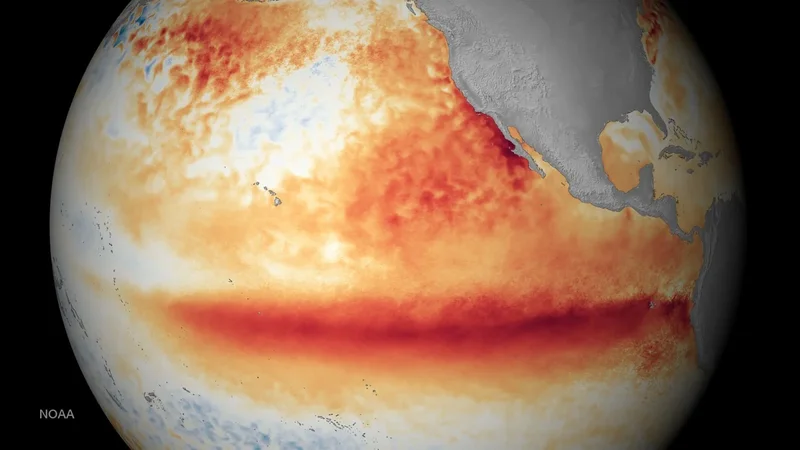
The already superlative El Niño that began earlier this year is looking to be the largest El Niño in living memory and likely the strongest since the 19th century, the U.K. Met Office reports.
“We should be clear that this is an unprecedented event,” said Adam Scaife, the Met Office’s head of long-range forecasting, in a statement. “I have never seen an El Niño signal this intense in our forecasts.”
El Niño is a cyclical climate phenomenon where a “warm pool” in the tropical Pacific shifts from its usual spot in the west to the east. This El Niño has steadily gained steam since it was declared in early June, setting a sea surface temperature record for that time of year. And because El Niño typically peaks in late fall to early winter, this event is likely to be a blockbuster.
On supporting science journalism
If you're enjoying this article, consider supporting our award-winning journalism by subscribing. By purchasing a subscription you are helping to ensure the future of impactful stories about the discoveries and ideas shaping our world today.
During an El Niño, temperatures in the eastern tropical Pacific generally rise by about one to two degrees Celsius (1.8 to 3.6 degrees Fahrenheit) above normal, “with 2o C being a really big event,” Scaife said. This year’s event is predicted to hit around three degrees C (5.4 degrees F) above normal, well into the territory of what is colloquially termed a “Super El Niño.” If that forecast bears out, “then 2026 will far exceed our recent experience of El Niño and its worldwide climate influences,” he added. The most recent very strong El Niños occurred in 1982–1983, 1997–1998 and 2015–2016.
El Niño changes the weather around the world by adjusting where heat is released into the atmosphere, which alters major wind patterns. In fact, this event has already juiced Hurricane Lala, whose rainfall devastated Hawaii (though it is keeping a lid on Atlantic hurricane activity) and has contributed to well-below-normal rainfall from the Indian monsoon.
The strength of this El Niño could cause 2026 to become the hottest year on record—it will certainly be among the hottest years. But 2027 may be more likely to take the top slot because the effects of El Niño’s heat release happen on a delay. (Both 1998 and 2016 were record hot years, but both have since fallen down the rankings as climate change has made record hot years more likely.) Either way, 2027 will probably be “another year to temporarily exceed +1.5 C above the preindustrial period,” the Met Office’s Nick Dunstone said in the statement.