In November 2024 an open standard for connecting AI models to outside tools was downloaded about a hundred thousand times in its first month. By March 2026 the same standard was being downloaded 97 million times a month. On Thursday the largest cryptocurrency exchange in the world plugged itself into it.
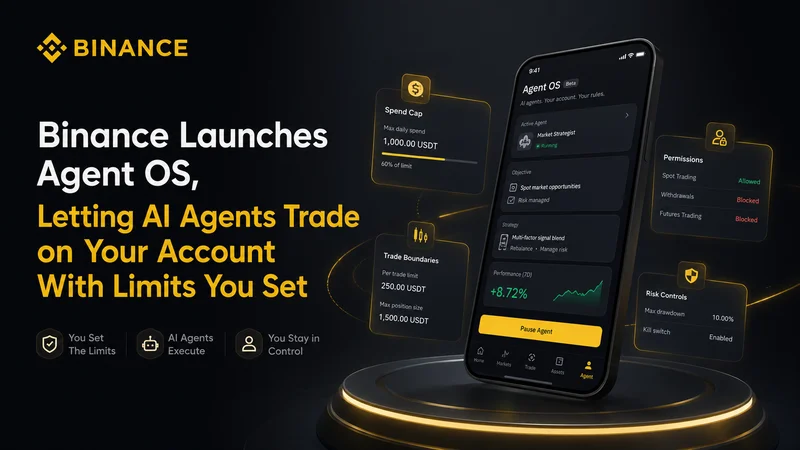
Binance introduced Agent OS, a developer platform and standardised access layer that connects AI applications to the exchange's trading, market data, wallet, payment and on-chain capabilities across crypto and traditional markets. Built as part of Binance Intelligence, the company's programme for AI-powered products, it bundles Binance APIs, the Binance Wallet Agentic Hub, Binance x402 for programmable payments, the Binance Skill Hub and newly introduced support for the Model Context Protocol. Compatible clients that speak MCP over Streamable HTTP connect at https://agent.binance.com/mcp/agentic, with setup documented in the Binance MCP Server documentation.
The practical effect is that a user running ChatGPT, Claude Code, Codex or Cursor can authorise an agent to read market data, view account information and place trades, subject to permissions the user configures. Each agent can be assigned its own subaccount, which segregates the funds and the activity from everything else the user holds.
The standard that stopped being optional
The choice of MCP is the most consequential design decision in the announcement, and it is worth understanding why before assessing what Binance built on top of it.
Anthropic ecosystem updates and Practical DevSecOps, compiled from published MCP adoption reporting.
MCP was published by Anthropic in November 2024 and grew roughly 970 times in eighteen months, but the shape of the curve matters more than its slope. Each acceleration follows an adoption decision by a competitor rather than by the author. OpenAI built MCP into its Agents SDK in March 2025, Google added it to Gemini shortly after, Microsoft shipped it across Copilot Studio, Windows, GitHub and Azure AI Foundry by July, and AWS followed in November. In December 2025 Anthropic handed governance to the Linux Foundation, which removed the last objection an enterprise architect could raise, namely that adopting MCP meant adopting a single vendor's roadmap. By the time the 2026-07-28 specification landed in July, more than ten thousand public MCP servers were running.
For an exchange, that history reframes the build decision entirely. Two years ago, exposing trading to AI applications meant negotiating a bespoke integration with each assistant vendor and maintaining it as each one revised its tool format. Today it means publishing one server and being reachable from every client that already speaks the protocol.
The arithmetic that makes a standard worth adopting
The fragmentation Jeff Li describes is not rhetorical. It is a multiplication problem with a specific answer.
With roughly 300 MCP-capable clients and about 10,000 servers in the ecosystem, a world without a shared protocol would require up to three million individual integrations to connect everything to everything. With a standard it requires 10,300, one per client and one per service. That is 291 times less software to write, review, secure and keep working through every version change on both sides.
This is why Agent OS is better understood as a distribution decision than a product launch. Binance has not built an agent, and it has not built a trading assistant. It has published an address at which every agent already in existence can find it, which is a different and considerably cheaper bet.
What the machines are actually moving
The sceptical reading of agentic finance is that it is a demonstration in search of volume, and until recently that reading was correct. The data has moved.
x402, the protocol Binance has integrated for programmable payments, revives the dormant HTTP 402 status code so that a machine can pay for a resource inside the request itself. Coinbase reported roughly 165 million cumulative x402 transactions across about 69,000 active agents by late April 2026. Raw transaction counts are the least interesting number in that sentence, because a great deal of early activity was testing rather than commerce, and daily volumes fell sharply from their December 2025 peak as the speculative cohort left.
What is interesting is the composition. Payments of a dollar or more went from 49% of protocol volume in early 2025 to 95% in early 2026, while the ten-cent to one-dollar band collapsed from 46% to 4%. The count of agentic payments has cooled and the value of each one has risen by an order of magnitude, which is the profile of a rail that is being used rather than demonstrated. That transition is precisely when the identity of the counterparty starts to matter, and when a venue holding real customer balances becomes more useful than a testnet.
Permissions as the product
The most defensible part of Agent OS is the part that constrains it, and the design reflects a clear-eyed view of what can go wrong. An agent operates inside a dedicated subaccount. It can view balances, portfolio information and transaction history for that subaccount, plus balance and portfolio information for the main account. It cannot reach non-trading personal data, which explicitly includes email address and KYC records. Crypto withdrawals from subaccounts are disabled by default. Permissions are set by the user, scoped to specific activity such as spot or futures, and revocable at any time.
"Instead of total freedom, we put the power in users' hands to give them the granular access control of what they can do through the agent," Jeff Li, Binance's VP of Product, told TechCrunch. Li joined Binance in October 2024 after running CeFi product at another major exchange and, before that, the TikTok Money and Compliance Platform, with earlier engineering roles at Instagram, Twitch and Oracle. A product leader whose formative work was a payments compliance platform is an unusual and rather appropriate person to design the permission surface for autonomous trading.
The company is equally direct about the boundary of its own visibility. Binance monitors and applies controls to the trading activity an agent initiates, including the resulting orders, but the agent's information sources, interpretation and reasoning run inside the user's chosen AI application and are not visible to the exchange. "We really cannot see the reasoning of what the user's action is," Li told the same publication. That is an honest statement of where responsibility sits, and it is the sentence regulators will read first.
They are already reading. Singapore's SAFR framework proposes runtime governance for AI agents, and ESMA has told investment firms deploying AI that MiFID II obligations on organisation, conduct and acting in clients' best interests continue to apply. The Agent OS permission model, with its per-agent subaccount, default-off withdrawals and revocable scopes, reads like an attempt to build the audit trail those regimes will ask for before anyone formally demands it.
Last to the race, first in liquidity
Binance is not the first exchange to open its systems to agents, and the piece is more useful for saying so plainly.
Coinbase shipped Agentic Wallets in February and Coinbase for Agents in June. Kraken published a command-line tool with a built-in MCP server in March, covering spot and futures. OKX released its open-source Agent Trade Kit on 2 June and an AI marketplace at the end of that month. Finance Magnates Intelligence counted at least ten retail brokers and platform vendors wiring agents to live client accounts between January and June.
Arriving eighth is a disadvantage in a feature race and close to irrelevant in an infrastructure race, because what an agent needs from a venue is not novelty but depth. Binance closed 2025 with 300 million registered users and $34 trillion in total product trading volume, held roughly 38.7% of top-ten centralised spot volume in the second quarter of 2026, and reported $152.9 billion in customer assets. An agent executing a strategy cares about the spread it crosses and the size it can move without moving the price, and on both measures the venue that shipped last is the venue that matters most.
There is a second signal in the dateline. The announcement came out of Abu Dhabi rather than Dubai or Singapore, because Binance.com became the first crypto exchange to secure a global licence under the ADGM framework in December 2025, with the global platform running through three regulated entities and commercial operations beginning in January 2026. Launching autonomous trading from inside a supervised jurisdiction, rather than from a jurisdiction of convenience, is a deliberate choice about which conversation the company wants to be having in twelve months.
The gap this is really aimed at
Set the agentic economy's current throughput next to the balance sheet it is now connected to, and the strategic logic becomes hard to miss.
Real x402 commerce currently annualises to roughly $10 million and all x402 settlement since launch amounts to about $50 million. a16z crypto has projected that autonomous transactions could reach $30 trillion by 2030. Between those two figures sits a gap of six orders of magnitude, and the interesting detail is where Binance already stands relative to both. Its 2025 product trading volume of $34 trillion is larger than the entire 2030 projection for autonomous transactions. The measures are not like for like, and one is a forecast rather than an observation, but the comparison establishes the point that matters commercially. The liquidity agents will eventually need already exists, it is already concentrated, and it has just been given an address that agents can resolve.
What has to go right
Agent OS occupies the hardest possible position, sitting between a probabilistic system and a live order book, and the four open questions are worth naming precisely.
Authorisation is the first. The permission model is granular and revocable, and the harder problem is what a user actually understands when they grant a scope. Binance has addressed the mechanics well, with per-agent subaccounts, withdrawals off by default and immediate revocation, and the remaining work is in how those choices are presented at the moment of granting.
Attribution is the second. Because reasoning stays inside the user's AI application, reconstructing why a trade happened requires evidence from two systems that do not share a log. Binance's decision to monitor and control the resulting orders gives it the half of the record it can actually hold, and the emerging governance frameworks will determine who is expected to hold the other half.
Prompt integrity is the third, and it is the risk least discussed in the coverage so far. An agent reading market commentary is reading text, and text that reaches a model can carry instructions. The subaccount boundary is a sound structural answer, since it caps the blast radius by construction rather than by detection, and the layered defence beyond it will develop as the category does.
Metering is the fourth. Exchanges price for humans, in fee tiers built around the assumption that a person places a bounded number of orders. Agents poll, re-evaluate and act continuously, and rate limits designed around human latency become the binding constraint on what a strategy can do. Whoever solves pricing and throughput for machine clients will define the commercial shape of agentic trading, and Binance ships this with the deepest book from which to make that call.
What to watch
The honest read on Agent OS is that Binance has made a modest technical bet in service of a large strategic one. Publishing an MCP server is a week of engineering compared with what the exchange has built elsewhere. What it buys is optionality on a question nobody can answer yet, which is whether autonomous software becomes a meaningful share of order flow, and the cost of being wrong is a maintained endpoint while the cost of being absent is discovering that agents standardised on a competitor's tool schema.
Three things will show whether the bet lands, and none of them is a press release. The first is the shape of the flow. If agent-initiated orders cluster in small, frequent, market-neutral activity, Agent OS is a retail convenience with a long tail. If they arrive as size, in subaccounts funded like desks, Binance has opened a new institutional channel under a different name. The second is what ships next, because Li has called this a first step and the components already assembled point somewhere specific. An MCP server is discovery, the Skill Hub is capability, x402 is settlement, and the Wallet Agentic Hub is on-chain reach. Read together they describe an agent that can find a service, use it, pay for it and settle it without a human in the loop, and the sequencing of that stack will say more about the roadmap than any roadmap does.
The third is the one the whole category turns on. Agentic finance has spent eighteen months proving that machines can transact and almost no time proving that they should be trusted with balances that matter. The transition from 165 million tiny payments to a dollar-weighted rail is the first evidence that the question is becoming real, and the arrival of an exchange with $152.9 billion of customer assets is what makes it consequential. Binance has drawn the boundary in the sensible place, giving the agent a walled subaccount and the user the key, and the interesting thing about that design is how much it resembles the way institutions have always handled delegated authority. The mandate is narrow, the limits are explicit, and the principal can withdraw it at any time. What is new is that the party receiving the mandate is not a person, and the exchange that runs the largest book in the market has just decided that is a distinction it can build for.
Don’t forget to like and share the story!
Vested Interest Disclosure: HackerNoon has reviewed the report for quality, but the claims herein belong to the author. #DYOR.