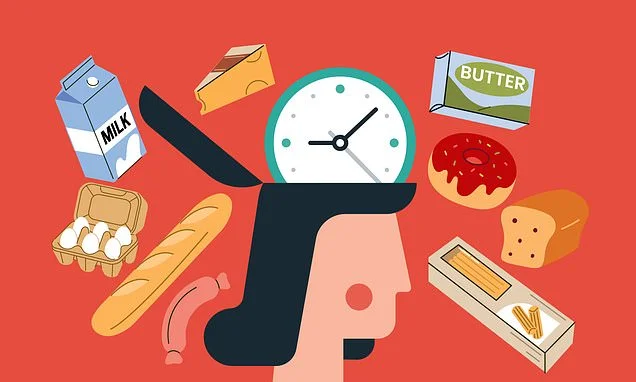
I have always felt fat. As young as ten (I know because I still have my childhood diaries), I was complaining about the size of my stomach. I regularly berated myself for how much I had eaten.
Only twice in my life have I felt ‘thin’: the first was on my wedding day, when I was 29, and the second was after a bout of pneumonia when I was 35.
At all other times I have considered myself to be fat, podgy, doughy. Objectively, I am not overweight and never have been. As an adult I have always been between dress sizes 10 and 12. I am 5ft 6in, my weight shifts between nine and 9½ stone and I have a BMI of around 20.8.
I’m not sure where my anxiety comes from – my mother had a healthy attitude towards food and I don’t remember fat-shaming going on when I was growing up.
I’m too lazy to go to the gym. I am active: housework sees me running up and down stairs and with two children I’m constantly busy. I also choose to walk whenever I can. But when it comes to my weight, I focus on what I eat.
When the phrase ‘food noise’ came along about three years ago, I didn’t think it applied to me – I thought it meant you were unable to resist the siren call of biscuits. But it can also be worrying about what you have eaten and are going to eat.
This is definitely me. At times it is unbearable. I can spend weeks feeling panicky about my weight and my solution is control.
I turn down social events to stick to my time-restricted eating window (11am-7pm), ban sugar and spend half my day shopping for and then cooking elaborate, ultra-healthy meals that will regulate my blood sugar.
'Food noise' can refer to worrying about what you have eaten and are going to eat, says Esther Walker
My family tease me relentlessly when I am on these health drives. ‘Only a tiny stick of celery for me!’ my teenage son will squeal.
My husband, who is a restaurant critic, knows that I will not go to a restaurant with him if there is a multi-course tasting menu or if I’m expected to eat late. He gave up insisting that I’m not fat, as it falls on deaf ears. And he’s sympathetic to my neurosis – he, too, worries about being or getting fat (it’s a major occupational hazard).
But even when I have ‘won’ and lost weight, I’m never happy. And all the hard work only ever results in a tiny difference, anyway, probably just visible to me.
This is a familiar story to Elle Mace, author of the new book Food Freedom, which addresses this doom-cycle. Mace is an integrative practitioner specialising in disordered eating and has years of experience working with athletes.
She has her own story of body-image issues: early in the book, she recalls making herself sick before a client dinner. Her inner voice demanded she bring up her lunch and she obeyed. She went directly to her work event as her usual chirpy self.
She writes: ‘Nobody would have known that ten minutes before I was lying on my bathroom floor feeling like I was having a psychotic episode.’
It was the epiphany she needed to address the negative way she viewed herself. She embarked on a psychological journey, including therapy, extensive reading and her own research to understand herself better and, in turn, decided to help others.
The first thing, she explains, is to understand where the issues come from.
‘For me it was a combination of things,’ she says. ‘First, just who I am – a competitive person. I also learned that my worth was based on what I looked like: at primary school the thin girls were popular. I concluded that to be accepted, I needed to be thinner. I also internalised everything.’
Control over food and weight for Mace – as it is for me – felt soothing.
The most common problem Mace sees in clients is a cycle of restricted eating, followed by bingeing. ‘Many have been dieting for years and don’t even realise they’re doing it. They have lapsed into a disordered pattern of not eating enough then overeating, which is the quickest way to gain weight.’
So-called ‘diet culture’ is often blamed for disordered eating. Instagram users who pause for too long on weight loss content will subsequently be bombarded with diet and exercise inspiration.
Mace is clear on this: avoiding social media will help. ‘This was sold to us as inspo, but it can make you feel bad about yourself. My advice to clients is that if they are feeling vulnerable, TikTok or Instagram content won’t help.’
I discuss my strong perfectionist streak with Mace, which expresses itself in relentless forward-planning and a strict inner voice telling me that things must be done to a certain standard.
Perfectionism doesn’t mean you’re perfect (in fact, perfectionists’ lives can seem chaotic); it’s an offshoot of low self-esteem. It sees you setting yourself a series of unachievable goals – used as proof to yourself that you’re worthless.
Mace points out that control over food and weight is a big part of this and reminds me that everyone has a set weight point. ‘To be two sizes down from that you would have to be living in a constant state of restricted eating, which makes it hard to live a normal life.’
Mace is surprised at how much misunderstanding there is around nutrition, seeing clients who eat protein bars rather than meals or believe all carbohydrates are bad. ‘I urge people to go back to basics: have carbs, protein, fibre and fats in as many meals as possible.’
The inconvenient fact, though, is that shopping for and cooking healthy meals is time-consuming. For many it seems far easier to use GLP-1 medication – commonly sold as Ozempic or Mounjaro – which mimics the ‘fullness’ hormone. I’ve thought about using Mounjaro many times, even though I wouldn’t qualify.
Mace is scathing about the misuse of these drugs by those who don’t need them, but have a distorted body image, as perhaps I do.
‘I know people who have gone from a size 10 to a size 6 by taking these drugs,’ says Mace, ‘but there are consequences. Rarely do I meet someone on them who hasn’t had a problem with hair and muscle loss, as well as skin or stomach issues.
'They’re often depleted, exhausted. Then, when they come off medication, their hunger returns with a vengeance and the weight goes back on.’
The bottom line, she says, is there are no shortcuts. ‘At some point you have to make peace with your body.’
So much of what Mace says rings true to me. While I can’t see myself ever giving up my time-restricted eating window, or relaxing about various no-no foods, I can see she is right about social media. Those harmless-seeming body inspo accounts do give me a distorted idea of what I ‘ought’ to look like – so they’re out. The only social media I use is Instagram. I have a 15-minute time limit and content that makes me feel bad gets muted.
Mace has also helped me see that panic about my weight is connected to feeling out of balance with work, family and friendships. There’s still plenty to do, but Mace’s advice has made me think there might, one day, be peace for me, too.
Food Freedom by Elle Mace is published by Vermilion, £14.99. To order a copy for £12.74 until September 6, go to mailshop.co.uk/books or call 020 3176 2937. Free UK delivery on orders over £25.