There's a trending topic on X under the hashtag #wherearetheblackgirls—a social media movement and cultural critique that was created to demand better representation for Black women and girls in television, film and media.
Every new show or film with an ensemble cast seems to centre on a white or racially-ambiguous main female character who has at least one non-white actress as a friend, antagonist or recurring character who doesn't recur that much.
In a world that churns out these kinds of (mis)representations in the coming-of-age genre, stories like Sandulela Asanda's Black Burns Fast become all the more important.
The study of identity and becoming in the social structures of high school is a teen media staple but the tropes have often sidelined Black girls, rarely affording them the grace to simply exist and be young.They are either flattened, tokenised or typecast into trauma-laden narratives that make them appear far more mature than their counterparts.
In contrast, Asanda's feature debut is a whimsy exploration of Black girlhood and first love.
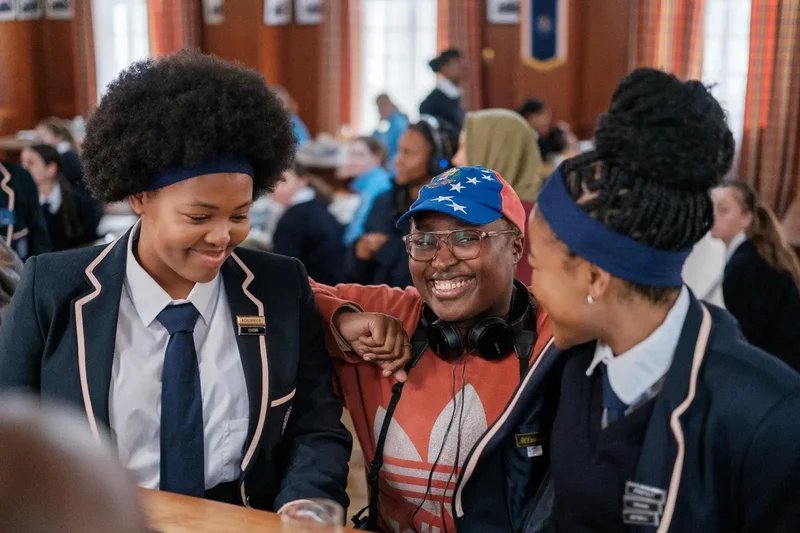
Set in a prestigious Christian boarding school, the film follows Luthando, 17, played by Esihle Ndleleni, a smart and incredibly disciplined scholarship pupil whose curated life takes an interesting turn when a new student, Ayanda, played by Muadi Ilunga, arrives.
What unfolds is a cute and quirky, visually intriguing coming-of-age romance that bypasses the tropes and takes a girl who's always believed herself to be one thing and places her in a group of girls who show her the possibilities of girlhood.
Asanda delivers a whimsical love letter to queer Black girlhood that insists on treating young womanhood as the joyful act of self-discovery it is, rather than a moral obstacle.
Speaking to Asanda about her film, the queer writer-director with a background in economics and law says they have always been curious about the world and the way things work, especially where women and queer people are concerned."When I started writing this film, I had been a baby gay on the streets of Cape Town for a while but I had decided to tell my parents. This was around the first year of Covid," they say.
During online conversations with a group of people from previously all-white schools about their experiences, the Safta Youth Achiever recipient was taken back to their time in high school, wondering if their queerness was known to them and the people in their lives at the time, coming to the conclusion that it couldn't have been.
"There was no way for me to know because there was just no room for it in that space. No one spoke about it."
There is a sadness that comes with the realisation, Asanda notes, highlighting how they feel like they got to know themselves after confirming their sexuality."I was just so much more confident and happier as a person. Whereas in high school, I really had a rough time, especially in an all-girls boarding school setting."
You would not be remiss in believing this is what led to the existence of Black Burns Fast but the breakthrough came when Asanda went searching for Black lesbian films to aid them in telling their story.What they found was Pariah, Dee Rees's 2011 film that follows Brooklyn teenager Alike navigating her burgeoning identity as a lesbian while battling societal stigma and her religious family's pressure to conform.
"Pariah scared me so much," Asanda chuckles, adding how it is a "beautiful" film, groundbreaking in its storytelling and cultural importance."But it did scare me in a sense because I saw so much of my own parents in that film."
Asanda also saw themself and was shown what it's like to exist as a queer woman, especially how the fun parts of their experience weren't as prominent in the stories.
It was a glaring realisation that led them to what would become Black Burns Fast—how few mainstream stories centred Black queerness with nuance, warmth and playfulness.That is the space they needed to occupy, a gap they wanted to fill.
Determined to avoid trauma porn, the writer-director created a narrative where girls like Luthando, Ayanda, Zenande and the Galz are granted the grace and complexity they deserve, even when navigating complex familial dynamics.Asanda does this with the characters in mind—their psyche and how they best position themselves in the spaces.
"I always knew that this film needed to focus on the interiority of a Black girl," Asanda says."Especially for a character like Luthando who, like me, grows up being told that she's not like a normal Black girl."
Aiming to prioritise Luthando's interiority as they experience it, Asanda's earliest decision was framing the narrative in a 4x3 aspect ratio that locks us inside Luthando's world.Everything else is noise.
Black Burns Fast works as a quirky and cute visual diary of a girl navigating young adulthood because of how it is shot and edited, with cinematography from Pierre de Villiers, editing by Talya Jay Kahan and VFX by Nicolai Groudev.Instead of filtering Luthando's growth through the world's reception of her, Asanda uses playful video game inserts, fish-eye lens shots and engaging dream-like cut-outs; stylistic flourishes that act as direct portals into Luthando's frame of mind and view of the world.
For Asanda, these were deliberate choices that stemmed from their own experiences of their youth and coming into themself and their queerness, to show the fun side of growing up—composites of a cinematic movement founded by Kenyan filmmaker Wanuri Kahiu called Afrobubblegum dedicated to tracking joyful, vibrant and thriving African protagonists.
"Yes, times were tough," Asanda continues, speaking about their decisions to put in the jokes and special effects that painted the world of the particular stories."But we had so much fun and we made it work. This is also a love letter to all those girls who kept me sane during that."
Through research into animated films, music videos and adverts, Asanda built on techniques explored in their debut short film, Mirror Mirror, to infuse the script for Black Burns Fast with playfulness to highlight the innocence of adolescence.
When Luthando meets Ayanda, the outspoken rebel who openly critiques outdated ideals of sex education, smokes and bakes space muffins, her world is turned upside down. Questions arise. Friendships are neglected. She meets herself anew. And with that comes the mess of teenage pangs.
We see each girl go through changes in this period.Black Burns Fast, in staying true to the director's goal of subverting classic high school tropes, showcases a spectrum of Black girlhood, rejecting monolithic representation.
"A lot more media would benefit from having more than one Black girl," Asanda says about representation and how Zenande and Ayanda's characters stand out.
Zenande, the Galz trio leader, is a popular girl who is kind and fights for her friends.Ayanda is a dark-skinned girl who shakes things up the same way we assume she did at her previous school.
"It was important for me to show that Black girls can be more than one thing."And they need not be punished for being those many things.
In a review I read in preparation for my conversation with Asanda, there was a critique of how the resolution to Luthando's transgressions with the school were quickly resolved.
Asanda noted that Luthando, like the other girls, is allowed to be messy.Her journey to self-discovery is an exploration of the fragility of a character in flux, showing how easily a teenager can descend from innocence into chaotic rebellion and back again.
The film understands that teen self-discovery is rarely linear; Luthando devolves and evolves but, crucially, her mistakes are never judged as moral failures.They are simply the awkward, essential ruptures of a kid growing up in a suppressed environment.
The refusal to indulge Luthando's punishment is yet another example of the director's intention to centre Black girls' experiences and not the trauma the world imposes on them.
Having made its festival debut at the Durban International Film Festival in June last year, before travelling internationally to festivals like BFI Flare and the Berlin International Film Festival, Black Burns Fast will be returning to South African cinemas from July 31.
The bold and bubbly film brings a vital message back home: queer South African youth deserve mainstream space, joy and the freedom to see their full humanity celebrated.