Every property professional in Cape Town seems to have heard a version of the Martin Wragge story, usually never the full picture. He’s a colourful character whom I have heard a lot about over my time spent in real estate.
Wragge is a South African property developer and executive. His kaleidoscope of a career includes developing the start of what we know today as Century City and Canal Walk Shopping Centre; Africa’s first amusement park, Ratanga Junction; and Tygervalley Shopping Centre, which he developed over a decade before Canal Walk.
He has also written and produced motion pictures, including The Last Warrior, Survivor, A Matter of Principle, Death Rattle, Death of a Snowman and Ratanga’s Fire & the Galopata Machine.
Wragge’s speciality is large-scale mixed-use developments. By his company’s count, he has developed more than three million square metres of commercial, industrial, residential, leisure and retail space in South Africa as well as a further two million square metres in China.
Yet search his name or ask around and there’s little to learn about the man who has done some remarkable work in the real estate world.
In the mid-1990s, the land that would become Century City belonged to a listed company, Ilco Homes, which had been trying to build affordable housing on the site under the name Summer Greens.
It didn’t work. Ilco owed Christo Wiese’s Boland Bank about R80 million and was losing roughly R1m a month. The banks needed someone to rescue the project. They turned to Monex, the Cape Town development company Wragge headed.
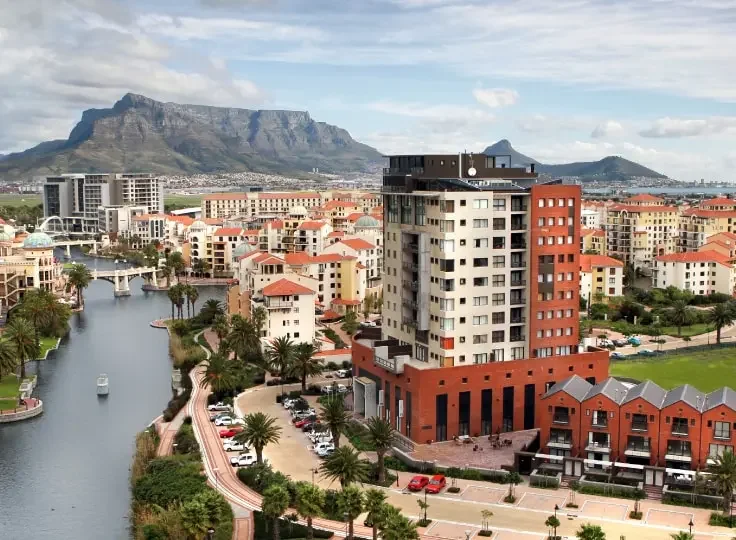
What he inherited was, in his own words via a Finweek interview, “basically a swampland, underwater and with no access to the N1”. Wragge’s insight was that the land could be saved only by rezoning it from residential to mixed-use. The infrastructure the site needed could never be paid for by housing alone.
“We knew that if we failed to get the land rezoned, we were going to go down the toilet. No cigar,” he said.
He got the rezoning: 680 000m2 of commercial bulk, then believed to be the largest single rezoning approved in South Africa. Sod-turning began in 1997.
People thought Wragge had lost the plot. The project looked too ambitious for the time. The first years were slow and a recession made corporate buy-in almost impossible. Then PwC, Vodacom and the Louis Group announced new offices in Century City, with the South African Police Service, Unisys and Business Connexion following.
Many people predicted that Canal Walk would be a disaster. The enormous plans included a 252 hectare precinct intended to hold 3 500 houses, 1 500 flats, 700 000m2 of office space, Canal Walk with a gross lettable area of around 140 000m2 and a 40ha amusement park called Ratanga Junction.
Getting retailers on board for the mall was, in Wragge’s own words, “the nut to crack — the key success factor to the whole development”. Landlords feared Canal Walk would cannibalise turnover from Tyger Valley, Sanlam Parow, N1 City, the Cape Town CBD, Cavendish and the V&A Waterfront.
Wragge signed 15 major tenants, representing 60% of the mall, before they broke ground, which unlocked R1.6 billion in financing for Canal Walk and Ratanga Junction.
Ratanga Junction is what nearly sank the company. It was built between 1997 and 1998. It was never meant to be the standalone park it became. The original plan was a modest amusement offering inside the mall’s food court, budgeted at R180m.
But the Milnerton Ratepayers’ Association fought the idea. With R100m worth of rides manufactured overseas, Wragge relocated the park to the N1 corner of the site instead. The budget nearly doubled, to R360m.
“In retrospect, I lost Monex with that decision,” he said years later. At its peak, Ratanga had 17 restaurants, 37 rides, four roller-coasters and two theatres. But Cape Town’s wind and winter rain made it a seasonal business at best and the losses became the single biggest drag on Monex’s balance sheet. The park closed for good on 1 May 2018.
Monex’s fortunes swung wildly through the late 1990s — a market cap of R89m in 1996, a profit of R11.4m in 1997 (up from a R12.7m loss), a 340% jump to R39m profit in 1998, R66m by mid-1999 — before a R43m loss in 2000 that included R22.8m in Ratanga pre-opening write-offs.
The share price collapsed from 875 cents to under 400 cents in a year, roughly halving the company’s market value.
The lowest point came in late 1999, when Standard Bank threatened to default on a R621m loan committed to Canal Walk. Wragge described it as “three and a half of the longest months” of his life — he lost 27kg during the crisis.
The bank eventually cut its exposure to R500m, forcing a R121m reduction in the project’s budget.
Despite that, Canal Walk was finished on time and R121m under budget, opening in October 2000 to trading numbers that beat every projection.
Then came the scandal that finally ended his run at Monex.
In mid-2001, Wragge sold 85 000 Monex shares at R1 each before a corporate announcement and didn’t immediately disclose it to the board.
“I reported the sale routinely when I next saw the other directors,” he said. It was reported to the JSE in the same period he disclosed it internally. The Financial Services Board later found no grounds to pursue the matter as insider trading but the accusation had done its damage. Shareholders were furious — Greg Rawlin described his investment as “whittled away by about 90%” and accused the board of having “failed investors” for three years.
Wragge resigned in September 2001. He’d opposed BoE’s push to sell off Canal Walk and Monex’s commercial land bank for quick cash — a call that, in hindsight, looks like the costliest decision of the saga.
Assets were sold at a fraction of their worth: Bellville Waterfront went for R22.5m to a buyer who later made roughly R100m in profit on it. Canal Walk was sold in 2003 for R1.165bn, barely above its R1.24bn construction cost.
By 2007, it was valued at R3.75bn — a R2.58bn gain that Monex’s shareholders and the man who built it never got to share in.
A week after resigning, Wragge joined a South African trade mission to China. He spotted an opportunity on land between the twin cities of Yinchuan and, within days, had a deal in place to build a million square metres across 180ha. That became Forest Park — houses, villas, 11km of canals, a public park and a 56ha theme park in Ningxia province.
In 2007, Chinese premier Wen Jiabao awarded him a gold medal for his contribution to developing the country’s north-west.
Today Wragge is chairperson and chief executive of Gritprop Investment Holdings, the Cape Town company he’s run since 1987, through the Monex years and beyond. Its flagship (according to Wragge’s personal website) is Altona Residential Villages in Worcester — five gated estates planned across roughly 1 967 residential plots.
Today, Century City is home to businesses and residents across thousands of square metres of built space, representing billions of rand in investment. One of Cape Town’s most successful mixed-use nodes, built on land nobody else wanted, by a man who nearly lost everything getting it there and who wasn’t in the room by the time it paid off.