On a spring evening four years ago, the peace of a Bristol cul-de-sac was shattered by what a judge would later describe as ‘shouts and screams of a horrifying nature’.
Neighbours looked out to see a full-scale battle being fought between rival Albanian gangs over control of a cannabis factory in what had only recently been a respectable £400,000 family home.
Witnesses described a scene of ‘extreme violence’ in which one man was stabbed in the back and another smashed around the head with a metal bar.
The carnage ended with the murder of a 32-year-old man who bled to death at the roadside from multiple knife wounds.
Detective Chief Inspector Phil Walker later explained that the ‘incredibly frightening’ incident over a £100,000 cannabis operation or ‘grow’ was down to the burgeoning trend of organised crime gangs using residential houses to ‘ply their exploitative trade under the radar’.
His words were to prove prophetic. The murder in May 2022, committed by two Albanians who had only just arrived in the UK, came at the beginning of a surge in small-boat immigration to Britain from the Balkan state.
And the Albanian gangs’ business model for cannabis farms has exploded in the four years since then.
Today, following a forensic, six-month investigation, the Daily Mail can reveal the terrifying true scale of this industry that has become the cornerstone of the £2.6billion annual UK cannabis trade.
There are no fewer than 450 Albanian cannabis farms operating across the country, although the figure is likely to be very much higher
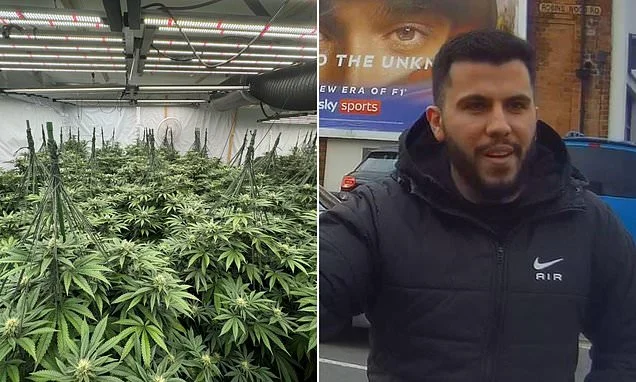
Albanian Ramiz meeting with undercover Daily Mail reporters in Nottingham to provide a fake driving licence, bank statements and pay slips
We have discovered there are at least 450 Albanian cannabis farms operating across the country, although the figure is likely to be very much higher.
Our calculation is based on a detailed examination of police records and Press reports, both local and national, that show an average of two new cannabis farms have been raided or uncovered every week for the past four years, a trend that shows no sign of diminishing.
In an undercover operation as part of the investigation, we have also, for the first time, infiltrated the highly sophisticated ancillary industries servicing these cannabis factories – illicit operations that produce fake documents the criminals use to rent properties as well as specialised ‘cannabis factory clean-up companies’ that help cover the gangs’ tracks when they move on.
And we can reveal that at least 70 per cent of the 620 Albanians convicted for working in the drugs dens uncovered in these past four years were illegal immigrants running grows that produced hundreds of millions of pounds worth of the drug each year.
Yet these figures represent just the tip of the iceberg because many convictions were never reported and the majority of the criminals involved in the trade have never been caught.
What we do know is that more than two-thirds of the 450 Albanian-run cannabis factories we identified operated in residential homes stretching the length of the UK, from Cornwall to the Scottish Highlands.
Grows producing multi-millions of pounds worth of cannabis have also been set up in abandoned primary schools, college campuses, care homes, register offices, nightclubs, cinemas, abattoirs, local newspaper offices, social clubs, pubs and municipal swimming pools.
The collapse of the High Street has presented Albanian mafias with a major opportunity, too, and huge factories have been found in empty WHSmith branches, Barclays and NatWest banks, long-serving department stores, shopping centres, fancy dress shops and, in one case, empty offices above a Jobcentre Plus.
Albanian Tanushi promised our undercover reporters he could clean two houses in five days to ensure all DNA and fingerprints were scrubbed with ‘no problem’ from police or landlords
Criminals advertise on TikTok offering to provide fake documents for potential migrants coming to the UK
The industry is a driver of illegal migration into the UK – one Albanian gang even runs its own small-boat Channel crossings to bring in scores of new workers and their families for its £1.6million farming operation in Oxford.
It also leads to an illegal migration merry-go-round which has seen multiple cases of Albanians deported after convictions for running cannabis farms – sometimes several times – only for them to sneak straight back into the country to resume their criminality. One was found running a major drugs den a year after he was released early from jail having told the Home Office ‘he wanted to go home as quickly as possible’.
Another convicted grower dodged deportation after finishing his sentence by claiming asylum – and immediately went on to start a new cannabis factory that flooded his area with the drug.
An Albanian murderer deported from the UK after serving his sentence was also able to return and start a massive farm – while some illegal immigrants found running UK cannabis factories had previously been convicted of murder and heroin trafficking in European countries.
As for the Albanian-run network of subsidiary operations that provide support logistics, they have become a specialised branch of the dark economy.
To rent a property to set up a cannabis factory requires showing letting agents extensive documentation that the drug gangs usually do not have. UK Papers is an operation advertising itself on TikTok using pictures of London buses and Albanian and Union flags. It also advertises ‘documents needed to rent a house’, sometimes with specific slang references to cannabis factories.
The business offers an array of fake documents including UK passports (‘books’) for £1,900; driving licences for £80; three months of bank statements for £35; utility bills and payslips for £35; and immigration documents.
When an undercover Daily Mail reporter posing as someone hoping to rent a property to set up a cannabis factory asked an operator at the firm to supply fake documents, he was happy to help.
A few days later, at a meeting on a Nottingham street corner, the grinning boss known as Ramiz took our £200 in cash as he handed us a fake driving licence, bank statements and payslips.
Numerous cases in the past four years have shown how false IDs have been used to rent properties for cannabis houses.
Brothers Sokol and Amarildo Rranci used a ‘staggering’ number of fake documents including bank statements to rent 13 homes across Yorkshire and the East Midlands to produce ‘mind-blowing’ amounts of cannabis worth almost £1million, Judge Steven Coupland said as he jailed them at Nottingham Crown Court in January 2024.
Five Albanian illegal immigrants were jailed in 2022 for using fake documents to rent houses for a network of cannabis factories in Bradford, Leeds, Keighley and Barnsley. Their illicit farms were hidden in spaces accessed via trapdoors under washing machines, behind secret panels and in lofts reached ‘like Narnia’ through wardrobe doors.
Albanian Afrim Krasniqi was jailed last year after using a fake ID to pose as an Italian looking for family accommodation to rent 12 properties across Scotland that were used as cannabis factories producing £3.8million of the drug.
Albanians have previously funnelled £5.5million of profits from a nationwide network of grows to crime boss Besnik Hoxha via a bank account his wife opened with a fake Greek ID card. She funded shopping trips to House of Fraser, nail bars and beauty salons with the drugs money.
After renting a property, gangs usually complete two to four harvests – each of which can take around three months – then move to a new location to avoid landlord inspections and police investigations. Before handing the keys back to the letting agent, organisers attempt to restore the property to its original condition, removing any visible signs of cannabis production and potential forensic evidence such as DNA traces or fingerprints that could later identify them.
It is to meet this demand that an entire industry of ‘cannabis factory clean-up’ firms has sprung up. One, called House Cleaning Jobs with a Union Jack and Albanian flag logo and the tagline ‘we take care of every detail’, has posted footage on social media of workers clearing scores of cannabis houses around the country, including in Maidenhead, Manchester, Leeds, Bedford, London, Doncaster and Leicester.
One of the numerous Albanian cannabis farms being advertised on TikTok
Contacted by an undercover Daily Mail reporter, the owner laughed as he described how he has been running the business for three years after getting the idea when he was running his own cannabis factory in Leicester.
Giving his name as Tanushi, he promised his team could clean two houses in five days to ensure all DNA and fingerprints were scrubbed with ‘no problem’ from police or landlords. He asked to see the house before quoting.
When Tanushi was later contacted by the Daily Mail for comment, he denied doing anything illegal. He said he did it because ‘you don’t give me any other chance to work’ and this was an ‘easy way’ to earn money for his family. ‘They call me, I go, I clean up, I paint,’ he said.
He said he did not recall the phone call with the undercover reporter where he described previously running a cannabis factory and denied doing it. Another site, Repairs And Cleaning UK, which includes cannabis plant emojis in its biography and boasts ‘no job too big or small’, offers an extensive price list scaled according to the property size. Costs start at £3,500 for a three-bedroom house, rising to £4,500 for a five-bedroom and £6,500 for a pub.
The service includes painting and decorating, carpet cleaning and rubbish removal.
Others variously advertise with pictures of police officers in riot gear captioned ‘when they come and break, we come and fix’, boasting of serving ‘all over England 24/7’ and leaving houses ‘beautifully clean… like entering a pharmacy’ and responding to ‘emergencies… at any time of the day or night confidentially’.
One shows footage of gangs fly-tipping scores of disused cannabis plant pots.
Another has a sideline selling on equipment used in cannabis factories for other makers, with adverts offering grow buckets, cables, lights, air filters and electric motors from its apparent headquarters in Huddersfield.
Most brazenly, an Albanian site called House Cleaning UK, with 61,000 followers, includes a post captioned: ‘We managed to put off the uncles’ (Albanian slang for police) accompanied by a string of laughing emojis.
It features a cleaner filming himself joking with two police officers outside a property.
Having convinced the visitors that nothing untoward is going on, one of the officers tells him: ‘I’m quite happy with everything so thank you very much. We’ll let you get back on with your work.’
After shaking hands with the departing police, the cleaner walks back into the house to reveal he is dismantling a cannabis factory.
TikTok, where the cannabis factory support services were advertised, previously banned the fake documents page and took action against the ‘clean up’ companies after being alerted to them by the Daily Mail.
With such an extensive system in place, is it any wonder that so many Albanians come to the UK to work on cannabis grows?
And it’s not just hardened criminals. Those convicted include a former Albanian police officer, who was jailed for his part in an £800,000 cannabis factory, and a biochemistry graduate who worked for the Albanian Ministry of Defence before taking a job at a £105,000 factory in a residential street in Tyne and Wear.
Another, Xhafer Furriku, came to the UK to get free dental work on the NHS – then stayed to work in a cannabis factory.
The rewards can be huge. The leaders of a gang in Leeds enjoyed ‘vast personal wealth’ from their £3million chain of five cannabis farms across West Yorkshire with a Range Rover, Porsche, £150,000 Mercedes G-Wagon and Rolexes.
Even lower level workers enjoy luxuries. One cannabis factory was found in Southampton in 2022 with a fully stocked kitchen and gym for workers, while designer aftershave bottles were found in the living quarters of a pair working in a £400,000 Swansea grow.
Rigles Ndreka was found with a £400 pair of trainers at the Sheffield cannabis factory he ran. He told police he was only working there to pay off a £50,000 debt. Oetjon Agalliu, who arrived in the UK on the back of a lorry, used his proceeds from the £146,000 cannabis farm he ran in Mansfield to try to buy asylum documents for £25,000. Much of the rest went on prostitutes.
The cost to local communities of these enterprises in residential areas comes in the form of violence and terror – guns, knives and machetes have often been found in factories.
A year before that cul-de-sac murder in Bristol in 2022, three Albanians were jailed after beating to death a thief who raided the produce of their £120,000 cannabis factory in Cardiff and dumping his body in a nearby street.
The gangs’ farms also put neighbouring families’ lives at risk from fires and explosions caused by the way they illegally bypass the electricity mains and tamper with meters to avoid high bills and evade detection.
There have been at least 640 fires at cannabis farms between 2019 and mid 2024; they have caused three deaths including that of a seven-year-old boy in 2024 who was sleeping innocently with his family in a block of flats in Newcastle where a neighbour was producing the drug.
In a separate case, Kastriot Prendi, who was in the UK illegally, initially refused to open the door to firefighters into a residential maisonette where he was running a cannabis factory even as smoke billowed from the windows.
Fire crews eventually forced entry into the property in Fife but even then Prendi initially refused to let them check all the rooms during the blaze in March 2024.
Only when police were called did he relent and officers discovered the £342,000 cannabis factory. Prendi, who had overstayed his visa, was jailed for two years. When caught, the drug den operators frequently use the same story, dubbed the ‘Albanian defence’ by one exasperated judge, that they only worked as a ‘gardener’ and had been at the factory for a few days after travelling to the UK to try to pay off the debt for a relative’s medical treatment.
Another judge said that almost every week he hears the other ‘very familiar’ excuse that the accused had been ‘forced’ to work in the factory to pay off debts to people smugglers who trafficked him to the UK.
But while some of the crime gang members have faced the full force of justice, other judges have demonstrated an inexplicably lenient attitude towards them.
Redis Shahini arrived in the UK on a small boat and, after his asylum claim as an alleged victim of a ‘blood feud’ was rejected, he promptly started a cannabis farm in Ystalyfera, Wales.
Sentencing the 20-year-old at Swansea Crown Court in May 2024 to 12 months in a Young Offender Institution, Judge Huw Rees struck a compassionate note, saying he was ‘sensitive to the desperation’ the offender must have felt to have left his family in Albania.
Shahini was deported in 2024 after completing half his sentence and repaid the judge’s sympathy by smuggling himself straight back into the UK to set up another £200,000 cannabis factory in Nottingham. He was jailed for 22 months in February.
Benis Asllanaj, Fatos Daci, Luan Maci and Luan Prozllomi walked free from court despite admitting working in a £4.5million per year cannabis factory in Bodmin, Cornwall, after a judge blamed this on the delays in their applications to work legally in the UK.
As he gave them suspended sentences at Truro Crown Court in January 2024, Judge Simon Carr described the men as ‘gardeners’ who must have been ‘put into the premises’ and ‘told what to do’ and had ‘no alternative’. He added: ‘The reason you could be preyed on in this way is you are all Albanian nationals, seeking to stay in this country lawfully but caught up in a system which takes years for such applications to be considered, and little or no opportunity to earn income while that is done.’
Perhaps most depressing is the case of Xhoni Leka, who was jailed for 40 months in September 2020 after being found running a cannabis farm packed with 1,300 plants in Whitehaven, Cumbria. He was also caught in possession of class B drugs with intent to supply.
Most foreign criminals are booted out of the country as soon as their sentence is finished. But not Leka, who fought a lengthy legal battle to remain and this year successfully appealed against deportation by claiming it would breach his rights under the European Convention on Human Rights.
Upper immigration tribunal judges Fiona Lindsley and Mark Symes ruled deportation would be ‘unduly harsh’ on his four-year-old daughter as it would leave her without a male role model.
Meanwhile, Albanian cannabis factories keep on producing the drug.
This month alone, busts have included a ‘sophisticated and substantial’ cannabis factory in a Nottinghamshire home (only found because of a fire which was narrowly saved from spreading to neighbours); a Wiltshire grow where £1.5million of electricity had been stolen from the National Grid; a £5million factory in Aston, Birmingham, detected after it caused a power outage because electricity had been illegally diverted for lights and fans; and a ‘huge’ grow worth £1.7million run by a suspected organised crime gang in Doncaster – where guns were also found.
With the rewards so great and the punishments so light, the industry and its millions of plants are flourishing as never before.
- investigations@dailymail.co.uk