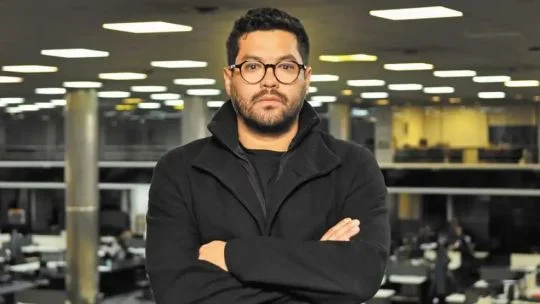
Journalist Óscar Martínez is the editor of the El Faro media outlet and author of the 2006 book Bukele, el rey desnudo (“Bukele: The Naked King”).
Martínez, 43, has spent over two decades documenting violence, pandilla criminal gangs and power in Central America. Spied on via the highly advanced spyware Pegasus and exiled in Mexico since last year after exposing a pact between Bukele and the pandillas, he maintains that El Salvador’s president has concentrated all state powers in barely two years, converting himself into a model for new leaderships in the region.
In a feature-length interview, Martínez discusses Bukele’s rise from the leftist FMLN movement, his quest for power, the conversion of El Faro into a foundation for survival and, as sustained from exile, the revealing network of sources within the El Salvador government.
In your latest book, there is an image from the Hans Christian Andersen tale The Emperor’s New Clothes when somebody says aloud what everybody sees and nobody wants to say: “The emperor is naked.” What does this phrase mean in the case of the president of El Salvador?
The reference to that tale is not necessarily something directly explicit and literal, although it seems so to me. Bukele is still trying to maintain some democratic traits, such as now announcing elections which are a joke. Bukele is competing as a primary hopeful within a party he controls completely, preparatory for elections next year. A dictatorship, according to my criterion and that of my newspaper, as we have exposed in editorials – he’s going to win.
In other words we face some cosmetics which he is still trying to sell as a democracy. We thus believe that in that sense Bukele is like the naked emperor. I begin the book by saying that Bukele is a dictator, somebody controlling all the state powers by using illegally what the ballot-box has legitimately granted him, for example, replacing the attorney-general of the Republic investigating him or getting the Supreme Court to make a reinterpretation [of the Constitution] worthy of the [Mexican] comedian Cantinflas [Mario Fortino Alfonso Moreno Reyes] to say he could be re-elected, etc, etc.
Bukele was a militant for almost 10 years in El Salvador’s left-wing party FMLN [Frente Farabundo Martí para la Liberación Nacional] before breaking with it and founding his own party, Nuevas Ideas. What remains of that phase from his forms of action and exercising power? What does that drastic leap from left to right imply?
Bukele always sold himself as a man of the left at the start of his career. Videos of him appearing on different channels and in interviews can be sought out saying that he was essentially a man of the left, coming from a leftist family tradition and saying things like the Nicaraguan dictatorship of Daniel Ortega was being the most prosperous example for Central America or, for example, anniversary tweets mourning Che Guevara. He was thus a man who sold himself as a leftist militant in two City Halls. The first, where he started out in 2012, was unimportant but afterwards Bukele moved to the City Hall of the capital San Salvador, which was his great political launching-pad with the red shirt of the FMLN, which was a guerrilla movement during the civil war years between 1980 and 1992.
What happened to Bukele? I believe that he never had a clearly defined ideology but always a messianic plan and at that point he understood that the FMLN was the most probable vehicle for getting where he wanted. Firstly, it was very clear to him that he had to become mayor of the capital to have some national perspective and a launching-pad for what he always wanted, the Presidency of the Republic. Bukele was a FMLN militant until he found out, when mayor of the capital, that the FMLN was not going to give him its presidential candidacy. So Bukele’s decision started out then and there to find a taxi party in which to compete, registering at the last minute with El Salvador’s far right GANA party. With that move, Bukele demonstrated to us that he had neither principles nor ideology – what he was after was to rise to power any which way.
The institutional erosion of El Salvador has been preceded by a civil war, years of extreme violence, the pandillas. How much of Bukele’s rise is explained by his own political skills, beyond any ethical questions, and how much by an exhausted society ready to cede anything in exchange for security?
The first thing I have to say, and I must leave it floating there, not as a challenge but as an invitation to readers of this interview, is that it is superdemonstrated that Bukele has been making pacts with the pandillas for the last eight years. We were the first to publish the proof in November 2020 – documents of the Nayib Bukele government itself, signed, sealed and delivered, where prison intelligence agents became aware of the illegal pacts into which government officials and hooded street gangsters were entering by meeting up with the leaders in prison. But not just that. In time the State Department of the United States sanctioned two Bukele officials heading up the pacts. This had already been mentioned in the trial in the East Court of New York City against 29 Mara Salvatrucha leaders who were partners of the government. It was also published by The Washington Post, The New York Times and ProPublica, who have made their own investigations, or Frontline, who have contributed to that.
For years, Bukele during his rise to power was the political partner of El Salvador’s murderers. Of course, Bukele did get to reduce the homicides. The pact was a reduction of homicides and also a concealment of corpses. In our last interview with two of his partners for years – two national leaders of Pandilla 18, who are the great rivals of Mara Salvatruch – they told us about the pact. One of Bukele’s officials gave them these instructions: “Without a body there is no crime.” At that moment, when they said that, it so happened that the Bukele government, which already controlled all the country’s authorities, decreed secrecy as to the clandestine graves, which is how the gangsters made the corpses disappear. In other words, if there was a reduction of homicides, it came from making a pact with the pandillas so that they were less copious and also less evident. Now when Mara Salvatrucha, the most violent of the pandillas, complained of some obstruction to that pact in March, 2022, that gave rise to the most violent weekend in all the post-war period of El Salvador, murdering 87 people in a single weekend. At that moment, Bukele decided to make a U-turn, cancel that pact and decree emergency rule which still continues with less rights for the citizenry and more for the soldiers and the police.
“No body, no crime” reminds me that this is exactly what happened in Argentina during the [1976-1983] military dictatorship. I don’t know if you have been informed of that but they directly hid bodies in the bottom of the ocean, tossing them off aircraft.
Yes, unfortunately we are very much aware of what was suffered under the Argentine dictatorship, which was a school for the Central American military who afterwards repressed us. They took note and many of the Central American repressors did their military training here, history will tell you that. The number of corpses which have still not been found in El Salvador must be enormous, and counting. That is one of the reasons, I suppose, why, when counting the dead, Bukele and his régime have violated the Protocol of Bogotá, which established that the clandestine graves must be added. Bukele took them out of the equation, as well as those who die in prison. Two out of every 100 people in El Salvador are jailed with at least 537 corpses coming out of the prisons in the last two years, many with signs of torture. And Bukele has also omitted those dying in confrontations with the authorities, modifying the ways of counting the dead. I’m not saying that there has been no reduction, as there already had been in El Salvador since the previous government. What I am saying is that the figures are fudged, no other way of putting it.
In your book you reconstruct election night in February 2024, when Bukele proclaimed himself winner from the balcony of the National Palace before the Supreme Electoral Tribunal gave the official results. Why did that Tribunal not sanction him, why did no authority tell Bukele that what he was doing was illegal?
Because Bukele already then controlled everything. The 2024 elections were a joke. Somebody else winning was not in the realm of possible reality. Bukele even modified the country’s electoral districts in violation of the Constitution. He competed in 2024 violating four articles of the Constitution, which explicitly says that no person may be a day longer than five years in power. Then he changed the electoral districts etc when the Constitution said that the electoral rules cannot be modified, thus showing us that he does not consider the Constitution to be above him.
Bukele’s first election victory in June 2019 was a democratic election if we remove from the equation the fact that the pandillas aided his triumph, threatening the citizenry in their neighbourhoods. But apart from that, he won the Legislative Assembly elections of 2021 resoundingly, again in complicity with the pandillas. In the first session of his Legislative Assembly, Bukele used the vote of his deputies, to whom he gave orders, not suggestions, to oust the prosecutor investigating his pacts with the pandillas and his looting of the public coffers during the pandemic.
All the prosecutors of the anti-mafia unit investigating Bukele and his officials in the Catedral case are now in exile. This was revealed by Germán Arriaza, the head of that unit, when he went on record giving an interview to Reuters. That election you were asking me about was cosmetic. Bukele was going to win, everybody knew that.
You also compare him with [Nicaragua’s] Daniel Ortega, who needed 11 years to dismantle the democratic system and Bukele less than half that. Why is that?
It took Bukele from June 2019 to May 2021 – next to nothing because Bukele, you’ve got to hand it to him, had read the politics very efficiently. I refer to Bukele knowing that in the post-war period, which was too long in this country, from 1992 until Bukele disrupted everything in 2019, the people became fed up with the parties of left and right, the two governing for years: FMLN and ARENA respectively. Of the two last centre-right presidents, Francisco Flores ended up going on trial for having embezzled millions of dollars from a Taiwanese donation earmarked for those hit by El Salvador’s earthquakes and died during that trial. Antonio Saca, the last president of the centre-right establishment, is in prison after confessing to having misallocated over US$300 million from the Treasury for his companies and his personal benefit. Then in 2009 the left came to power in the person of Mauricio Funes, an excellent television journalist who had won the Maria Moors Cabot Prize, giving rise to great hopes but he too looted the state coffers. We published the evidence in El Faro. Then the left, in order to correct having opted for an outsider, made Salvador Sánchez Cerén, a veteran former guerrilla commander, president. Sánchez Cerén gave El Salvador its worst year for homicides, 106 per 100,000 inhabitants in 2015 – a rate which not even countries in open armed conflict have. That is where the postwar cycle ends. Bukele knew that people were desperate and that he could construct his electoral offer out of that despair.
It was thus not with law and order or the struggle against the pandillas which won him his first presidency because you are telling quite the contrary. What made him win the election the first time round in 2019?
Bukele promised the people that he was going to destroy what we understand to be politics, coming up with a slogan I still remember “Los mismos de siempre” (“the same ones as ever”), thus putting in the same bag all the rest with many political divergences between them.
He was saying: these politicians do not work anymore, there has to be a new option. And he began to create his party, which he called Nuevas Ideas. In other words, Bukele understood that what marked him out was saying: “I’m not one of them” when he was, having been the mayor of a party [the FMLN].
When Bukele came to power the first time, he did not have the control he was to have later in 2024, and it is said that when Milei took office, Bukele came along and gave a sort of course for La Libertad Avanza party leaders on how to govern without controlling Congress or the Courts. How did Bukele dismantle the albeit precarious democratic system existing in his country in those early years?
It is true that Bukele faced opposition in the Legislative Assembly and had no party when he won the presidency. Like I say, he competed with a taxi party called GANA, a party, there is no other way of defining it, of political mercenaries.
What happened is that Bukele was profoundly popular. For example, what he did on February 9, 2020 – he had neither the Legislative Assembly nor the Supreme Court on his side and the Assembly would not approve a loan for a security plan which he called territorial control but he never showed us what it consisted of. The deputies, in responsible fashion, told him: “Show us the plan, which you want us to finance with a loan of US$109 million.”
Bukele did not show it but instead rallied a crowd of around 7,000, called in the Army and stormed the Legislative Assembly, taking the Speaker’s seat. And Bukele, surrounded by cameras and soldiers, said that he was going to talk with God to take the decision to destroy the Legislative Assembly, a farce which you can see if you look it up on YouTube. He talks with God in tears and then goes out to tell the multitude: “God told me to be patient.”
In other words, if God had said otherwise, the mob would have burned down the Legislative Assembly that day. He gave the political class to understand: “The people are on my side and if you don’t step aside, I’ll remove you.” And he pulled it off before having full control of the institutions because many cowardly politicians were afraid of him.
Previously Bukele had been invincible when mayor of the capital, what did the electoral competitive advantages making him so popular consist of?
Bukele had some symbolic achievements in the capital. He did not really turn the capital around but he did buy off the citizenry with a lot of show.
What I’m going to say sounds like a joke, but it was like that. For example, the August Fair in the capital, a week of festivities with three days for the working-class. A histrionic Bukele competed in the Tagadá, a mechanical game with leaping, against a journalist with a misogynistic and vulgar personality, when he mimicked the populace and women in a very familiar way which people like very much. He knew how to put on a show and the people saw it but he also knew how to sell his great emblem.
Bukele said: “I’m going to recover the historic centre of the capital.” The historic centre of the capital was completely overrun by the pandillas, five cliques, internal sub-groupings of the Mara Salvatrucha, a territory which was a zone of conflict with an internal sub-grouping of Barrio 18. It was a zone where everybody had to learn to walk the labyrinth between the frontiers of war zones because if a shopkeeper sold in Mara territory, even without belonging to the gang, he could not tread the zone of Barrio 18, one of the zones with the most deaths.
Bukele pulled it off, of course, because he had a pact with the pandillas permitting him to liberate around a dozen blocks downtown when the centre has 250, selling that achievement as something unprecedented. And it was. Nobody else had managed it. Those 12 blocks were only for tourists but Bukele converted that achievement into the hope for many things. One was being able to enter gang territory, another being able to convert something completely rotten into a touríst area. And thirdly, he showed that there was somebody who kept their promises.
Bukele used the 12 blocks of San Salvador city centre to convince the people to give him total power.
Being in Argentina it must strike your attention the differences between Milei and Bukele from the ideological viewpoint. Milei is a libertarian, Bukele has no ideology and even started out in a leftist party. What links them, where are the points of contact in your opinion?
Milei was very happy with the unconstitutional way Bukele took office. Of all the presidents, he looked the happiest, smiling at the cameras, very happy with his afternoon in the palace, applaudíng like mad. What Milei admires about Bukele is what Milei yearns for: total power. I’m not saying that he’s going to achieve it, I’m saying that it is what he would like, the possibility of having no counterbalances, of being able to speak openly. Saying, like Bukele has ended up saying in some outbursts: “I believe that all the counterbalances of democracy are hindrances, I believe that the separation of powers is useless.”
They show themselves for what they are: authoritarian. It surprised Milei and gained his admiration that somebody had achieved that so what interested him was knowing how. We know they had some private meetings. The focus of Bukele was at that time very much on the Trump delegation headed by Donald Junior and a delegation of bitcoiners, etc.
I do not know what the nature of his conversation with Milei was but that is the impression it gives me, the Mileis of this world, with the differences he has with the [Ecuador President Daniel] Noboas of this world, with the Trumps, they admire Bukele for something he achieved: total control of power.
You underline the influence which Bukele might have had on his imitators: the case of the president-elect in Colombia, we have mentioned the case of Milei. When did Bukele become somebody more significant than himself?
I’ve always thought so and that’s why it seems important to me to publish this latest book with Anagrama, of which I’m very proud: Bukele, el rey desnudo. Now I didn’t want to write that book. I run a digital newspaper, we’ve been talking about Bukele since 2020 and I’m getting tired of that but it seemed important to me because of your question. Because that question is not about Bukele being the dictator, the despot, the man with all the power in a country of 21,000 square kilometres, Central America’s smallest. Bukele is not simply the ruler with the sum total of all powers over the more or less six million inhabitants living in El Salvador. Bukele has become the standard-bearer for many who wish to imitate him.
And, of course, the problem is that when you speak of the Bukele model, you seem to be referring to an archetype but Bukele is not an archetype. Bukele began by saying that he was going to make bitcoin and ended up requesting a loan from the International Monetary Fund (IMF); first Bukele began by making pacts with the pandillas and afterwards decreeing emergency rule. Again, I repeat, he has whims more than ideas. Now when they say they want the Bukele model, the subtext of that is very clear, they want all the power because that is the only rule of the Bukele model, all the power for one man, zero counterbalances, the absolute destruction of the due process of law in El Salvador.
Most of the 97,000 people jailed since March 2022, according to the official figures, have not been brought to trial or accused of anything, they have not seen a judge to convict them, they are huddled in prisons, they do not look like Bukele wants to show them, like in the CECOT [mega-prison], where they gather together all the gangsters with tattooed faces. In the other prisons there are peasants, female shopkeepers, soup kitchen cooks, bricklayers, carpenters and people who were arrested just to serve the political discourse of saying we are going to arrest everybody.
In other words, what people admire about Bukele when they say they like the Bukele model is an aspiration. And the statements of that aspiration should scare us because what they are saying is: “I also want to have all the power.” And I ask a country like Argentina, which already knows what happens when a handful of men take all the power, how could it come to this?
In May 2025, the Bukele Assembly approved the Law of Foreign Agents obliging media like El Faro, financed in large measure with funds of international cooperation, to register as such under the threat of fines. Faced with that situation, how did it manage to survive?
We are still in a tremendous struggle. I must say with pride that we have not had to let anybody go, even in this year of exile.
El Faro has been toughened by a persecution lasting years. Bukele accused us long before proclaiming the Law of Foreign Agents in May, 2025, which is a law – let us not mince words – to smother any person or organisation critical of the Bukele government, collecting 30 percent of all earnings, over and above the taxes already being paid, which makes life unviable. That is why all the collaborators have withdrawn, they do not want to give that percentage of money to the Bukele dictatorship.
What did we do? Bukele accused us via nationwide broadcast of money-laundering in 2020, which is absurd because to launder money you have to have money. So we understood that Bukele had it in for the institution, he wanted to freeze our accounts so that we would cease to pay and the newspaper stop making the investigative journalism which affected him. So we moved our legal status to Costa Rica when [Rodrigo] Chaves was still not president and when Costa Rica was still called the Switzerland of Central America without that hostility towards the media. We moved to Costa Rica and changed from being a company of El Salvador to a foundation of Costa Rica. We’ve done that in order to survive and to protect our employees and their salaries. Now we’re on the point of becoming a US foundation with our headquarters in New York.
We’ve had to diversify because it has become clear to us that within national territory, Bukele will do everything possible to persecute us. The accusations of money-laundering came together with the interventions of Pegasus, when we were investigating for the first time his pacts with the pandillas. That is to say, Bukele knew that we were investigating him.
In 2022 Citizen Lab covering cybersecurity at the University of Toronto in Canada confirmed that at least 22 journalists of El Faro, including yourself, had been spied upon with Pegasus software for over a year. How did they get that confirmation and what was the beginning of the investigation?
It all began with a colleague, Julia Navarrete, a journalist at El Faro, who, as she told in an article, felt that her mobile telephone was overheating and losing its charge very quickly like the flutter of a butterfly’s wings. And she had contacts, somebody very much on top of that world who could examine the telephone. She made arrangements to meet me one night as her editor in the parking-lot of a service station, took my mobile away from me and threw it in the bin, telling me: “I’m infected with Pegasus.” Then we sent four more telephones, of section chiefs and journalists investigating the pacts with the pandillas, to the organisation Access Now, who together with Citizen Lab, the technological lab of the University of Toronto, have detected Pegasus in more than 10 countries worldwide throughout over a decade. They told us that all four were infected. So we went through the entire newsroom until reaching the administrative area and executive board, all infected. So what did we do? We permitted them to keep on tapping our telephones without telling them and to keep on spying on us.
But sending them wrong information.
We sent them wrong information or talked rubbish over the telephone or simply used other means of communication. Just when Citizen Lab was analysing the mobile of my brother Carlos, a live intervention was detected. From the territory of El Salvador the telephone was being tapped at that moment. So we managed to obtain more evidence. The geographical location of an intervention can rarely be detected because this spy software can be operated from elsewhere but in our case we have evidence that whoever was operating it was in the national territory of El Salvador. And when we published that in concert with The New York Times and Reuters, it was a scandal.
What have we done now? We have sued the Israeli company [who created it] in California because the company does not want to tell. Although we all know who it was, the company assures that it only sells that software to states and Bukele already controlled the entire state. But we want proof to be able to lodge an international lawsuit if that is the decision. We have sued the company in California where the servers are closest so that they tell us who is robbing our information.
But the lawsuit was dismissed and you are appealing.
It was dismissed by a judge but we immediately received an amicus curae, a legal category whereby other corporations who feel affected by similar cases can support us. And that amicus was backed by The New York Times, the company Meta, the owner of WhatsApp and Microsoft. The United States thus found out that this was not just about a tiny El Salvador newspaper and the lawsuit continues.
As told by El Faro itself in its article ‘El exilio no alcanza’ (“Exile is not enough”) last July, before publishing the interviews with two gang leaders revealing their pact with Bukele, four of your journalists left the country as a precautionary measure, then a further 13 and in the following weeks, 25 colleagues. How do they do it?
We are in the first year of exile. I cannot tell them that I have the formula but we have made some discoveries which have permitted us to continue conjugating the main verbs of journalism, to reveal and to expose. We did not know that there were so many people in exile – policemen, prosecutors, judges, government officials and employees.
**There you found sources you never imagined. **
Never imagined because people do not go out to request exile. No evidence of when they were threatened by a public official, they just leave. We found some marvellous sources going to a grocery in a country, sources linked to the security systems. We have come across a lot of information in exile and when people see us as exiles, we get to talk to them now that we are in the same boat. We continue having courageous sources within the Bukele government, with whom we have very exotic mechanisms for meeting. We keep an eye on the country. I cannot elaborate on that because then the dictatorship would cancel it.
And there is a further advantage, we already knew that we were going to end up in exile. We understood that Bukele’s path was the road of the dictator and that sooner or later he was going to kick us out of his kingdom. So we began to download databases while still public, downloading gigabytes and gigabytes of business relations which we are only just starting now to analyse. And I guarantee that we have already found financial connections, which we will soon reveal pointing to this being not only a dictatorship but also a kleptocracy.
I will ask you for a final reflection on what you see in Argentina and the journalism in my country along with any comparisons you might make.
Take care of what is left of democracy although it might not seem much, although you may not like it, although it is thought to be very petty. Look after what is left, take care of the centímetres you have so that you do not end up outside your country like me.
Production: Sol Bacigalupo