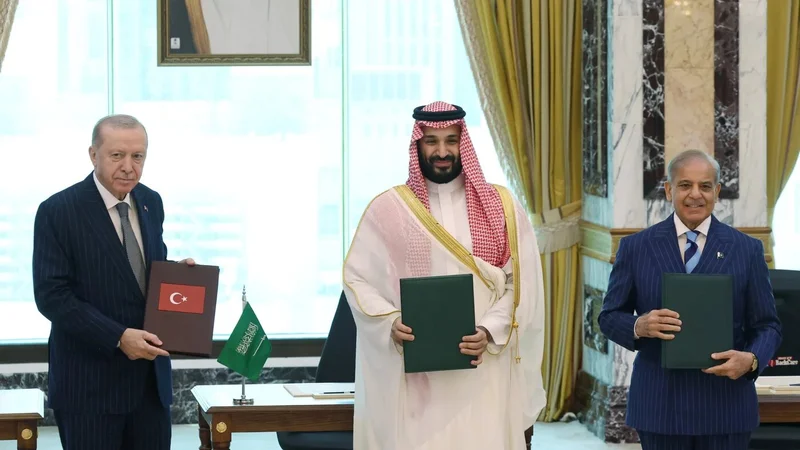
Mecca Agreement: A Muslim Nato or yet another Baghdad Pact?
The recent Mecca Joint Defence Agreement, signed by Saudi Arabia, Turkey and Pakistan, has reinvigorated longstanding US ambitions for a subcontracted "Middle Eastern", "Arab" or "Muslim" Nato to serve US regional security interests.
Some pro-American and pro-Israeli analysts have misconstrued the agreement as an alliance against Israel, while others see it as a sign that the Saudis are seeking new security guarantors in light of US failures to fully protect the kingdom and its Arab neighbours.
The Mecca Agreement, however, is merely the latest iteration of a US policy dating back to early in the Cold War to preserve existing pro-western regimes, their US sponsor, and their unspoken ally, Israel.
Its real targets, unsurprisingly, are the enemies of the US and Israel.
US President Donald Trump welcomed the agreement at once, declaring himself "very happy" that the three countries had "recently, and finally, signed" it.
The new agreement follows the model of the US-sponsored 1955 Central Treaty Organization (Cento), better known as the Baghdad Pact.
Pactomania
It was John Foster Dulles, secretary of state under President Dwight Eisenhower, known for his global "pactomania", who created the Baghdad Pact as the main anti-Soviet front in the Middle East. Its members included Britain, Turkey, the shah's Iran, Pakistan and Hashemite Iraq.
The Americans worked hard to enlist Jordan but failed amid nationalist anti-imperialist opposition to King Hussein's wishes. Nasser's Egypt also rejected the pact, as did then anti-Hashemite Saudi Arabia.
The pact preceded the January 1957 articulation of the Eisenhower Doctrine, which provided the framework for American imperialist aggression aimed at protecting what the US president called "free" nations from Soviet and communist subversion.
Eisenhower insisted: "The Middle East is the birthplace of three great religions - Moslem, Christian and Hebrew. Mecca and Jerusalem are more than places on the map. They symbolize religions which teach that the spirit has supremacy over matter and that the individual has a dignity and rights of which no despotic government can rightfully deprive him. It would be intolerable if the holy places of the Middle East should be subjected to a rule that glorifies atheistic materialism."
At the time, East Jerusalem was part of Jordan, which had annexed it in 1950.
Since then, and thanks to US policies advancing Eisenhower's strategy, Mecca and Israeli-occupied and -annexed Jerusalem, it seems, have been subjected to capitalist theistic materialism rather than to the "atheistic" variety.
Despite Iraq's withdrawal after the 1958 revolution, the Baghdad Pact survived for another two decades and was dissolved only after revolutionary Iran withdrew from it in 1979, depriving the US-backed alliance of its central regional link.
Nevertheless, the US never gave up on creating a regional "Nato". In 2006-2007, US Secretary of State Condoleezza Rice hoped that the "new Middle East" to which she, on behalf of the US, wanted to give birth would include a US-led military alliance. At the time, Rice recruited Saudi Arabia, Egypt and Jordan to her new pact, but the time was not yet ripe to include Israel fully and openly.
Nato redux
The project of including Israel had to wait until 2022, when the US shepherded an Arab military alliance with Israel targeting Iran. Dubbed by some a "Middle East Nato", the Middle East Air Defense Alliance (MEAD) was unveiled by Benny Gantz, then Israel's defence minister.
Soon after, Jordan's King Abdullah announced on US television that he "would be one of the first people that would endorse a Middle East Nato", adding: "I'd like to see more countries in the area come into that mix."
At the time, this military alliance targeted Iran, Assad's Syria, Hezbollah and Hamas, and even Russia. Formal arrangements culminated in full integration within the US Central Command (Centcom) in January 2026 - on the eve of US-Israeli aggression against Iran.
A few days before the Mecca Agreement was announced, Saudi Arabia created yet another military alliance on 30 July with 13 other countries
A few days before the Mecca Agreement was announced, Saudi Arabia created yet another military alliance on 30 July with 13 other countries: Bahrain, Bangladesh, the Comoros, Djibouti, Egypt, Jordan, Kuwait, Pakistan, Qatar, Somalia, Sudan, Turkey and the Saudi-backed Aden-based Yemeni government.
The Multinational Maritime Defense Alliance (MMDA) was concluded in Riyadh to secure shipping and energy routes in the Red Sea, Bab al-Mandeb Strait and Gulf of Aden following naval blockade threats and attacks by Yemen's Ansar Allah (Houthi) movement.
The MMDA is clearly nothing but the successor to "Operation Prosperity Guardian", the American-led military campaign launched in December 2023 to punish Ansar Allah for targeting Israel-linked shipping in solidarity with Palestinians facing genocide in Gaza.
The operation included 20 nations, but Bahrain was its sole regional participant, with neighbouring states standing back for fear of being implicated or exposed as supporting Israel's genocide.
The new MMDA averts any such misapprehension by targeting Ansar Allah for its interdiction of Saudi, rather than Israeli, shipping.
Why, then, have Egypt and Jordan - two staunch US allies - not also joined the new Mecca pact?
While Egypt is reportedly still weighing its options, perhaps the absence of both countries indicates that the current signatories fear that they could be called on to intervene if either Egypt or Jordan faced an Israeli invasion or aggression, a prospect that, given Tel Aviv's relentless bellicosity and continuing threats to both countries, is not altogether unlikely.
Complement, not alternative
Some pro-Israel analysts, for their part, fear that the new agreement undermines Israel and its recent Abraham Accords partners who were not invited to join.
Council on Foreign Relations fellow Steven A Cook claims simplistically that "Trump's apparent impulsiveness has now left some in the region to wonder whether they will be left in the lurch to face an empowered Iran on their own".
He also worries that "the Saudis, who have clearly become concerned about the reliability of the United States, are now looking for other options" and that "their new security partners are seeking a new order that allows them, not Washington, to shape the region".
The faulty assumption here is that an alliance among three longtime US military allies - with Turkey itself a Nato member - could somehow operate independently of US authority, or that its members could act without orders from Washington.
The pro-Israel Cook concludes that "the US-aligned regional order could now become a Middle East with two blocs: the countries that remained committed to the Abraham Accords and its alternative, the Mecca Agreement".
Yet the Mecca Agreement is not an alternative to the Abraham Accords; it is a complement. After all, Turkey maintains diplomatic and trade relations with Israel, and Saudi Arabia has held unofficial talks with Tel Aviv for years and has officially sought to integrate Israel into the region since at least 1981.
Saudi Arabia is neither considered an enemy of Israel nor considers Israel its enemy. Pakistan would like to align with Israel were Israel not a major ally of its archenemy, India.
Others, such as Khalid al-Jaber, executive director of the Doha-based Middle East Council on Global Affairs, see the new agreement as a warning that "diminished American weight could leave the region inside an order whose rules are set by two actors alone: Israel and Iran".
Jaber argues that "the Mecca pact is best understood as an early attempt to build a third pole - a bloc that does not need to fight either power, but one that has enough weight to deny either a monopoly over the region".
But this interpretation is mistaken. Only last November, Saudi Crown Prince Mohammed bin Salman was in Washington signing a strategic defence agreement with the US, coming away a "major non-Nato ally" with a promise of F-35 jets.
Saudi Arabia is neither considered an enemy of Israel nor considers Israel its enemy
Turkey remains a Nato member, and Pakistan's prime minister thanked Trump for his "courageous and decisive leadership" within hours of his post. Indeed, there is no third pole at all.
The Mecca Agreement, like the MMDA, is an element of an updated Baghdad Pact. It joins a succession of US-organised military alliances meant to safeguard US domination of the region.
Their principal goal remains to challenge all of Israel's enemies in loyal service to US and Israeli power.
This is hardly anything new. No wonder Trump extended his congratulations to all three signatories: "Big, bold, and important first step." Enough said.
The views expressed in this article belong to the author and do not necessarily reflect the editorial policy of Middle East Eye.