- Published
A county in Wales had one of the world's highest carbon emissions per square kilometre due to wildfires in July, according to a charity.
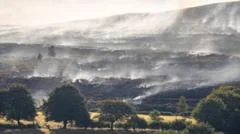
The fire above Blaenavon, Torfaen was described as "one of the largest and most challenging" in south Wales in recent years by the fire service.
Save the Children said it was concerned about possible health consequences after data, external published by the European Union's earth observation programme, Copernicus, showed Torfaen behind Malanje in Angola, Spain's Ãvila and Annaba in Algeria in terms of wildfire emissions in July.
Torfaen council said it was unaware of the EU data but its own air quality monitoring showed "elevated particulate concentrations".
A blaze the size of about 300 football pitches broke out on Mynydd Garnclochdy, between Abersychan and Blaenavon, with people reporting smelling smoke about 30 (48km) miles away in Cardiff.
Combined with others across the region it contributed to a major incident being declared, which eventually required assistance from the military.
Blaenavon councillor Janet Jones said the smoke had been "particularly bad" on 13 August - about three weeks after the fire first ignited.
"There was great concern about air quality and the impact on elderly people and those suffering with respiratory issues such as emphysema and COPD."
Jones said she had spoken with GP practice nurses two weeks ago and was not aware of any increase in patients complaining about respiratory problems, but added this "could change in the months ahead".
Melanie Simmonds, head of Save the Children Wales, said: "In Wales and across the world, children are breathing in smoke from wildfires, coping with extreme heat and losing the freedom to play outdoors because the air is no longer safe.
"These conditions are not only frightening - they carry serious health consequences for children whose bodies and lungs are still developing."
Torfaen council said it was not aware of the research and "it is not clear what data or evidence was used in the assessment to arrive at the reported conclusion".
It said it "recognises that prolonged wildfire incidents have the potential to adversely affect local air quality, particularly through increased levels of smoke and particulate matter".
It added it "continuously monitors" air quality through a monitoring station in Croesyceiliog Cwmbran.
"While elevated particulate concentrations have been observed during the wildfire period, the council's monitoring station is intended to provide information on general background air quality rather than conditions at specific locations immediately adjacent to the fires," it said.
The Copernicus Atmosphere Monitoring Service (CAMS) website, external said it was part of European Union's Space programme, and provided global information related to air pollution and health.
Its data said emissions in Torfaen had been "extremely unusual".