- See more Daily Mail on Google - save us as a Preferred Source
Four years and six months into the Russia-Ukraine war, Moscow has plunged Britain into its crosshairs by delivering a chilling warning.
Russia’s embassy in London accused the UK of 'deliberately opting for an escalation of the Ukraine crisis, while hypocritically professing a desire for peace' after it emerged that Britain was supplying attack drones to Kyiv.
'London’s actions will inevitably carry consequences for which it will have to answer,' the embassy cautioned in the startling statement.
While Russia has been engaged in hostile behaviour towards the UK for years, the threat could signal the beginning of a new era of unmasked aggression.
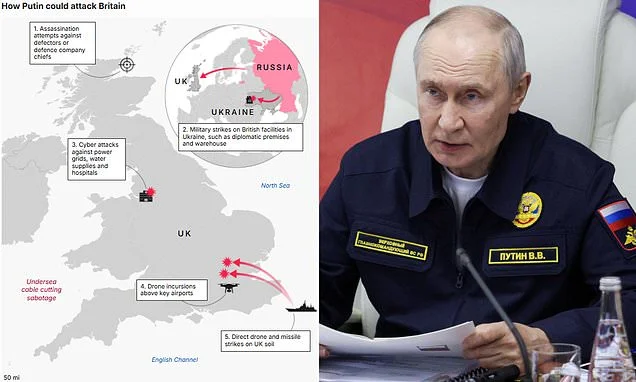
The opportunities for escalation are numerous, from ruinous cyber attacks and sabotage, to espionage and even assassinations on British soil.
Such activity would not be unprecedented: Moscow conducted two poisoning operations in Britain of defectors – Alexander Litvinenko in London in 2006, and Sergei Skripal and his daughter Yulia in Salisbury in 2018 – while Russian hackers routinely target the UK.
But the Kremlin could go even further, by pummeling British facilities in Ukraine, or by sending suspicious drones to loiter above major airports such as Heathrow, Gatwick or Glasgow Prestwick.
Another scenario is that Vladimir Putin unleashes strikes on Britain, with long-range missiles or drones. While the Russian military certainly has the capacity, would the Kremlin chief risk triggering all-out war?
Russian President Vladimir Putin chairs a meeting on board of a missile cruiser 'Varyag' in Russia's far eastern Sakhalin Region, Russia, August 12
Expand the existing campaign of cyber attacks, sabotage and drone incursions
Britain is no stranger to Russian-led cyber attacks.
Methods range from cyber-crime for monetary gain, such as ransomware attacks and financial fraud by state-tolerated cybercriminals, to cyber espionage and disruption targeting infrastructure, government institutions, and corporations.
In July, the Government sanctioned individuals behind Lumma Stealer which enables cybercriminals to collect sensitive information from compromised devices at scale.
Moscow has used Lumma Stealer’s stolen credentials to conduct cyber espionage operations against targets globally, to support the Kremlin’s objectives.
According to the National Crime Agency, within the last six months, there have been at least 2,100 Lumma Stealer victims in the UK.
Russia has a strong foundation in cyber, with intelligence services like the GRU, the FSB, or the SVR conducting major operations involving cyber-espionage, sabotage, and disinformation campaigns.
Russian-speaking ransomware criminal gang Qilin claimed responsibility for a cyber attack on NHS medical services provider Synnovis in 2024.
The attack halted tests and operations at hospital trusts and affected GPs across London, disrupting more than 10,000 appointments and leading to at least one patient death.
'Russia is likely already deep into conducting cyber attacks against the UK, and this kind of offensive activity can only be expected to increase over time,' Jonathan Hackett, a retired US Marine Corps interrogator, told the Daily Mail.
'Russian-backed hacking groups have long been searching for vulnerabilities in UK systems, and targets range from individual users to government entities to infrastructure.
'Perhaps the most concerning in a time of potential conflict are those vulnerabilities that Russia has already exploited in the UK's supervisory control and data acquisition control systems, unbeknownst to GCHQ.
'In a time of war, the so-called zero day vulnerabilities in these systems could be exploited to disrupt fresh water, destroy energy infrastructure, take out telecommunications, and worse, all on a wide scale.'
'Certainly the Russians will try,' British former Army officer Hamish de Bretton-Gordon says.
'Cyber is the obvious thing, but I expect most of the critical national infrastructure and places they would want to attack are pretty hardened. So they might go for softer, civilian-type targets.'
When it comes to sabotage, the possibilities are numerous – and potentially explosive. In June, two Russian-linked arsonists were jailed for conspiring to carry out arson attacks targeting property and a car connected to former Prime Minister Sir Keir Starmer.
Perhaps the personal residences of other politicians will be targeted with petrol bombs, or, Moscow might choose to burn down warehouses in the UK fuelling Ukraine's war effort.
In October 2025, six men were jailed for their parts in a Russian-ordered arson attack on a London warehouse providing aid to Ukraine.
The blaze at industrial units in Leyton, east London, on March 20, 2024, caused £1.3million in damage.
One simple way of inflicting cost and damage would be to send more drones to loiter above the runways not of RAF bases, but of Heathrow or Gatwick or Glasgow Prestwick, plunging global travel into chaos.
Police forensic technicians prepare to deploy an explosive-disposal robot near a Ukrainian aircraft at Leipzig-Halle Airport, Germany, August 5, 2026
A bomb disposal robot deployed by police at German airport Leipzig-Halle after a drone was found near a Ukrainian plane
A device for drone detection is displayed during the inauguration of a new drone safety technology centre at the German Aerospace Center (DLR) site in Cochstedt district of Hecklingen, Germany, August 18
One only has to look at recent events in Germany. Earlier in August, Russia forced the shutdown of Leipzig-Halle airport, used by more than two million passengers every year.
On the night of August 4-5, a drone carrying Semtex explosives flew into a Ukrainian cargo plane on the tarmac, without detonating. At about the same time, a Boeing 757 cargo plane collided with a second drone flying above Leipzig-Halle, causing minor damage to the aircraft's nose.
Assassination and espionage
'Espionage is already ongoing, with reports of GRU operations being identified and disrupted already in the UK this past year,' says Mr Hackett.
'Preparations for assassinations also look very similar to preparations for espionage: identify a target, monitor pattern of life, identify vulnerabilities, gather materials, and act when the opportunity is open.'
Russia has a long history of murdering people on British soil. The former spy Alexander Litvinenko, for instance, was killed by radioactive polonium-210, believed to have been administered in a cup of tea, in November 2006.
The UK also blames Moscow for the attempted assassination of the former Russian military intelligence officer Sergei Skripal in Salisbury in 2018, with the nerve agent Novichok.
On March 4 that year, the double agent was found slumped on a shopping centre bench, alongside his unconscious 33-year-old daughter Yulia Skripal.
Former Russian spy Sergei Skripal and his daughter Yulia Skripal survived the 2018 poisoning
Skripal survived, but his erstwhile assassins carelessly discarded their lethal substance, which killed Dawn Sturgess, a 44-year-old British mother of three.
'Russia has been attacking the UK for many years with assassinations, in the cyber environment, and with other activities,' says Philip Ingram, a former British Army colonel.
He cites the attacks on Sir Keir's property, warehouses in London, bombs being planted in DHL depots, and undersea critical infrastructure being threatened.
'These are the ones we know about,' he says, adding: 'What Putin will likely do is start to increase these activities, until there is a proper bite rather than just a stiff letter, from the British Government.'
If Moscow seeks to escalate, it could expand its target list to include British citizens responsible for arming Ukraine. The possibility isn't off the cards, given the fact that in 2024, the CIA uncovered a Russian plot to assassinate Armin Papperger, the chief executive of Rheinmetall, the German defence giant.
His British equivalent would be the chief executive of BAE Systems, the largest British defence company and a supplier of advanced drones to Kyiv.
But such figures would likely be well protected, argues Mr de Bretton-Gordon.
'I don't think even Russia would attack anybody who's not ex-Russian or Ukrainian. I don't think they will be trying to kill the defence minister, that's not quite their way.
'Russian assassinations are usually their double agents. There might be a few prominent Ukrainians around Europe, who I'm sure have always been aware that they're targets. But I'd be very surprised if the Russians started killing Western politicians or leaders of Western defence companies.'
Strikes on British facilities in Ukraine
Britain's ability to aid Ukraine's war effort against Russia is contingent on a network of physical facilities inside the country.
In March, the Ministry of Defence confirmed there were four 'maintenance, repair and overhaul' facilities in Ukraine, where 'UK companies with British and Ukrainian workforces' are busy reconditioning armoured fighting vehicles and equipment, including UK-gave CVR-T armoured vehicles, Husky support vehicles, L119 light guns and former Soviet-era kit, returning them to Ukrainian forces faster.
In 2023, BAE Systems revealed that it was establishing a 'local presence' inside Ukraine.
If the Kremlin knows where any of these facilities are located, targeting them with missiles or drones – and probably killing any British personnel working inside them – would be a straightforward way of retaliating against the UK.
Another option would be attacking British diplomatic premises in the country, such as the embassy in Kyiv. But Moscow is less likely to take this step because of its vested interest in preserving the immunity of its own embassies around the world.
It is possible that Moscow may start targeting the drones that Britain is sending to Ukraine, as soon as they enter the country.
According to Moskovsky Komsomolets, a Russian daily newspaper, the drones in question are delivered as finished products.
Targeting them as soon as they cross the border would require precise intelligence about the timing of drone consignments and the exact vehicles in which they are carried.
According to Mr de Bretton-Gordon, it's doubtful that Moscow has sufficient intelligence, or such attacks would have already happened.
'Their intelligence is not as good as the other way around, as it were,' he says.
'There are thought to be a few UK warehouses in Ukraine. You would have thought the Russians would have hit them by now. But the fact that they haven't, is quite telling.
'Whenever Russia says it's going to escalate, it very rarely does, because actually, Russia's been at full pitch virtually the whole war. They're doing everything that they can. They don't have that much spare capacity to do other things. But I'm sure if they could hit a UK warehouse in Ukraine, then they would do it with great delight.'
Drone and missile strikes on UK soil
'Military strikes are of course the least likely scenario, but they cannot be completely discounted,' says Mr Hackett.
'The advent of military strikes would likely emerge amid a widening of the conflict on the continent for a sustained period before reaching the UK.'
As Ukrainian attacks demolish oil refineries, critical warehouses and arms factories across Russia, Moscow must be sorely tempted to hit back against one of its enemy’s most important allies.
Countries across Europe, particularly Britain, are making advanced weapons to fuel Volodymyr Zelensky's war effort, which so far has led to approximately 700,000 Russian deaths, according to the president in a July interview.
Nato is increasingly seeing signs of Moscow conducting probing attacks to test the alliance's resolve, including Russian cruise missiles that have landed in Poland and drones flown into Romania.
The Kremlin has also been steadily developing a series of secret bases – capable of firing high-powered suicide drones across the continent.
Military experts told the Daily Mail that Russia 'absolutely' has the ability to launch drones deep into European nations, with the United Kingdom, Italy, and most of France potentially all within striking distance.
Russia’s Geran-2 drones, based on the Iranian Shahed, have a range between 1,118 and 1,553 miles, according to Ukrainian intelligence.
Bases like Cape Chauda in occupied Crimea or near Bryansk are already in use, while another strategic location for a launch would be near St. Petersburg, which offers easy logistics and a favourable range.
From these locations, a Geran-2 with a 1,118-mile range could reach all of Scandinavia, the Netherlands, most of Germany, and southern Italy.
Extending that range to 1,553 miles would put all of the United Kingdom, Italy, and most of France within striking distance.
Russia has been busy building new launch pads for its most advanced long-range suicide drones at ten bases, according to the Telegraph.
As Vladimir Putin continues to wage his war against Ukraine, the dictator is making it abundantly clear that Russia has the capability to breach European borders with its long-range suicide drones
The Kremlin has also constructed at least 59 new launch rails – mechanical guide tracks used in the takeoff of fixed-wing drones in lieu of a traditional runway – along Russia’s border with Belarus and Ukraine.
The latest Russian drone models, named Geran-4 and Geran-5, can fly fast enough to evade air defence systems while carrying a 90kg payload, according to Ukrainian government documents leaked online.
The new bases have been supplied by multiple munition factories scattered around the country, including the Alabuga special economic zone – a Russian drone-building campus producing 6,000 units a year.
Nevertheless, experts caveat that the Kremlin chief is ultimately playing a state-level version of Maskirovka, or 'Call My Bluff', designed to spread fear among his Western enemies and bolster support among the disillusioned Russian population.
Despite Moscow's capability to attack Europe, Putin is unlikely to risk the potential for a collective response under Nato's Article 5, they said, which would overwhelm the Russian military.
The latest blood-curdling warning from the embassy, which threatens Britain with unspecified 'consequences' and declares that the 'deeper its involvement' the 'higher the price it will pay', is part of Moscow's classic playbook.
Mr Ingram says: 'Putin is playing with us - he is playing a game of Maskirovka [Russian: маскировка] – masking – effectively a state-level of Call My Bluff. The launch pads and fixed launch sites don't reflect the utility of drone warfare, which is light, rapidly deployable, and not reliant on fixed infrastructure.
'Therefore, the fixed infrastructure sends a message: an oblique threat we could carry out if we wanted to. It’s part of a sustained series of operations in the Grey Zone.
'The reality is we are under attack from Russian drones today and have been for some time. The mysterious drones over USAF Airbases in the UK, the drone with explosives at Leipzig airport near a Ukrainian transport aircraft, the many drone sightings over German, Danish and Swedish critical infrastructure and military bases.
'So the question is, would Putin attack European countries overtly with identifiable military capability to punish them for supporting Ukraine?
'The simple answer is no – he would not risk the potential for a collective response under NATO's Article 5 or another coalition.
'Putin's conventional military capability is weak; it can't generate enough combat power to win decisively in Ukraine – he can’t afford to open another conventional front.
'The other issue is, he doesn't need to; he is attacking us on a daily basis in the Grey Zone, and he can ramp that up as much as he likes, as he is seeing the West fail to respond to those attacks.'