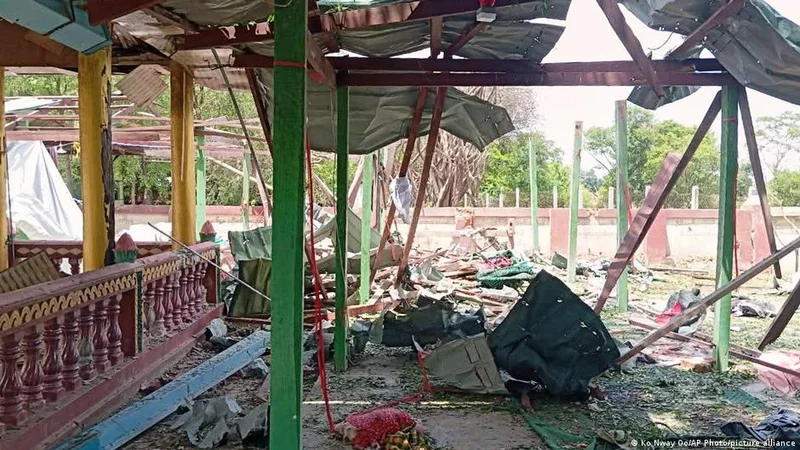
At least 14 people were killed when a military airstrike hit a Buddhist monastery in Myanmar's central Sagaing region, an opposition group and local witnesses said Saturday.
Friday's attack, by the ruling military regime that seized power in a 2021 coup, is the latest deadly assault on pro-democracy forces in the Southeast Asian country's ongoing civil war.
What do we know about the airstrike on the monastery in Myanmar?
The strike happened in Swel Le Oh village, Myaung township, in central Myanmar, said Nway Oo, a spokesman for an anti-government resistance group.
The village is about 75 kilometers (45 miles) west of Mandalay, the country's second largest city.
Nway Oo, from the Civil Defense and Security Organization of Myaung Township, or CDSOM, said the dead included three women and that 20 others were wounded.
The Associated Press spoke to a villager who confirmed the death toll and said that a military jet dropped two bombs 15 minutes apart.
The villager said the second strike damaged a nearby house.
Victims were civilians attending a retreat
More than 100 people were taking part in a weeklong meditation retreat to mark Buddhist Lent, the villager added.
AFP news agency cited Nway Oo Myaung, a pro-democracy rebel, as saying: "It wasn't a mistaken target; they intentionally attacked a monastery."
The military government has yet to confirm the strike.
Myanmar's military has often used airstrikes to counter opposition forces, especially in Sagaing region, a stronghold of armed resistance.
UN flags sharp rise in airstrikes
A United Nations investigation team said last week it had observed a notable increase in aerial attacks over much of the past year.
The UN's Independent Investigative Mechanism for Myanmar (IIMM) accused the military-backed government of "indiscriminate and intentional aerial attacks against civilians."
Last month, conflict monitoring group ACLED accused the regime of adopting "a terror strategy" that it said focuses on "civilian infrastructure and social gatherings, such as weddings and religious festivals, to maximize psychological impact."
Myanmar government defends strikes
On Sunday, Myanmar’s foreign ministry rejected the IIMM report, insisting that its operations were in response to insurgents and terrorist groups.
The ministry said it uses maximum restraint to avoid civilian harm.
Myanmar's army took power from the elected government of Aung San Suu Kyi in February 2021.
Suu Kyi, a Nobel Peace Prize laureate, was detained and sentenced to lengthy prison terms on multiple charges widely viewed as politically motivated. She was moved to house arrest in May.
After a brutal crackdown on peaceful demonstrations, many opponents of military rule armed themselves and plunged large parts of the country into conflict.
More than 100,000 people are estimated to have been killed on all sides over the past five years, according to ACLED.
Myanmar held elections this year, which were widely condemned as a sham.
The polls culminated in the chief of the former junta, General Min Aung Hlaing, being appointed president, as the military regime sought to present itself as a civilian government.
Edited by: Karl Sexton
Don't let the algorithm hide the news. If you rely on our team for trusted reporting, please take a moment to select us as your Preferred Source on Google by clicking here and hitting the "star" or "preferred" button, so you'll always see our verified news first.