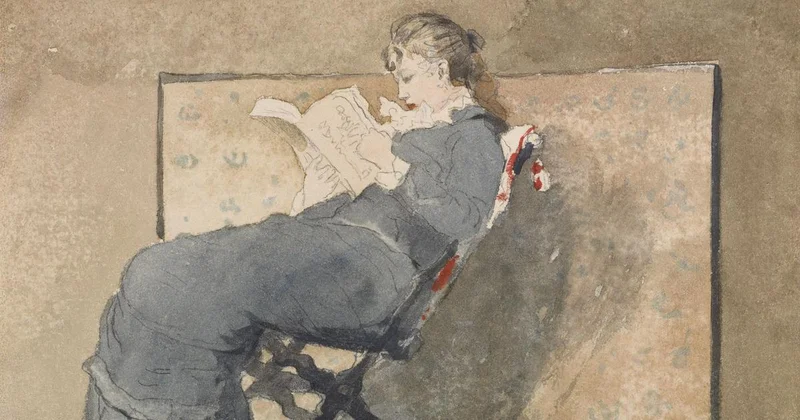
This summer I picked up my friend’s half-read copy of Eula Biss’ Having and Being Had and read a hundred pages curled up on his sofa. I did not particularly find it relatable – she is an essayist and educator living in a palatial house in Chicago, and the book is mostly about her own complicated relationship with owning a house and the material reality that emerges from it. But I was hooked.
After that I read Rachel Cusk’s Outline and Annie Ernaux’s Exteriors in quick succession. The books don’t have much in common; they are not all memoirs, and some resemble the literary style of a confessional. But they all wanted me to see the author as someone with a voice, an opinion, a style, a vision. The structural nature of these books reminded me of a conversation with an acquaintance – I could step into their world for a bit, but I could never really immerse myself. Ultimately it was the inevitable solipsism of their world, where there was no respite from their mind – everything existed in the world that solely belonged to them. Solipsistic writing makes interiority a structural necessity, but at the same time leaves you alienated as a reader.
The interior world
Eula Biss, a critic of class, lives in a palatial house in Chicago, and the book centres on a collection of essays on work, owning property, and capitalism. And what it means to be in a certain class – to own things when you move up the ladder. These markers of “American success,” according to her, are things that she holds in relation to how she views her relationships, the world, and herself, and how her dissociation from her own life was predicated on the accumulation of material goods. She traces this materiality back through Karl Marx, Silvia Federici, and David Graeber to try to explain her own alienation as a person participating in the labour market, though not as a “labourer” in that she is an intellectual producing work in a university setting.
Biss spends much of the book weaving her narrative through these Marxist texts, her own self being created in the space where she explains events. She is not an active participant, but a viewer and analyst of her own actions. This is a memoir where everything has an explanation. Biss masterfully gives you a glimpse of her world without really letting us in. There are nods to how she lives her life, what she does, but there is no way to access her – instead, what we see is the aftermath of her sanitised attempt at preserving and presenting to us an intellectualised version of her life. No doubt a therapist would be upset with this.
Biss is, however, in the long list of writers, zealously trying to show how many books she has read instead of what she really feels about things. Authorial intent is obfuscated under the garb of a lazy literature review – maybe that was the intention all along? But it would be remiss of me to fault Biss for this. After all, she is writing non-fiction essays, and those things tend to have a New Yorker structure to them – a new paragraph begins with a throwaway reference to another text lest we start to believe the writer has their own unique point of view. Biss’s interior world leaves no space for a reader to imagine themselves in ways that feel connected to her life. My friend said maybe it is because I don’t own and manage property, or really care about class distinctions in urban America, but books don’t necessarily only appeal to readers who exist in the same identity niche as the author’s.
Cusk moves away from this essayist style, but retains a detached tone in her entanglements with the people she is writing about. Outline is premised on a set of conversations she has with people she meets on a quaint Greek island where she is teaching a writing workshop. These conversations are told through her version of what happened; although they happen sequentially in the timeline of when she met these people, the conversations themselves are analysed and then reported instead of being told as they happen. I guess that would make it a play and not a novel. Outline is a stunning book. Cusk is contemplative and cares about listening, or maybe selectively picking on things that she thinks are important. Although I don’t know if I would have enjoyed a book entirely premised on small talk, perhaps that can be Cusk’s next foray. But of course, the conversations are then layered with her own sense of morality and positioning of the world. The report is then premised on how she analysed the specific moment she is talking about, how she read the mood, and that is what we are getting.
Yet immersion is something that Cusk keeps at arm’s length. You can see yourself as a viewer looking in, but never experience the writing in the same way you experience life. Some might say that is an odd requirement. I don’t mean to assert that this is essential for great writing, but it does seem as though this absence repeats itself in this genre of writing about the self. The deeper you dig into yourself, the more you become a passive recipient of the experiences of your own life.
Looking outward
Exteriors by Annie Ernaux, however, tries to look outward. Ernaux, with an anthropologist’s eye, writes about what she witnesses on the train rides she takes in Paris, or the plaza she sips coffee at, or at the grocery store. Ernaux’s project is clear, in that she spells it out for us – she merely wants to document as a witness, to go into the background and completely erase herself from the narrative. She obviously fails. It is still her reality – the characters of the book are not as real as she is. The book, in its journal style, tries hard to map the lives she is witnessing, but in the seeing, Ernaux warps these people into vignettes, breaking them sequentially into things she witnesses and not experiences.
Structurally, Ernaux and Cusk are both writing with the same intent: to excavate themselves. But where does that leave us as readers? Do we have any control over the narrative we get from the book? Do we get to experience it in a way that makes us active participants instead of passive receivers?
As I ploughed through my summer reading, I was reminded of The Hour of the Star by Clarice Lispector, which I had recommended to my friend recently. He finished the book on a train ride, and when he texted me to say that he had read it, all I could really say was, “Doesn’t the book feel so claustrophobic?”
It is a book that I have tried very hard to write about, but couldn’t. I felt nauseous when I finished it, as if I was there with the protagonist. The absurd abstractness of her existence felt more real to me than my own life. I wonder what the detached first person has done to this form of storytelling. And I wonder if the need to know yourself has become so deeply individualised that we forget that a lot of life we live is not really inside our head, but as a projection of how we live outside of it. And that interiority is not necessarily the devil here, but the analytical frame of this project – where the world is what you make of it, and not how you experience it.
Barthes, in his famous essay, “Death of the Author”, argues that “the birth of the reader must be at the cost of the death of the author”, that true meaning is not born at the origin of the text but instead is in the hands of the reader. But what happens in the spaces where interiority is the ultimate form, and takes on the structural form of the text itself? Does the reader remain relevant, especially when the authorial presence remains front and centre? These are questions for the rest of the summer, perhaps.
The author would like to thank Walter and Gimlet Deleon, for both the books and the conversations that led to this essay.
We welcome your comments at letters@scroll.in.