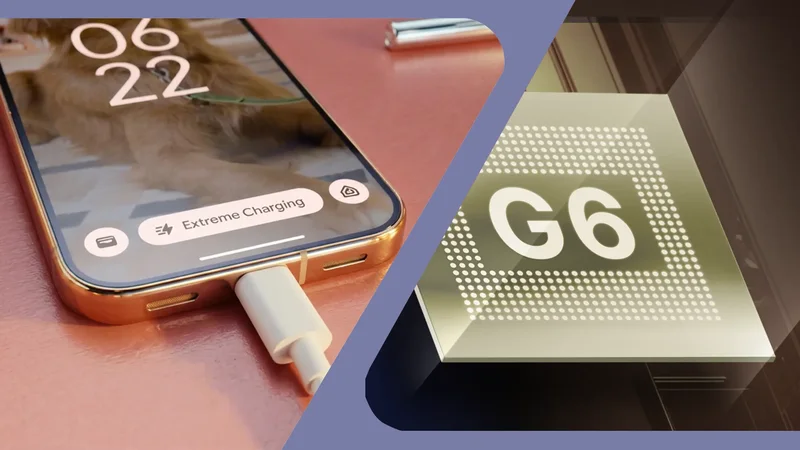
Most major Android flagships can now easily deliver a full day of battery life, even under heavy use. Some, like the OnePlus 15, can last a day and a half with moderate use and recharge within minutes to keep going for a few more hours.
Then there is Google, which has not introduced any meaningful upgrade to either battery capacity or wired charging across the Pixel 11 family. Instead, Google is asking Tensor G6 to deliver a battery upgrade the hardware does not.
Android phones have moved beyond one-day battery life
Silicon-carbon batteries changed the game
For years, an Android flagship making it through a full workday without needing a top-up in the middle of the day was considered good battery life. This made sense back then given the powerful chipsets and big displays they packed.
However, that standard is now outdated. Premium and flagship Android phones are shipping with bigger batteries than ever and offer multi-day battery life.
The OnePlus 15 is the best example. It packs a massive 7,300mAh battery and supports 80W wired charging. That big cell means that despite a power-hungry Snapdragon 8 Elite Gen 5 and a big 6.78-inch 165Hz OLED display, the OnePlus 15 can deliver almost two days of use.
Outside the US, there are even more examples, such as the Oppo Find X9 Pro or the compact OnePlus 15T, both of which pack 7,500mAh silicon-carbon batteries.
Samsung has not joined this trend, but with the Galaxy Z Fold 8 Ultra, it took a step in the right direction. The foldable retains the slim dimensions of its predecessor, yet it packs a bigger 5,000mAh battery. That's 600mAh more than the Z Fold 7 and enough to ensure more than a full day of use.
While Apple hasn't embraced silicon-carbon batteries, it has equipped the iPhone 17 Pro Max with the largest battery ever in an iPhone (~5,088mAh for eSIM models).
As a result, this phone lasts longer than any previous model and even beats many premium Android devices with bigger cells. It also charges faster, supporting 40W wired charging.
That's the competition Google's Pixel 11 family is launching against. Instead of fitting a bigger battery, Google is betting on the Tensor G6 to make up for it.
Google is betting big on the Tensor's weakest aspect
Tensor and efficiency don't go hand in hand
As much as Google likes to hype its Tensor chips, the truth is they have historically been one of the weakest aspects of Pixel phones.
Previous Tensor chips tend to run hot, deliver subpar performance, and offer battery life that isn't as good as it should be.
With Tensor G6, Google skipped two generations, ditched the big.LITTLE architecture, and went straight to the newest Arm CPU cores: the C1. It also reduced the number of CPU cores from eight to seven, possibly to improve efficiency. But that's only half of the story.
The other half is that Google has not paired these efficiency gains with bigger batteries. And it shows how the company is operating in a vacuum, ignoring the competition.
The Pixel 11 ships with a 4,985mAh battery, just 15mAh more than the Pixel 10. The Pixel 11 Pro and Pro XL go in the opposite direction, with their battery capacities decreasing slightly: from 4,870mAh in the Pixel 10 Pro to 4,850mAh in the Pixel 11 Pro, and from 5,200mAh in the Pixel 10 Pro XL to 5,115mAh in the Pixel 11 Pro XL.
Google says the Pixel 11 Pro can last for 30 hours on a single charge, six hours more than the Pixel 10 Pro. That is a notable jump for a phone that ships with a similarly sized battery, and it shows how much faith Google is placing in the improved efficiency of the Tensor G6.
The problem is that Google's estimates do not always match reality. Mobile data, weak network coverage, navigation, wireless Android Auto, high screen brightness, and heavy camera use can all drain the battery much faster than light use over Wi-Fi.
In these situations, past Tensor chips have struggled, and it's where the Tensor G6 must shine.
Even if the Pixel 11 lasts longer than its predecessor, that's not a high bar. Google's newest Pixels should match the likes of the iPhone 17 Pro Max and OnePlus 15. But even in a best-case scenario, that's unlikely to happen given the almost unchanged battery capacities.
The Pixel 11's unchanged 30W wired charging speeds will only make the situation more frustrating.
A bigger battery would have provided more breathing room, while faster charging speeds could have reduced the anxiety of running out of juice. The Pixel 11 family offers neither, leaving the battery life heavily dependent on one of its weakest aspects: the Tensor chip.
That's not a bet Google should be making, especially when the competition is offering a better deal.
Trust in Tensor G6 cannot replace battery upgrades
Google may be confident that Tensor G6 can squeeze more battery life out of the Pixel 11 family. However, that confidence is not the same as a hardware upgrade.
Other flagship phones no longer ask buyers to choose between efficient chips or bigger batteries. They deliver both, with fast charging support on top.
Unless the Pixel 11 can match the battery life of its closest competitors, Google's approach will look more like complacency.