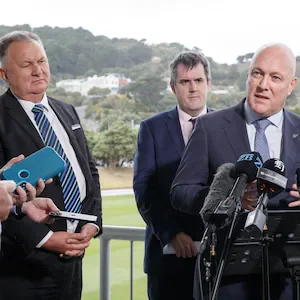
Earlier this week, Christopher Luxon was asked by Mike Hosking whether he agreed with Act’s policy to remove ethnicity-based requirements on government departments as employers. He answered that the bigger prize was to “radically reform and restructure” the public sector so it could deliver better services. That would have been music to the ears of some centre-right voters. If National has decided that much bolder action is required, has it come too late?
It’s been more than 30 years since New Zealand had a government that was dedicated to the serious, sustained reform of our state and economy. Governments in the MMP era have mostly tinkered with the fundamentals left to them. Some National MPs in the Luxon and Key governments will probably privately acknowledge bolder change is, or was, needed.
With National’s leadership troubles in the headlines again last week, the right bloc’s chances of returning to government after November 7 have taken a hit. If the election has been lost with the events of the past several days, has New Zealand lost another chance at the big reforms needed to maintain our status as a first-world country? And where could the coalition have gone much further?
Let’s start with the size of the public service. All three Government coalition parties have talked at great length about the number of bureaucrats hired by Labour. But, despite claims of austerity, there were 64,535 full-time equivalents in the core public service in March. That’s 1825 more than at the same point three years earlier. What’s now being proposed is some mergers, sinking lids and the greater use of AI. But the Government should have started by asking the question “what functions can government, and only government, perform?” The answer to that question would have led ministers to conclude that much more radical action to reduce the size and scope of the public service was necessary.
The big jump in government spending during the pandemic has been baked in. In 2019, under Jacinda Ardern, government spending represented 28.7% of GDP. Again, despite some claims we’re living through a period of austerity, the 2026 budget forecasts we will only get spending down to 30.3% by 2030. In 2023, the government spent about $127 billion. In 2026, it is forecast to spend around $147b. Our stubborn deficit means we are borrowing from future generations and preventing future governments from cutting taxes. New Zealand has more government departments than it needs to deliver the core services people need. Once a government commits to spending money on a particular programme, a constituency comes to rely on it (consider Working for Families, a programme John Key originally labelled “communism by stealth”), and politicians find it difficult to remove the spending because some voters will fight hard to keep it.