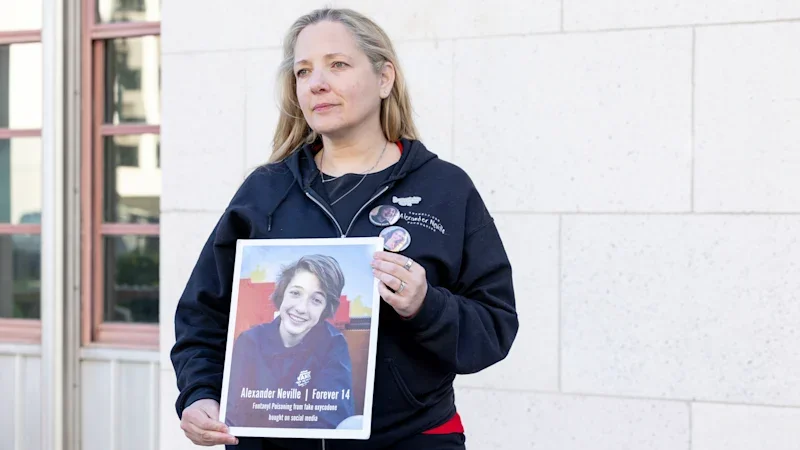
Washington: Early in the summer of 2020, Amy Neville found her 14-year-old son Alexander dead in his room at their California home. He had been experimenting with the opioid oxycodone; the single pill that ended his life was laced with enough fentanyl to kill three people.
In the years since, Neville has deployed her agony into seeking change for the better – in particular, lobbying for reforms to social media and children’s safety. Like many his age, Alex had ordered the deadly drugs on the text-and-visual messaging app Snapchat.
Neville is one of the most active and accomplished drug advocates in the United States today, and the journey has been a fulfilling one. At the same time, she is clear: “I’d push everybody off a cliff that I’ve met and give it all up – I’d give it all up to have my kid back.”
Theirs is an all-too-familiar story across the US, where just under 70,000 drug overdose deaths were recorded in the 12 months to the end of February. Opioids were to blame in about two-thirds of cases, more if you count natural opioids such as morphine or semisynthetic drugs like heroin.
But this was a good result, relatively. Fatal overdoses were down 12.1 per cent from the year prior, and it marked the third straight year of decline.
“In three years, it’s down about 38 per cent,” says Barrye Price, president and chief executive of the Community Anti-Drug Coalitions of America (CADCA). “It’s good news that the trend is going this direction. And my message would be: let’s put our foot on the gas.”
The fentanyl crisis has savaged America since the synthetic drug first flooded the country in 2013. From major cities to small towns, few areas have been untouched by the epidemic. In some places, such as San Francisco’s Tenderloin district or Kensington in Philadelphia, the regular order has given way to open-air drug markets and homeless addicts bent over in the familiar “fentanyl fold”.
That is the public face of the disease. The other is more insidious: patients with chronic pain who develop addictions after injury, or curious teens like Alexander Neville, who unknowingly happen upon a poison pill.
The Trump administration has boasted of pursuing a “relentless, multi-front campaign” against fentanyl by securing the country’s northern and southern borders, targeting transnational gangs (including by bombing boats in international waters) and pressuring other countries with tariffs.
Among other things, US President Donald Trump formally designated major cartels, including Tren de Aragua, MS-13 and Sinaloa, as foreign terrorist organisations, and classified fentanyl as a weapon of mass destruction.
“President Trump’s ironclad commitment to border security and relentless pressure on every node of the supply chain is delivering these lifesaving results – and America is finally winning the fight against fentanyl,” the White House said in a statement.
The figures certainly show a turnaround. But the trend began well before Trump took office. The fastest decline actually followed the summer of 2023, after overdose deaths peaked at 112,000 over the preceding 12 months.
The COVID-19 pandemic ended what had been, until then, a flatlining of fatal overdoses during Trump’s first term. Joe Biden, who took office in January 2021, presided over the worst spike in deaths, as well as the rapid correction.
Joshua Sharfstein, a professor of public health at Johns Hopkins University, says three factors came together in the pandemic to produce a “perfect storm” for fatal overdoses.
“The drug supply was almost completely filled with fentanyl at that time,” he says. “It was harder to provide interventions and care for people because of the need to protect against COVID. And people were isolated, anxious and miserable.”
Now, things are changing. The potency of fentanyl pills has fallen: the Drug Enforcement Administration said late last year that three in 10 pills it tested contained a potentially fatal dose, down from six in 10 in 2022.
Resources have been ploughed into treatment and harm minimisation efforts. It is common to see rescue boxes containing naloxone – the medicine that can reverse an opioid overdose – on street corners in big cities. Narcan, the most common brand, is stocked at pharmacies. Community and advocacy groups, backed by state and federal funding, are educating people about the risks of fentanyl and other drugs, and how to get help.
Many of those improvements were actually made during the first Trump administration (2017-21) and were the result of unusual bipartisan co-operation. The 2018 SUPPORT for Patients and Communities Act included extending Medicaid for substance abuse patients, measures to prevent doctor shopping, and research for non-addictive painkillers, among other things, and passed with near-unanimous support.
While some of that bipartisanship began to break down around the 2022 midterms, Congress has continued to pass legislation to tackle the opioid crisis, including under Trump 2.0.
“They were making investments in programs, and the strategy was reasonable,” Sharfstein says. “All of those things that were particularly bad [during COVID] are getting better. But there are some challenges.”
One of those challenges is that the drug supply is changing and unpredictable. Fentanyl toxicity may have decreased, but new substances are increasingly contaminating pills.
Xylazine and medetomidine, for example, are animal tranquillisers that are not approved for human use. They can have severe side effects, including dangerously low blood pressure. They do not fully respond to naloxone, and can also lead to life-threatening withdrawal symptoms.
In April, the Centres for Disease Control and Prevention issued an alert about medetomidine after reports indicated it was showing up in more states across the US, and at a greater frequency. The substance is longer-lasting and believed to be 200 to 300 times more potent than xylazine.
Maryland’s Department of Health said that of 885 drug paraphernalia samples it tested in the first quarter of 2026 – mostly in Baltimore – about 5.5 per cent contained medetomidine.
Canada’s Centre on Substance Abuse and Addiction reported similar increases across most provinces early this year. In the first quarter, about 12 per cent of seized drug samples in Ontario, the most populous province, contained medetomidine.
Amy Neville knows all too well that overdose deaths – poisonings, as she calls them – occur when people do not know what their drugs contain. She believes Alex – “a very adventurous kiddo” – was not experimenting with oxycodone for long before the fentanyl-laced pill killed him.
“He was having an off couple of weeks in June 2020,” Neville says. “I asked him, like, ‘Hey dude, what is going on, are you using something?’” Alex told her no, he’d just eaten something bad. She believed him.
“But he came back to us a day and a half later. He was like, ‘I got to talk to you guys’. He proceeded to tell us: ‘I wanted to experiment with oxy. I got it from a dealer on Snapchat. And it has a hold on me, I don’t know why’.”
Neville has told this story many, many times, but it’s at that point that she chokes up. The next day, she called a treatment facility. They committed to calling back with a recommendation. “He died that night.”
There was a pill left behind in Alex’s room that tested positive for fentanyl. At that time, Neville did not even know what that was.
Having spent the past six years fighting for drug education and protections for children on social media, she is nervous about singing from the rooftops about the recent decline in fatal overdoses.
“It is great, I want to be clear; they’re going in the direction we want them to go in,” she says. “But I don’t want us to settle for that. I’m really worried about that.”
That’s especially so because in Arizona, where Neville now lives, deaths are going up. They increased 5.3 per cent year-on-year, according to CDC data, and last month The New York Times reported that the drug death rate in Arizona was almost twice the national average, based on an analysis of CDC figures.
Meanwhile, fatal overdoses in nearby Colorado climbed 11.6 per cent, and in New Mexico, 28.3 per cent. Out in the desert, the south-west is bucking the national trend.
It’s difficult to ascertain exactly why. Merilee Fowler, the Arizona-based executive director of substance abuse non-profit MATFORCE, says one of the big problems is the resurgence of meth.
“We’ve had a huge increase in meth overdoses … people are using psychostimulants and opioids together at way higher rates,” Fowler says. Overdose deaths have risen sharply among older people, rather than the young.
Neville puts it this way: “We’re so focused on fentanyl that we’re losing focus on the other drugs. As of this spring, in Arizona, meth was killing more people than fentanyl.
“It’s being called meth 2.0. The problem is, people aren’t scared of meth. They think it’s the meth from the ’80s or ’90s, and that’s just not what we’re dealing with.”
As Barrye Price at CADCA points out, it’s not just about how many people are dying from overdoses. Non-fatal overdoses are harder to track, but emergency room visits were near 260,000 last year, he said, which was not a great improvement.
Last month, the federal government’s Substance Abuse and Mental Health Services Administration released the results of its 2025 National Survey on Drug Use and Health. It pointed out that despite improvement, “overdose deaths remain high”. It found 0.3 per cent of the population said they knowingly used illegally made fentanyl in the past year, an unchanged figure.
And among people 12 or older with a substance use disorder in the past year, an estimated 2.8 per cent – or 1.3 million – visited an emergency room, according to SAMHSA.
“It’s not that people aren’t indulging,” Price says. “It’s that we’re able to save lives through things like Narcan [naloxone] and Opvee [nalmefene]. The reality is we can’t really rest on our laurels right now.”
Terrance Cole, the administrator of the Drug Enforcement Administration, acknowledges this. On Wednesday, he spoke at the International Drug Enforcement Conference in Buenos Aires, where he warned about as many as 20 new nitazines – synthetic opioids – showing up in everything from fentanyl to vapes.
“Fentanyl remains the most immediate threat facing the United States,” Cole said.