- READ MORE: See me! Grammar trouble for new Education Secretary who dismissed spelling tests at school as 'ridiculous'
- See more Daily Mail on Google - save us as a Preferred Source
New Chancellor John Healey turned his fire on predecessor Rachel Reeves on Thursday – accusing her of plunging Britain's economy into gloom.
In an apparent attack on her legacy, Mr Healey said he now wanted to lift 'the pessimism that has eroded not just the public's confidence but has eroded our own prosperity'.
The comments were in stark contrast to Ms Reeves' claim to have left the economy stronger at the end of her time in office.
And they echo the thoughts of many business leaders bludgeoned by a series of tax hikes and minimum wage increases under the former chancellor.
The remarks could also be seen as a swipe at Ms Reeves' decision, on taking office in 2024, to claim to have found a £22billion black hole in the public finances.
Her dire prognosis was widely seen as crushing business confidence and stoking rampant speculation over tax hikes in her first Budget.
Mr Healey was Andy Burnham's surprise choice to replace Ms Reeves at No 11.
Just six weeks ago, he resigned as defence secretary after Keir Starmer and Ms Reeves failed to back the military spending increases he said were needed to keep Britain safe.
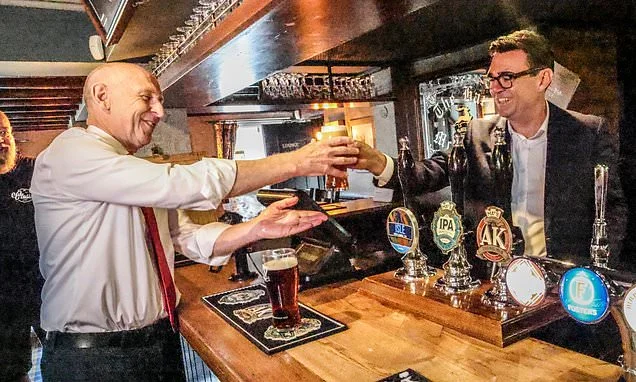
Pour performance: Andy Burnham serves John Healey a pint on Thursday at an Essex pub
Ousted: Sir Keir Starmer and Rachel Reeves on Monday outside Downing Street
Now, Mr Healey has turned his fire on his former nemesis – saying she had left both businesses and households struggling for 'breathing space'.
And in comments aimed at bringing Britain's bosses back onside, he acknowledged that firms were feeling 'really squeezed' by tax and other cost pressures.
Speaking to executives at Bloomberg's headquarters in London, Mr Healey said: 'Businesses of all sizes, in all sectors, are so critical to the good growth we seek to secure in this country – for delivering the investment, the innovation, the reindustrialisation that our economy needs, lifting the pessimism that has eroded not just the public's confidence but has eroded our own prosperity.
'My message to British business is quite simple: I will back you as your Chancellor.
'I know things haven't been easy. We talk a lot in government about the cost of living.
'And that's right, people have been facing increasing pressures, they've been feeling that lack of a breathing space in their life – but so have all of you.
'And I am just as concerned about the cost of business as I am about the cost of living.
'Tax, energy, supply chain costs, labour: I know that businesses large and small have felt really squeezed and when the Prime Minister and I talk about building a new economy that helps people live well, that must involve stepping up our support for and work with business.
In comments aimed at bringing Britain's bosses back onside, Mr Healey (centre) acknowledged that firms were feeling 'really squeezed' by tax and other cost pressures
'You're the ones who can ensure prosperity in every part of the country.'
Mr Healey also sought to provide reassurance that the Government would meet existing rules on public finances while maintaining a 'buffer against uncertainty'.
Yet the new Chancellor faces immediate challenges after a surge in oil prices back above $100 a barrel as conflict ramps up in the Middle East. That has also stoked inflation fears and pushed up UK borrowing costs.
Combined with a series of eye-catching and costly spending announcements by Mr Burnham, that will make it even harder to balance the books and will raise fears of fresh tax increases.
Mr Healey's comments come days after Ms Reeves claimed that the economy had become 'stronger, fairer and more resilient' since she took office.
Yet official figures point to higher unemployment, sluggish growth and stubborn inflation.
Britain's borrowing costs are the highest among all of the major advanced economies of the G7. And youth jobs have been a notable casualty, with the number of 16 to 24-year-olds classed as not in employment, education or training soaring past a million.
Ms Reeves saddled the economy with £75billion of tax hikes including a £25billion raid on employer national insurance which has been widely blamed for making it harder to hire workers.
She also won the enmity of high streets up and down Britain with a botched attempt to reform business rates that resulted in many shops and pubs saddled with even higher bills.
Higher minimum wage rates and the introduction of a raft of new workers' rights have taken a hefty toll on firms too.
Shadow Chancellor Sir Mel Stride said Ms Reeves' record was 'pretty abysmal'. 'She has left the economy in a very perilous state. She's overtaxed, she's overborrowed, she's overspent,' he added.
Responding to Mr Healey's comments, Anna Leach, chief economist at the Institute of Directors, said: 'Businesses will welcome the Chancellor's warm words.
However, firms ultimately judge governments not by rhetoric, but by the conditions they create for investment, hiring and growth.'
Ms Reeves was approached for comment.